



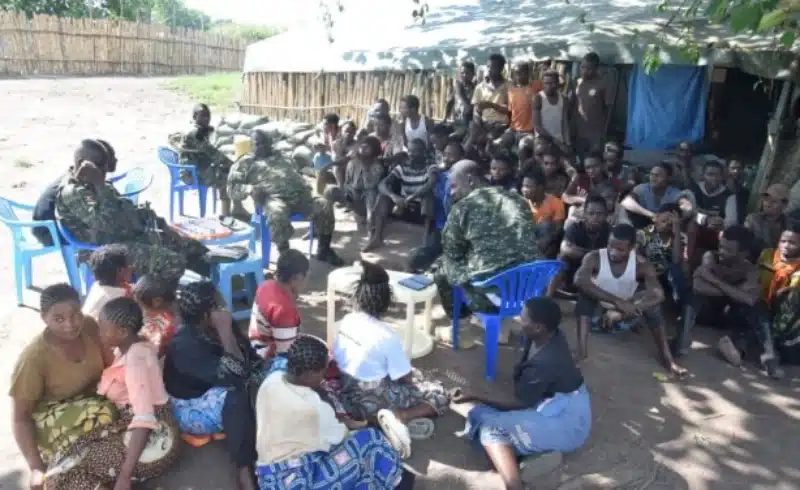

Ugandan and Congolese troops dismantled a major Allied Democratic Forces stronghold along the River Epulu in Ituri Province, freeing scores of men, women and children held under brutal conditions.
AfricanQuarters|East Africa Bureau
KINSHASA, 21 April 2025 – More than 200 ADF captives rescued in DRC last week after Ugandan and Congolese forces launched a precision assault on one of the Allied Democratic Forces’ most fortified camps, located along the River Epulu in Ituri Province, eastern Democratic Republic of the Congo.
The operation, conducted under the joint Uganda People’s Defence Force and Armed Forces of the DRC campaign known as Operation Shujaa, targeted a hub commanded by a senior ADF figure identified as Ssebagala, also known by his alias “Mzee Mayor.” Multiple militants were killed during the raid, and troops recovered a weapons stockpile along with a cache of improvised explosive devices.
Children Among Those Freed
Among the ADF captives rescued in DRC operation were a significant number of children and teenagers. The youngest confirmed survivor was a 14-year-old girl. The oldest was a 19-year-old boy.
That age range is not incidental.
Analysts tracking the ADF’s patterns say the group deliberately targets young people for forced labour, coerced “marriages” – in effect, sexual slavery, and long-term recruitment into its ranks. Those freed described regimes of harsh punishment, chronic food deprivation and no access to any form of healthcare.
Medical assessments conducted after the rescue found widespread malaria, respiratory infections, severe malnutrition and acute physical exhaustion across the survivor group.
ADF Captives Rescued in DRC Signal Strategic Shift
Operation Shujaa was launched in 2021, but Ugandan and Congolese military officials say its tempo has intensified sharply through 2026, with a clear shift from containment to the systematic dismantling of ADF infrastructure.
The River Epulu camp was not a fringe outpost. Security analysts increasingly describe the ADF’s network of such camps as a proto-state system, one that controls territory, imposes its own economy and sustains itself through diversified revenue.
The Ituri and North Kivu forests, where the ADF has dug deepest, remain among the least governed stretches of the continent.
How the ADF Funds Its War
Understanding why so many ADF captives end up in DRC jungle camps requires understanding how the group sustains itself financially.
The ADF draws revenue from multiple streams. It taxes or directly extracts resources from gold and mineral-rich zones across Ituri and North Kivu. It trades timber and charcoal. It imposes informal levies on fuel and goods moving between Uganda and the DRC. And it runs what amounts to a kidnapping economy, extracting ransom payments, forcing captives into labour and converting others into fighters.
The more than 200 ADF captives rescued in this DRC operation represent a direct blow to that system, disrupting both its labour supply and its coercive recruitment pipeline.
From Rebel Group to Islamic State Affiliate
The Allied Democratic Forces was formed in the 1990s with the stated aim of opposing Ugandan President Yoweri Museveni. Pushed into eastern Congo in the 2000s, the group has since undergone a far-reaching transformation.
In 2019, the ADF pledged allegiance to the Islamic State and now operates as the Islamic State Central Africa Province. That affiliation has brought the group propaganda reach, ideological alignment and possible financial and logistical support from the broader Islamic State network, while retaining its local operational autonomy.
The result is what security researchers describe as one of Central Africa’s most lethal hybrid militant organisations.
Intelligence Windfall
Beyond the immediate humanitarian impact, military officials say operations that produce large numbers of ADF captives rescued in DRC carry a secondary value: intelligence.
Cases of ADF captives rescued in DRC often provide critical intelligence; hidden camp locations, commander movements and internal supply chains. Information gathered from this group is expected to assist in tracking Musa Baluku, the ADF’s overall commander, whose whereabouts remain a primary operational focus.
Clearing the River Epulu corridor also reopens routes that have kept displaced communities from returning home, and allows the resumption of cross-border trade between Uganda and the DRC.
Retaliation Expected
Despite the scale of the success, military commanders are not treating the operation as a conclusive blow.
The ADF is known for its adaptability. Following significant losses, the group typically splinters into smaller mobile cells and redirects attacks toward soft civilian targets rather than military positions. Joint forces are already on heightened alert around the Mungamba and Lolwa areas, both identified as potential flashpoints for retaliatory strikes.
Even with growing cases of ADF captives rescued in DRC, the ADF’s decentralised structure and diverse funding model mean that no single operation, however well-executed, resolves the underlying conditions that sustain it.
What This Operation Achieved
The River Epulu assault achieved three things at once: more than 200 lives were freed from captivity, a key ADF command hub was dismantled, and significant funding and recruitment infrastructure was disrupted.
Every instance of ADF captives rescued in DRC weakens the group’s ability to replace fighters and sustain forced-labour camps. But eastern DRC remains structurally fragile, and the ADF has survived such setbacks before.
This was a high-impact tactical success, and possibly a turning point in operational momentum. Whether it marks the beginning of the ADF’s unravelling, or another chapter in a protracted conflict, will depend on what the joint forces do next.
Additional reporting contributed by Joshua Moracha. This article draws on military statements from Operation Shujaa, open-source security analysis and survivor accounts reported by relief organisations operating in Ituri Province.


