




Ghana ordered a nuclear reactor from Moscow in the early 1960s and never saw it run.
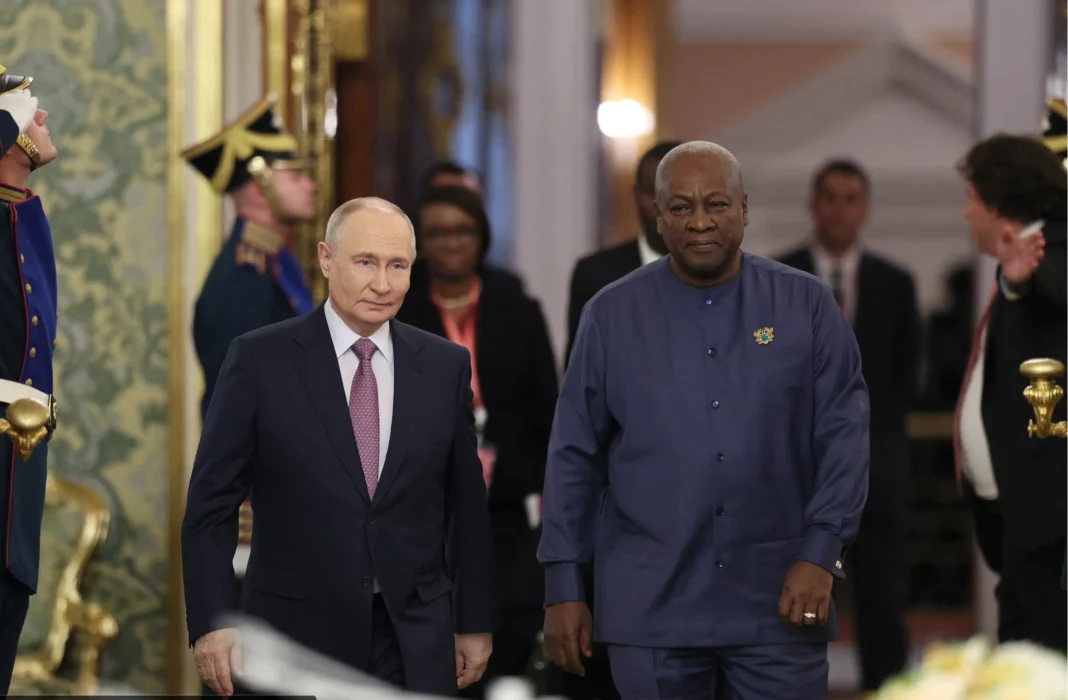
Last Thursday, President John Dramani Mahama stood in Moscow and reopened that story. Graphic Online reported that he told the Third Russia-Africa Summit that Ghana had “initiated discussions with Rosatom” on its first nuclear power station.
He gave no capacity, site, cost or timetable for Ghana’s 1st nuclear power plant. It was a conversation, not a contract.
Yet it shifts the picture. Russia was shortlisted for Ghana’s 1st nuclear power plant but missed the final cut. In March 2025, Nuclear Power Ghana confirmed its two partners: a US group built around NuScale, and China’s CNNC.
The Soviet Union and Ghana signed a nuclear cooperation agreement on 28 February 1961, according to the Russian Embassy in Accra. Equipment followed. Then a military coup removed Kwame Nkrumah in February 1966, and the Kwabenya project stalled.
Mahama, who studied in Moscow between 1986 and 1988, spoke of that era at the summit. He described a two-megawatt research reactor supplied in 1964, with Ghanaian scientists trained in Russia to operate it.
A Ghana Atomic Energy Commission presentation tells the ending differently. It lists the reactor project as cancelled after the 1966 coup. Historian Abena Osseo-Asare, in her 2019 Cambridge University Press book Atomic Junction, shows how long the wait lasted. A working reactor only arrived in the 1990s, and it came from China.
Ghana’s only operating reactor is Chinese. GHARR-1 is a 30-kilowatt research unit designed by the China Institute of Atomic Energy. It first reached criticality on 17 December 1994 at Kwabenya in Accra, under a three-way deal with China and the International Atomic Energy Agency (IAEA), according to a paper by Ghana Atomic Energy Commission researchers.
Small, yes. But it worked. In 2017, it became the first of five Chinese-supplied reactors outside China to switch from highly enriched to low-enriched fuel. The US National Nuclear Security Administration described the job as the result of more than a decade of work between Ghana, China, the US and the IAEA.
Beijing then moved up a scale, offering a reactor for Ghana’s 1st nuclear power plant. In April 2024, Nuclear Power Ghana signed a framework agreement with CNNC Overseas for a Hualong One reactor and grid upgrades. The then Energy Minister, Matthew Opoku Prempeh, called it “a profound commitment” to the sector.
Under the arrangement Nuclear Power Ghana announced in March 2025, China would build a 1,200-megawatt reactor on a build, operate and transfer model, with local equity.
Russia is now presenting a different proposition for Ghana’s 1st nuclear power plant. Ryan Collier, its regional chief executive for Southern and Central Africa, promoted a floating nuclear unit in September 2025 as “a very good first step”. Russia, he said, is the only country running such plants, and a floating unit could shorten the road to nuclear power on the grid. He still expects Ghana to go large-scale eventually.
In July, the Russian Embassy in Accra said the Ghana Atomic Energy Commission and Rosatom had signed a memorandum “laying the groundwork for potential future cooperation”. It sits on a 2015 intergovernmental agreement on peaceful nuclear energy.
So on paper the gap is plain. China has a signed framework agreement and a reactor that has run in Accra since 1994. Russia has history, a memorandum and a floating-unit offer.
The case for Ghana’s 1st nuclear power plant starts with the grid. The Public Utilities Regulatory Commission (PURC) says thermal plants produced 74.33 per cent of Ghana’s electricity in July. Hydro and solar together supplied 25.67 per cent.
PURC warned that this reliance leaves the sector exposed to fuel price swings, currency pressure and supply disruptions. Installed capacity stood at 5,818 megawatts in July, with peak demand at 3,968.
Ghana’s 1st nuclear power plant is expected to deliver about 1,000 megawatts by 2034, according to the official target. That is roughly a quarter of July’s peak demand. A reactor’s baseload output would not depend on gas supply or on rainfall over the Volta.
There is a catch. Talking to three suppliers keeps options open, but building with all three is another matter. A reactor ties its owner to one supplier’s fuel, training and maintenance for decades.
Robert Sogbadji, a Power Ministry official overseeing nuclear, said in 2024 that Cabinet would make the final call and that the answer could be one vendor or two nations. It is not yet clear how the Rosatom talks sit beside the 2024 agreements. Mahama framed the Moscow trip as non-alignment, telling the summit Ghana seeks friendship with all countries.
Money is the sharper problem. Nuclear Power Ghana’s executive director, Stephen Yamoah, told the Ghana News Agency in March that the programme sat in Phase Two, the construction-readiness stage. Funds for site studies and an environmental impact assessment had not been released. Without them, he said, the project “cannot progress beyond Phase Two”.
Phase One, he recalled, was meant to end in 2017 and closed in 2019 after late releases of money.
Ghana has never lacked suitors for a reactor. The harder contest for Ghana’s 1st nuclear power plant is at home, where the money for the studies has to arrive before the reactor can.


