



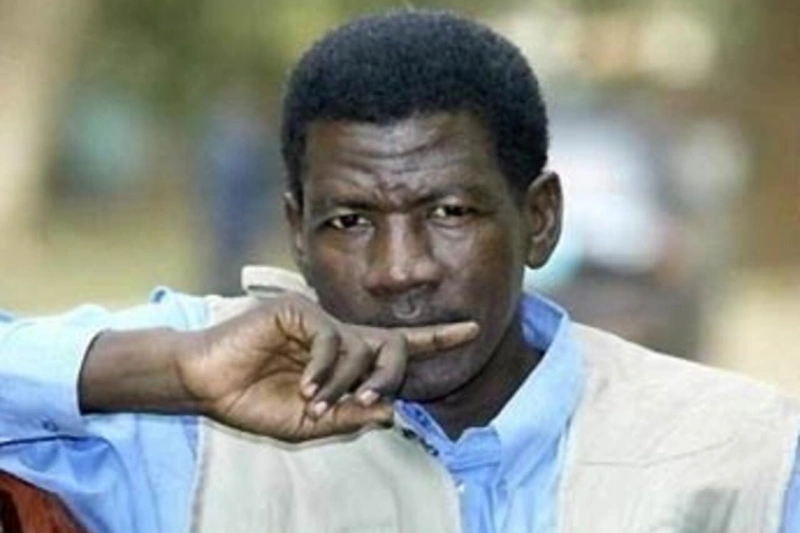

He left the office at about 7pm on 31 August. He got into his car and set off for home. He never arrived.
Moussa Kaka, a prominent journalist in the Sahel, has not been seen since.
That was 36 days ago. His personal vehicle has not been found either, according to Reporters Without Borders (RSF).
Niger’s authorities have not said where he is. RSF says they have neither announced an investigation nor shared any information about his fate.
Moussa Kaka is over 66 and has 40 years in journalism behind him, RSF says. He founded Radio Saraounia in 1999 and added a television channel in 2011. Today the group employs 70 people.
On the evening he vanished, he left the Radio Télévision Saraounia (RTS) offices in the Kalley Est neighbourhood of Niamey. His home is in Lossogoungou.
Relatives of Moussa Kaka went looking the next day. They checked hospitals and police stations across the capital, RSF says. They did not find him.
The family has also asked the judicial police in Niamey to investigate, an RTS journalist told the Committee to Protect Journalists (CPJ). The journalist asked not to be named, citing fear of reprisals.
‘We have not yet located Kaka,’ his lawyer, Boudal Effred Mouloul, told CPJ. He said legal steps were continuing.
Moussa Kaka is widely regarded as one of Niger’s most influential journalists. For decades he has reported on politics, security and armed conflicts across the Sahel, building a reputation for maintaining sources across political, military and civil society circles. His disappearance has therefore become a major press freedom concern both inside Niger and internationally.
The timing of his disappearance has added to the concern.
On 29 August, mutinous soldiers attacked strategic sites in Niamey. Human Rights Watch (HRW) says the army, backed by Russian Africa Corps forces, retook control the next day.
Soldiers accused of taking part were detained, along with one former minister, HRW adds.
The authorities have offered no explanation for the disappearance, RFI reports. No charge has been made public.
As the silence continued, civil society groups began conducting their own inquiries.
On 29 September, a coalition called G25-Niger issued a statement. It brings together civil society and media organisations, and most of its members stay anonymous for security reasons.
Its own investigation, the group says, found that intelligence agents followed Moussa Kaka. His vehicle was then stopped and taken away near the Gadafawa roundabout in Niamey.
RSF says it cannot verify that account. It does note that the roundabout lies along his route.
G25 spokesman Tahirou Garka went further when he spoke to RFI. He said Kaka is held by the DGDSE, Niger’s external intelligence directorate.
None of this has been independently confirmed.
Alioune Tine, the Senegalese rights expert who founded the Afrikajom think tank, told RFI he finds the claim credible. He links it to shrinking civic space since the 2023 coup. There is, he says, ‘absolutely nothing to justify the arrest’ of a man like Moussa Kaka.
For many observers, the allegations are particularly troubling because of Moussa Kaka’s long and complicated history with Niger’s authorities.
This is not his first run-in with the state.
In 2002, gendarmes questioned him for around ten hours. In 2004, they held him for several days after arresting him at his radio station.
The longest ordeal for Moussa Kaka began on 20 September 2007. He had interviewed leaders of the Tuareg-led Niger Movement for Justice, a rebel group. He was accused of complicity in threatening state security.
He spent 384 days in custody. An appeal court ordered his provisional release in October 2008.
Back then, Tine says, people knew where to find him. He mediated between RFI and then president Mamadou Tandja, and Kaka was released. Talking was possible because there was someone to talk to.
The pressure returned in October 2025. Police arrested Kaka and five other journalists after they announced a press conference about a government fund for the security forces.
They were charged under the cybercrime law with complicity in distributing documents likely to disturb public order. A court freed Moussa Kaka on bail in November, HRW reports.
His latest disappearance has therefore sent shockwaves through Niger’s media community.
Colleagues describe Moussa Kaka as a reporter with contacts everywhere: politicians, civil society, armed movements and the military. ‘Many are asking why him and not others,’ one journalist told RSF.
Another Nigerien journalist told HRW that in Niger today ‘one could disappear because of his or her opinions.’ He saw the same pattern as earlier disappearances of prominent critics of the military authorities.
HRW also spells out the legal term. An enforced disappearance happens when state forces hold someone and the authorities refuse to acknowledge it or conceal where the person is. Whether that describes the disappearance of Moussa Kaka remains unproven.
Since the 2023 coup, HRW says, the military authorities have dissolved political parties and suspended dozens of civil society groups. They continue to detain former president Mohamed Bazoum and human rights defender Moussa Tchangari.
International pressure is growing. RSF asked the African Commission’s special rapporteur on freedom of expression to act on 16 September. On 28 September it took the case to the UN Working Group on Enforced or Involuntary Disappearances.
CPJ and the Federation of African Journalists (FAJ) have also demanded action. ‘There can be no security justification for secret detention,’ FAJ president Omar Faruk Osman said.
RSF’s Sadibou Marong says Kaka’s family, friends and colleagues are ‘living in terrible anguish’.
In 2007, Niger jailed Moussa Kaka and everyone knew where to find him. Today the whereabouts of Moussa Kaka remain unknown, and calls for answers continue to grow as authorities maintain their silence.


