



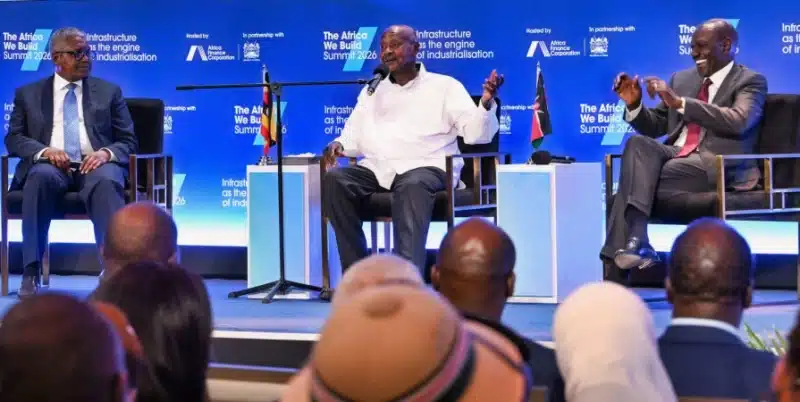

Aliko Dangote has told the world he is not done. At the Africa We Build Summit in Nairobi this April, Africa’s richest man announced plans to replicate the exact scale of his Lagos facility further east, in a move that analysts say could fundamentally reorder how energy flows across the continent.
The Dangote refinery East Africa expansion is emerging as one of the most ambitious industrial bets on the continent today.
The Announcement That Stopped the Room
The Africa We Build Summit in Nairobi was not short of ambition. But when Dangote laid out his blueprint for a second 650,000 barrels-per-day refinery, this time anchored in East Africa, even seasoned energy observers took notice.
The Dangote refinery East Africa expansion is not a scaled-down version or a pilot. According to details shared at the summit, it is a near-identical copy of the Lekki facility in Lagos, the same one that quietly reached full capacity in early 2026 and began exporting Euro-V standard fuel to Tanzania and South Africa.
That export track record matters. It has given regional heads of state, including Kenya’s William Ruto, Uganda’s Yoweri Museveni, and Tanzania’s Samia Suluhu Hassan, something that feasibility studies alone could never provide: proof.
Why Tanga, and Why Now
The proposed site is Tanga, a port city on Tanzania’s northeastern coast. The choice is deliberate. Tanga sits at the terminus of regional energy corridors and offers direct sea access for crude imports.
A proposed pipeline linking Kenya’s Mombasa port to Tanga would allow crude to move efficiently into the refinery and finished products to flow back into Kenyan and wider East African markets using existing infrastructure.
The sourcing model is also more complex than the Nigerian template. Where the Lagos refinery draws primarily on domestic Nigerian crude, the Tanga facility is designed as a multi-national processor. The plan involves refining crude from Uganda’s Lake Albert fields, South Sudan, Kenya’s Turkana basin, and potentially the Democratic Republic of Congo.
The timing is tied to something more urgent than opportunity. According to details from the summit, East African nations currently source more than 75 per cent of their fuel from the Middle East. Heightened tensions in the Persian Gulf in 2026 have already produced price spikes and supply disruptions that exposed just how fragile that dependence has become.
Breaking a Pattern That Dates to the Colonial Era
Proponents of the Dangote refinery East Africa expansion describe it in stark terms. For decades, East Africa has shipped out raw crude and paid premium prices to import it back as petrol, diesel, and jet fuel. The value-add, the refining, the petrochemicals, the jobs, have consistently been created elsewhere.
This project is structured to break that pattern. Beyond fuel, a refinery of this scale would produce polypropylene and polyethylene, the core materials used in packaging, construction, and textiles. Localising that production would, in theory, reduce the cost of a broad range of consumer goods across the region.
Dangote also used the Nairobi summit to announce plans for 20 fertiliser blending plants across Africa by 2028. The logic is integrated: refinery byproducts feed fertiliser production, which in turn addresses one of the largest drains on African foreign exchange reserves outside of fuel itself.
To attract continental investors, Dangote announced that the project would offer dollar-denominated returns, a hedge against the currency volatility that has weakened the Kenyan and Tanzanian shillings and eroded investment confidence across the region.
The Numbers Are Not Small, Financing the Dangote Refinery East Africa Expansion
Replicating a 650,000 bpd facility today is estimated to cost north of $20 billion. That figure sits against a backdrop of elevated global interest rates and cautious multilateral lenders.
The Africa Finance Corporation, which backed the Nairobi summit, is among the institutions being looked at for support. But project-level financing of this scale in East Africa has rarely been assembled quickly or cleanly.
Dangote’s own stated timeline is four to five years. Independent analysts who have tracked the Lagos project note that it took the better part of a decade from groundbreaking to full capacity. A more conservative operational target, they suggest, would be 2030 at the earliest.
Regional Politics Could Make or Break It
The Dangote refinery East Africa expansion is not just an engineering challenge. It is also a diplomatic one.
Uganda is already progressing with its own 60,000 bpd refinery, being developed with Alpha MBM Investments. President Museveni has consistently pushed a Uganda-first energy policy. If that posture hardens, questions arise over whether Ugandan crude would flow to Tanga or be retained for Kampala’s own refining ambitions.
The success of the Tanga model depends on Kenya, Tanzania, and Uganda arriving at a shared framework covering crude allocation, revenue sharing, and pricing. Each country has its own energy ministry, its own political pressures, and its own sense of what a fair deal looks like.
Without a binding regional agreement, the multi-national sourcing model that makes the East African hub commercially viable could unravel before a single barrel is refined.
What Success Would Actually Mean
If the political and financial pieces fall into place, the implications extend well beyond the energy sector.
The East African Community, which has long struggled to translate regional integration into tangible economic outcomes, would gain its most significant shared industrial asset. The bloc would move from being a net importer of refined products to a potential net exporter, insulating member states from the kind of global oil shocks that have repeatedly destabilised their fiscal positions.
For the African Continental Free Trade Area, a functioning Tanga refinery deepens regional value chains in a way that few projects at this scale have managed. Cheaper, more reliable fuel supports manufacturing, logistics, and agriculture simultaneously.
The Dangote refinery East Africa expansion, if it proceeds as announced, would be the largest single private-sector industrial project in East African history.
The Verdict
Aliko Dangote arrived in Nairobi not as a supplicant seeking government support, but as a man carrying a working proof of concept. The Lagos refinery is operational. It is exporting. It has done what critics said private capital could not do in Africa’s downstream oil sector.
The Dangote refinery East Africa expansion now stands as the real test of whether that success can be replicated across borders at scale.
The question is no longer whether the model works. The question is whether three governments, each with their own interests and their own smaller refinery ambitions, can set those aside long enough to back something significantly larger than any of them could build alone.


