Eight signatures in Abidjan have given Petrobras one of its largest single-country footholds in Africa, but whether those contracts produce oil remains an open question.
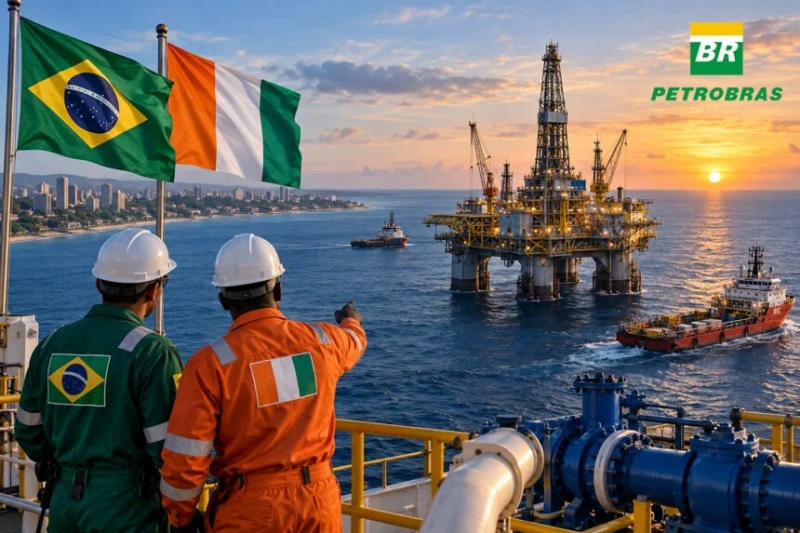
On 17 September 2026, Petrobras signed production-sharing contracts for eight offshore exploration blocks in Côte d’Ivoire, marking a major expansion of Petrobras oil exploration in Côte d’Ivoire. The deal, closed with the Ivorian government and state firm Petroci Holding, covers roughly 63,000 square kilometres of seabed along the equatorial margin.
Petrobras oil exploration in Côte d’Ivoire has moved, in one afternoon, from paperwork to reality.
The blocks, CI-513, CI-600, CI-601, CI-602, CI-603, CI-605, CI-701 and CI-702, sit in the western part of the country’s sedimentary basin. Through its subsidiary Petrobras Netherlands B.V., the company takes a 90 percent operating stake in each. Petroci holds the remaining 10 percent.
The structure gives Petrobras operational control over what could become the largest phase of Petrobras oil exploration in Côte d’Ivoire to date.
This did not happen overnight. Côte d’Ivoire’s government first approved Petrobras’ declaration of interest in nine offshore blocks back in June 2025, granting exclusivity to negotiate terms.
Fifteen months of talks later, eight of those nine blocks made it into the final contracts. One did not, and no public explanation has been given for its exclusion.
Even with one block left out, the agreement significantly expands Petrobras oil exploration in Côte d’Ivoire across the country’s offshore frontier. The government has not publicly disclosed why the ninth block originally covered by the exclusivity agreement was omitted from the final package.
Petrobras president Magda Chambriard framed the deal as a natural fit.
“With this acquisition, Petrobras assumes a relevant presence in Côte d’Ivoire, a country located in a region of high exploratory potential, with geological characteristics similar to those of our sedimentary basins,” she said.
It is a line company executives have used before, and it points to the real logic behind the expansion: Petrobras believes West Africa’s Atlantic margin mirrors Brazil’s own offshore basins closely enough to justify the risk.
That geological similarity is the foundation on which Petrobras oil exploration in Côte d’Ivoire is being built.
Côte d’Ivoire is not an isolated bet. Petrobras oil exploration in Côte d’Ivoire sits inside a wider African push that has gathered pace since 2024, when the company began rebuilding a presence it walked away from in the early 2000s across Nigeria, Tanzania, Angola, Benin, Gabon and Namibia.
That return has been steady rather than sudden. In February 2026, Petrobras took a 42.5 percent stake in a Namibian block alongside TotalEnergies. In April, it moved to acquire operatorship of a block offshore São Tomé and Príncipe. By August, talks had opened with Ghana.
The Ivorian contracts are the largest single piece of that puzzle so far.
In strategic terms, Petrobras oil exploration in Côte d’Ivoire now represents the centrepiece of the company’s renewed push into Africa.
The money behind it is substantial. Petrobras’ 2026 to 2030 business plan sets aside around $109 billion in total investment, with $69.2 billion earmarked for exploration and production and $7.1 billion specifically for exploration work at home and abroad.
None of that figure has yet been allocated block by block in Côte d’Ivoire.
For investors and industry observers, the next phase of Petrobras oil exploration in Côte d’Ivoire will be measured by seismic results and drilling activity rather than acreage announcements.
The company has disclosed no drilling timeline, no spending commitment and no well count for the new acreage.
Here is the tension worth sitting with. Petrobras now holds a large operating position off Côte d’Ivoire, but a signed contract is not a discovery.
The blocks are described as largely unexplored. Seismic surveys, appraisal drilling and years of technical work stand between this signing ceremony and any barrel of Ivorian crude bearing Petrobras’ name.
Some exploration blocks never produce a commercial well at all.
That uncertainty remains one of the biggest challenges facing Petrobras oil exploration in Côte d’Ivoire despite the scale of the new acreage.
Contrast that with what is already happening a short distance away.
Eni’s Baleine field, discovered in September 2021, moved to first production within two years and now anchors Côte d’Ivoire’s ambition to reach 200,000 barrels a day by 2030, a target that would place the country among West Africa’s top five oil producers.
Baleine’s early output of 20,000 barrels a day beat forecasts, and Phase 2 financing worth $358 million was secured by Petroci in April 2026 to push volumes toward 60,000 barrels a day.
Petrobras is entering the same waters at the opposite end of that timeline.
Eni is counting barrels. Petrobras is still counting square kilometres.
For Côte d’Ivoire, the calculation is simpler than the geology. Every new operator on its Atlantic shelf adds to a portfolio the government wants filled before 2030.
President Alassane Ouattara has already described the country’s production ambitions as a “spectacular leap”, and each fresh signature in Abidjan reinforces the pitch that Ivorian waters deserve a bigger place on the map of global exploration.
The arrival of Petrobras further strengthens expectations around Petrobras oil exploration in Côte d’Ivoire and the country’s broader offshore ambitions.
Petrobras, for its part, is playing a longer game. Sylvia Anjos signed the contracts on the company’s behalf, a routine detail that nonetheless marks the formal start of years of technical work ahead.
Petrobras oil exploration in Côte d’Ivoire will not be judged on the day it was signed. It will be judged on whether seismic data, years from now, turns 63,000 square kilometres of Atlantic seabed into something Brazil’s state oil company can actually pump.
For Petrobras, the contracts secure access. What they do not secure is oil. That answer lies beneath 63,000 square kilometres of Atlantic seabed that has yet to reveal whether it holds another Baleine-sized prize or little of commercial value at all.