For years, a tanker driver leaving Djibouti’s coast with a full load of diesel has faced roughly five days on the road before reaching an Ethiopian depot. Aliko Dangote wants to cut that to a matter of hours through the Dangote fuel pipeline.
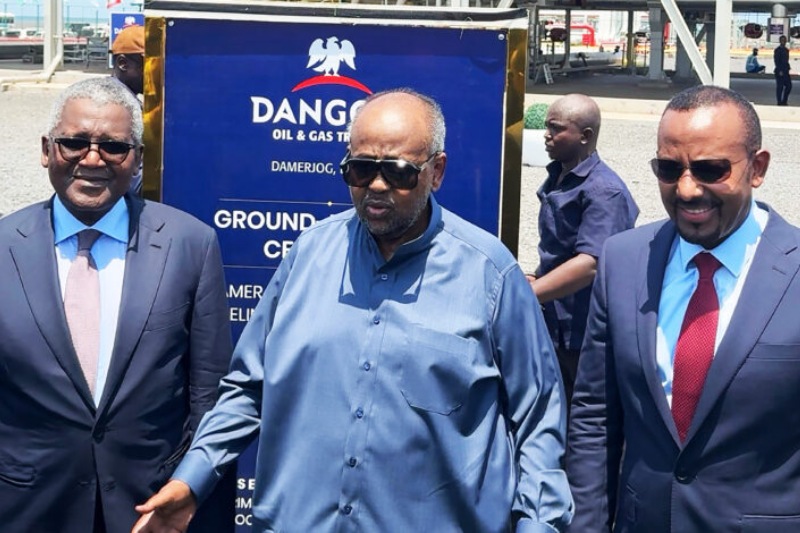
On 24 September, Africa’s richest man broke ground on the project meant to do exactly that. The Dangote fuel pipeline is a 120-kilometre multiproduct line linking Damerjog on Djibouti’s coast to Dewele just across the Ethiopian border, and it carries a price tag of $660 million.
The ceremony took place at the Damerjog Industrial Development Free Trade Zone. Ethiopian Prime Minister Abiy Ahmed and Djibouti’s President Ismail Omar Guelleh stood alongside Dangote as the deal was sealed. Abiy summed up the ambition on social media afterwards: “This landmark infrastructure will reduce logistics costs and delays, strengthen energy security, and enhance the efficiency and resilience of the Ethiopia-Djibouti corridor.”
The numbers behind that ambition are substantial. According to figures shared by Billene Seyoum, spokeswoman for the Ethiopian Prime Minister’s office and cited by Bloomberg, the pipeline will feed two storage terminals: roughly 375,000 cubic metres at Damerjog on the coast and 800,000 cubic metres inland at Dewele.
The venture pairs Ethiopian Investment Holdings, the state’s sovereign investment arm, with the Dangote Group. The figures underline the scale of the Dangote fuel pipeline, which is expected to transform fuel movement between Djibouti and Ethiopia.
The stakes extend beyond fuel deliveries. Ethiopia handles more than 90 percent of its seaborne trade through Djibouti, making the corridor one of Africa’s most strategically important logistics routes. Any improvement in transport efficiency along that route can have consequences for trade costs, industrial production and energy security across the wider economy.
This is not a sudden idea. Dangote has spoken for months about African markets losing money to poor fuel logistics. Executives at the company told S&P Global’s Platts division earlier this year that limited pipeline and storage infrastructure across the continent leaves many countries dependent on trucks, often stretching transit times to four or five days and pushing landed fuel costs higher. Djibouti had already been flagged as a market of interest before Wednesday’s ceremony made it official.
Seen against that backdrop, the Dangote fuel pipeline reads less like a standalone announcement and more like one piece of a wider continental strategy. Dangote is due to break ground on a 700,000-barrel-per-day refinery in Lamu, Kenya, within days. He is also building a $4 billion fertiliser plant in Gode, in Ethiopia’s Somali region. Both sit under the group’s Vision 2030 programme, a pledge to put $50 billion into African industrial and energy infrastructure.
The project also expands Dangote’s growing energy footprint beyond Nigeria, where the group’s refinery has become one of Africa’s largest refining assets. The Djibouti pipeline fits neatly into a broader pattern of coastal access, inland storage and infrastructure investments designed to reshape fuel supply chains across the continent.
Not every detail lines up cleanly, and that gap is worth noting. Early coverage of the groundbreaking put the pipeline’s operational target at eighteen months, a figure that circulated widely in the hours after the ceremony. Yet separate reporting attributes a longer, three-year construction and commissioning timeline directly to the Dangote Group itself. The discrepancy highlights the uncertainty that often accompanies major cross-border infrastructure projects in the Horn of Africa.
That question matters because Ethiopia has little room for slippage from the Dangote fuel pipeline project. Landlocked and reliant on Djibouti’s ports for the overwhelming majority of its seaborne trade, the country has watched fuel queues form in Addis Ababa before, most recently during a shortage linked to disruption at the Strait of Hormuz earlier this year. A pipeline only helps if it is actually pumping fuel when the next shock hits, not still under construction.
For Djibouti, the calculation is different but no less strategic. President Guelleh has been explicit about wanting the country to move beyond its role as a transit corridor and become a full logistics, energy and industrial hub in its own right.
The Dangote fuel pipeline is one of the biggest projects yet aligned with that ambition. Hosting the storage and marine terminal end of the Dangote fuel pipeline, connected to the existing Damerjog liquid bulk port and rail line, fits that ambition directly.
Whether the pipeline arrives in eighteen months or three years, the maths behind it is simple enough for anyone stuck behind a fuel tanker on the Addis road to understand. Five days by truck against a pipeline running underground, day and night, rain or shutdown.
Dangote is betting that gap alone is worth $660 million. Ethiopia and Djibouti are betting the Dangote fuel pipeline delivers on that promise.