



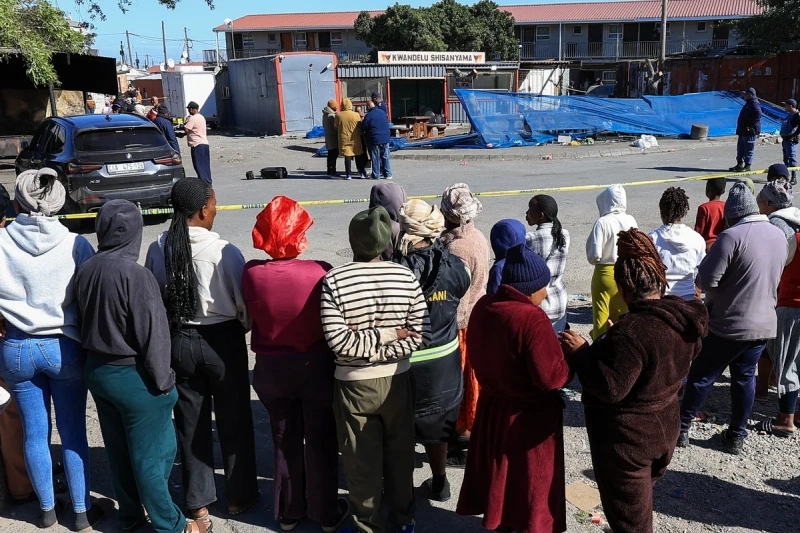

Twenty seven people are dead. Two crime scenes sit on opposite sides of South Africa. Not a single suspect is in custody. That is the brutal scoreboard from South Africa’s mass shootings this weekend, and by Sunday morning the country was still counting bodies.
The first attack hit Extension 3 in Wedela, a settlement on Gauteng’s West Rand, at around 9.30pm on Saturday. Eight men armed with AK-47 rifles and pistols, Gauteng police spokesperson Captain Tintswalo Sibeko said, opened fire on patrons drinking outside a tavern before walking inside to keep shooting.
By the time paramedics arrived, 17 people were dead. Thirteen were men, four were women. Fifteen more were wounded and taken to hospital. The gunmen, police said, searched some victims and took their phones before torching two cars and fleeing in two others. The scale of the attack rank as one of the deadliest South Africa’s mass shootings.
This was not the tavern’s first brush with gun violence. A shooting there two months earlier killed two people, according to TimesLive, and residents say the men responsible for that attack made a threat before they left.
“We are really scared because this is not the first time at this particular tavern,” one resident told TimesLive, asking not to be named. Locals in Wedela say gunfire tied to illegal mining disputes is common in the area, but nothing on this scale had happened before.
Barely five hours later, and on the opposite side of the country, South Africa’s mass shootings claimed a second scene. Gunmen walked into a shisanyama in Lwandle, near Strand in the Western Cape, at about 1.46am on Sunday and opened fire on patrons inside.
Ten people died. Five were killed on the spot, and five more died later in hospital. Eleven others were wounded and remain under medical care. No motive has been given, and no arrests had been made by Sunday afternoon.
Western Cape police commissioner Lieutenant General Sizakhele Dyantyi has set up a multidisciplinary team, led by Serious and Violent Crime detectives, to lead the investigation. Provincial police spokesperson Brigadier Novela Potelwa said officers were still working through the case.
“Detectives are hard at work in search of the perpetrators,” Potelwa said, adding that the names of the dead would only be released once families had been told.
Here is the tension at the heart of South Africa’s mass shootings this weekend. Two attacks, two provinces, two entirely different investigations, yet the same pattern. Gunmen arrive after dark, open fire on people who are simply drinking or eating, and disappear before police can respond.
Wedela and Lwandle are not similar places. One sits in a mining belt outside Johannesburg, the other in a working class township near Cape Town’s coast. But the venues targeted, a tavern and a shisanyama, both serve as the social heartbeat of their communities.
That is precisely what makes the attacks so unsettling for residents who now have to weigh whether a night out is worth the risk.
Gauteng police have opened 17 murder cases and 15 counts of attempted murder linked to Wedela, alongside two charges of malicious damage to property. In Lwandle, police have opened cases of murder and attempted murder. Both provinces have mobilised specialised detective units, but as of Sunday afternoon, the manhunts for South Africa’s mass shootings had produced no arrests and no confirmed motives.
For families in Wedela and Lwandle, the wait is not abstract. It is a phone that will not stop ringing, a next of kin list still being drawn up, and a community bracing for whatever comes next before anyone has explained why this happened at all. As investigators pursue leads in both provinces, South Africa’s mass shootings have once again raised questions about organised violence and public safety.


