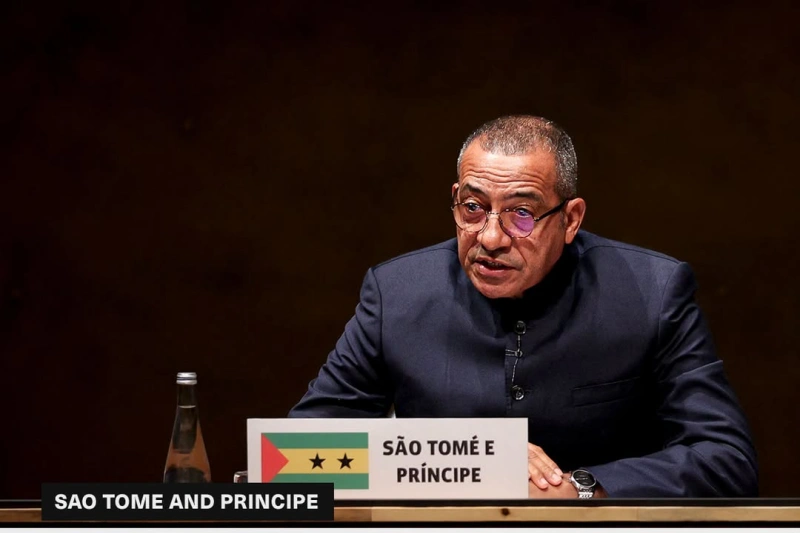
In a single week in January 2025, São Tomé and Príncipe had three prime ministers. President Carlos Vila Nova sacked one government by decree, installed a replacement, then watched that arrangement collapse almost as fast.
Most of the world barely noticed. But the turmoil exposed the fragile balance sitting behind São Tomé and Príncipe’s debt crisis, one voters and creditors are still trying to understand.
On Sunday, the tiny Atlantic archipelago returns to the polls. Voters will choose all 55 seats in the National Assembly, alongside local councils and the regional government of Príncipe. The election arrives at an awkward moment. The ruling Independent Democratic Action party, known as ADI, has split in two, and the fallout is increasingly intertwined with how the country manages its finances.
Patrice Trovoada led ADI for years and served as prime minister until his dismissal in January 2025, a shake-up that unsettled observers already watching São Tomé and Príncipe’s debt crisis closely. In June 2026, a party congress instead recognised Prime Minister Américo Ramos as ADI’s new president. The Constitutional Court later backed that outcome. Trovoada rejected the congress as illegitimate.
In a Facebook video posted in August, Trovoada told supporters he would step aside “with perfect calm, serenity,” adding that “no leader is irreplaceable.” He then urged ADI supporters to boycott Sunday’s legislative and municipal elections, while leaving them free to participate in the separate regional contest in Príncipe.
That split matters because whoever emerges with control of parliament after Sunday’s vote will inherit São Tomé and Príncipe’s debt crisis directly. Public debt stood at 56.5% of GDP in 2025, according to World Bank estimates, down from 65.2% a year earlier. The decline represents genuine progress. Yet the International Monetary Fund still classifies the country as being in debt distress.
The designation remains because of unresolved external arrears. São Tomé and Príncipe still owes legacy debts to Angola, Brazil and Equatorial Guinea worth roughly 1.3% of GDP at the end of 2024. Those outstanding obligations are the technical reason São Tomé and Príncipe’s debt crisis continues to carry the debt-distress label, even as headline indicators improve.
An IMF-backed Extended Credit Facility programme, scheduled to run for 52 months, has guided government policy since December 2024. During a review mission in March and April 2026, IMF mission chief Slavi Slavov said the country continued to face “persistent disruptions in electricity supply and delays in the energy transition,” while higher global oil prices were adding pressure to the outlook.
Electricity shortages are not a side issue. They sit near the centre of São Tomé and Príncipe’s debt crisis because unreliable power discourages the private investment policymakers say is essential if the country is to reduce its dependence on foreign assistance and generate stronger long-term growth.
Donor grants still account for close to two-fifths of public revenue. Few African countries remain as dependent on external grant financing for routine government spending.
There have nevertheless been signs of improvement. Economic growth accelerated to 2.1% in 2025 from 1.1% the previous year, supported by a rebound in tourism and stronger cocoa prices. Inflation eased to 11.2%, down from a peak of 21.3% in 2023. Officials point to those figures as evidence that São Tomé and Príncipe’s debt crisis is gradually becoming more manageable.
The numbers suggest recovery. They also reveal its limits. Cocoa exports and a modest tourism sector cannot sustain an economy of just over 230,000 people on their own, which is why policymakers continue to look offshore for a potential breakthrough.
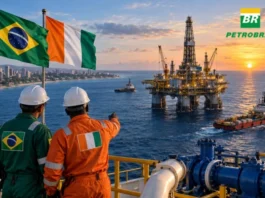
In April 2026, Brazilian energy giant Petrobras acquired a 75% stake and operatorship in Block 3, one of several offshore concessions under exploration in São Tomé and Príncipe’s waters. Seismic surveys are still mapping the seabed, and no oil has been produced.
Successive governments have viewed offshore hydrocarbons as a possible route out of chronic aid dependence, although previous exploration campaigns failed to produce a commercial discovery. For now, the Petrobras project remains a long-term gamble rather than an immediate solution.
Poverty, meanwhile, has not waited for that gamble to pay off. World Bank data show that around 13% of the population lived below the international poverty line of three dollars a day in 2024. Income inequality also remains elevated, with a Gini coefficient of 40.7. Many young people continue to leave the islands in search of better opportunities abroad.
This contrast sits at the heart of São Tomé and Príncipe’s debt crisis. Fiscal indicators may be moving in the right direction, but many households still contend with unreliable electricity, limited job opportunities and the steady departure of young workers.
Progress and hardship are advancing side by side, creating a recovery that feels very different depending on where one stands.
The Rio Times reported last week that Sunday’s election could reveal whether ADI supporters remain loyal to the party or to the man who led it for much of the past decade.
Yet personalities may not be what ultimately shapes life on the islands. The more consequential question is whether the next government can keep the fiscal recovery on track while maintaining public support for reforms.
Election years carry their own risks for São Tomé and Príncipe’s debt crisis. Governments facing voters often favour highly visible projects over the slower and more politically difficult structural reforms that international creditors typically encourage, according to the African Development Bank’s outlook for the country.
That tension is hardly unique to São Tomé and Príncipe, but the stakes are higher in a country with little fiscal room for error.
There is also a broader concern. São Tomé and Príncipe sits in the Gulf of Guinea, a region that hosts offshore energy reserves and maritime routes used by trafficking networks moving narcotics from Latin America toward Europe.
In November 2022, an attack on a military barracks allegedly involving members of the disbanded Buffalo Battalion, a unit originally created under apartheid-era South Africa, left four people dead and was widely described as an apparent coup attempt.
The incident was unusual in a country long regarded as one of Central Africa’s more stable democracies. That is one reason the 2026 elections matter beyond the immediate contest for parliamentary seats. A calm and credible vote would reassure investors and creditors that the violence was an exception rather than a warning sign. A disputed or chaotic outcome could deepen concerns already lingering beneath São Tomé and Príncipe’s debt crisis.
Three prime ministers in one week was never really about personalities. It was an early sign of a country trying to preserve a fragile fiscal recovery while its political landscape fractured beneath it.
Sunday’s vote will not resolve São Tomé and Príncipe’s debt crisis. It will simply determine who must navigate the next chapter of it.