




It took one press conference in Nairobi to rupture relations with Kinshasa. It has taken nearly three years to start mending them.
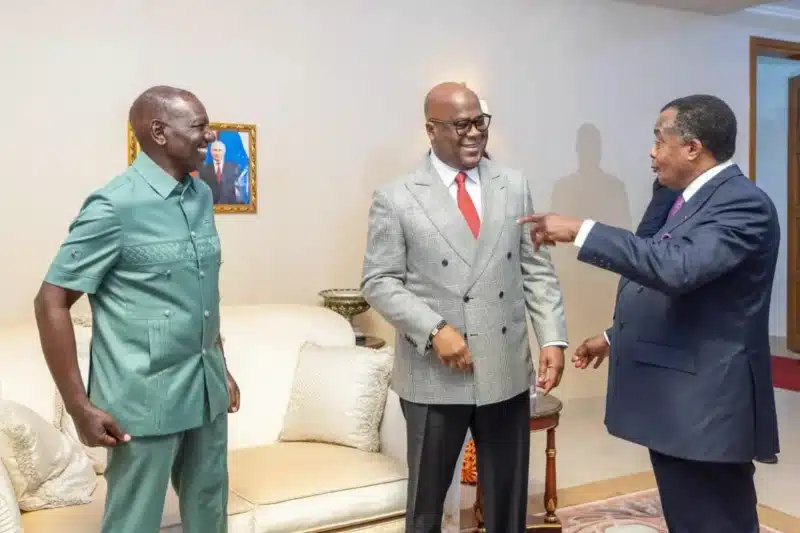
On Sunday 22 November, Presidents William Ruto and Félix Tshisekedi met in Oyo, in the Republic of Congo. They agreed to work towards restoring Kenya-DRC diplomatic ties, including the return of ambassadors.
The talks were hosted by Congo-Brazzaville’s Denis Sassou Nguesso. Togo’s Faure Gnassingbé, the African Union mediator on the eastern DRC crisis, mediated the discussions. Ruto cut short a tour of western Kenya to attend.
For Gnassingbé, warmer Kenya-DRC diplomatic ties could also ease the wider peace effort, The EastAfrican reported.
Ruto told reporters afterwards that the two countries had agreed to “open a new chapter. The joint communiqué names “the return of Ambassadors” as a way to prevent and settle future disputes.
Read closely, though, this is a promise rather than a repair. Neither government has set a date for an ambassador to travel. Nor is there a date for the revived Joint Grand Commission for Cooperation to meet. The restoration of Kenya-DRC diplomatic ties has been agreed in principle, but remains incomplete in practice.
Kenya was once the host of the peace effort. It launched the East African Community’s Nairobi Process on eastern Congo in April 2022, which put it at the centre of the crisis.
Then came the break. On 15 December 2023, Corneille Nangaa, a former head of the Congolese electoral commission, announced the Congo River Alliance in Nairobi. The coalition included the M23 rebels. Kinshasa recalled its ambassador, John Nyakeru Kalunga, and summoned Kenya’s envoy.
Nairobi replied that it had neither organised nor facilitated the event. It said it protected free expression but did not back activities that threaten other states.
A first thaw followed. In May 2024, Musalia Mudavadi travelled to Kinshasa as Ruto’s special envoy. The Congolese envoy briefly returned to Nairobi that summer. It did not last, and the thaw in Kenya-DRC diplomatic ties soon froze again.
Kinshasa refused to accredit Kenya’s nominees, among them Shem Amadi and Peter Tum, The EastAfrican reported. It also objected when Nairobi named a consul-general for Goma, the city M23 has held since January 2025.
Then came October 2025. Nairobi hosted a gathering of Congolese opposition figures around former president Joseph Kabila. A Congolese military court had sentenced Kabila in absentia to life imprisonment a month earlier, after Kinshasa accused him of treason.
Here is the twist. The alliance whose launch started the row no longer exists. On 12 October, Kabila unveiled the Front for the Refoundation of the Nation in Goma. The Associated Press reported that Nangaa serves as one of its four vice presidents.
Put plainly, the rebel coalition born in Nairobi now sits inside a movement led by a man Nairobi hosted last year.
That is why the language on sovereignty matters more than the language on ambassadors. Both presidents pledged “non-interference in the internal affairs of states. Kinshasa’s complaint has been consistent since 2023: that Kenya gave a platform to its enemies.
On paper, the communiqué answers it. In practice, the first test of Kenya-DRC diplomatic ties will be what Nairobi allows on its soil.
Money keeps the relationship alive. Kenyan exports to the DRC nearly doubled in five years, from Sh15 billion in 2018 to Sh26.4 billion in 2023, according to Kenya National Bureau of Statistics figures. Equity and KCB are among the largest lenders in Congo. Mombasa remains a gateway for goods bound for the east.
Even at their lowest point, the diplomatic tensions never severed those commercial links.
Ebola may be the quickest test. Kenya confirmed its first case on 6 October, in a man who had travelled home from the DRC through Uganda. Its last patient was discharged on 11 November. Health Cabinet Secretary Aden Duale says the 42-day countdown to an Ebola-free declaration ends on 23 December, provided no new case is recorded.
The communiqué commits both countries to step up joint efforts against a disease it says has had “particularly serious consequences”. A virus does not wait for diplomats to resume talking, and repaired Kenya-DRC diplomatic ties would make shared surveillance easier.
Foreign Affairs Principal Secretary Korir Sing’oei has warned outsiders against stoking tension over Kenya-DRC diplomatic ties. He insists that “Kenya and DRC are not abstractions on a map”. He points to the traders, transport workers and families who depend on cross-border links.
They are the people who paid for the silence between the two capitals.
Presidents can announce a thaw in an afternoon. Making it real takes an ambassador on a plane and a signed accreditation. Until both happen, Kenya-DRC diplomatic ties remain a promise on paper.


