



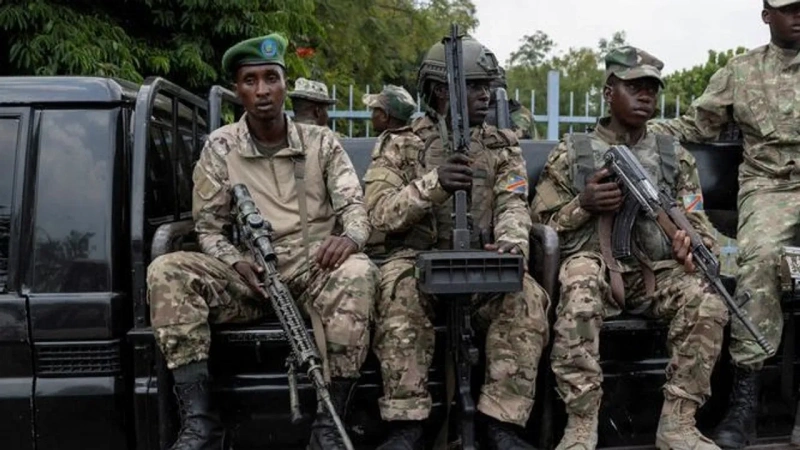

The Democratic Republic of Congo says a Rwandan Hutu militia blamed for the 1994 genocide has signed up to a formal FDLR disarmament, only for Kigali to reject the announcement within hours as a stunt designed to dodge its own peace commitments.
Government spokesman Patrick Muyaya told reporters in Kinshasa on Tuesday that the Democratic Forces for the Liberation of Rwanda had signed a protocol covering disarmament, demobilisation and cantonment. He said the document followed months of a quiet sensitisation campaign among fighters in the east and fits within the Concept of Operations attached to the Washington Accords, the peace framework Congo and Rwanda signed on 4 December 2025.
Muyaya described the FDLR disarmament as a major turning point. According to him, the militia’s presence has been used by Rwanda for three decades as a pretext to justify military operations on Congolese soil, and its removal strips Kigali of that justification. He was careful to clarify what neutralisation actually means in practice. Muyaya insisted it does not involve killing combatants but rather reducing their capacity to threaten Rwanda’s security, so that residual fighters no longer pose a genuine risk.
Regional Integration Minister Floribert Anzuluni framed the moment as mutual progress under Washington. Rwanda had committed to withdrawing troops and lifting what both sides call defensive measures, while Congo committed to neutralising the FDLR, and Tuesday’s signing was presented as Kinshasa fulfilling its half of that bargain through the FDLR disarmament.
Kigali was not persuaded. Rwanda’s Foreign Affairs Minister Olivier Nduhungirehe dismissed the FDLR disarmament as a manipulation with no legal standing under the Washington framework, arguing the militia was never a signatory to the accord and exists in it only as a subject of its security provisions. He used unusually sharp language, describing the arrangement between Kinshasa, the FDLR and what he called the ideology of genocide as incompatible with the accord’s terms.
Nduhungirehe went further, accusing Congo of deepening ties with the FDLR since the December signing rather than dismantling it. He alleged that fighters linked to the group have been absorbed into the Congolese army, and named four individuals he said the government was helping to organise politically.
The FDLR traces its origins to 1994, when close to two million Hutu refugees, including former soldiers and members of the Interahamwe militia responsible for the genocide, crossed into eastern Congo and settled largely in North Kivu and South Kivu. Rwanda has long demanded the group’s neutralisation as a precondition for lasting peace, and this history is exactly why the FDLR disarmament matters so much to both capitals, even as Congo has spent years alternating between denying the group’s relevance and pledging to dismantle it.
Muyaya’s own past remarks illustrate that tension. He has previously called the FDLR a recycled pretext and reduced its relevance to economics, once remarking that the group amounts to little more than coltan and gold in the ground. Several hundred fighters are reported to have already been repatriated to Rwanda in recent years, though the pace has been slow and contested.
Analysts tracking the file have questioned how Kinshasa secured a signature for the FDLR disarmament at all, given that much of the group’s territory sits behind lines controlled by the M23 rebel movement and Rwandan-backed forces. A United Nations Group of Experts assessment published in July 2026 has been cited as evidence that reaching the militia required exactly the kind of contact with Rwanda’s proxies that Kinshasa has consistently denied having.
For now, the FDLR disarmament stands as a paper commitment rather than a verified fact on the ground, and Kinshasa’s credibility on the FDLR disarmament will rest entirely on what happens next in the field. Whether cantonment sites are established, weapons handed over and fighters repatriated will determine if Tuesday’s protocol becomes the breakthrough Kinshasa is describing or another entry in a three decade long list of unmet disarmament pledges.


