



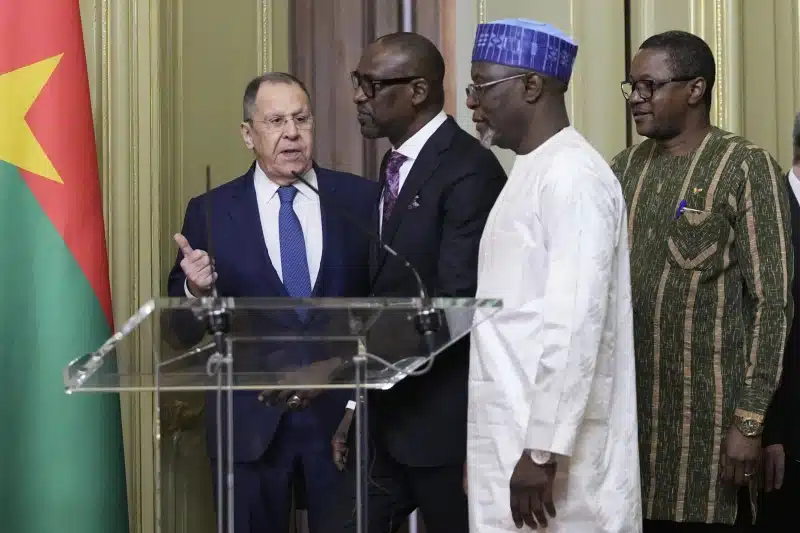

Russia has reaffirmed its commitment to arming and training the militaries of the Alliance of Sahel States, after Foreign Minister Sergey Lavrov held a fresh round of ministerial talks in Niger’s capital on Wednesday.
The meeting in Niamey marked Lavrov’s first visit to Niger and the second high-level gathering between Moscow and the Alliance of Sahel States, following an inaugural session held in the Russian capital in April last year. Foreign ministers from Burkina Faso, Mali and Niger sat with their Russian counterpart for what officials on both sides described as a candid exchange on security, trade and political cooperation.
At the close of talks, Russia and the Alliance of Sahel States signed a joint communique alongside a memorandum guiding future consultations between the two blocs.
According to a joint statement issued in Niamey, Moscow will keep building the operational strength of AES armed forces, a pledge that extends military and logistical assistance already flowing through Russia’s Africa Corps, the state-run outfit that absorbed the operations of the Wagner Group.
Lavrov used the occasion to extend an invitation on behalf of President Vladimir Putin, asking the presidents of Burkina Faso, Mali and Niger to attend the third Russia-Africa summit, due to take place in Moscow this October. The Russian foreign minister told delegates that Putin would be pleased to welcome the three leaders personally, adding that the summit’s agenda would centre on trade, economic and investment matters.
The Alliance of Sahel States was formed in September 2023 by three military governments that seized power through coups between 2020 and 2023. All three subsequently cut ties with France, their former colonial power, and pulled out of the Economic Community of West African States in January 2024, accusing the regional bloc of being unduly influenced by outside powers. The Alliance of Sahel States has since worked towards fielding a unified anti-jihadist force of more than 6,000 troops, a project Moscow has publicly welcomed.
Security dominated much of Wednesday’s discussion. The three Sahelian governments have battled jihadist insurgencies for years, with tens of thousands killed across the region since the violence intensified.
A joint statement from the talks accused Ukraine and France of colluding with armed groups operating in the Sahel, describing the alleged involvement as coordinated aggression alongside economic and media pressure against member states. Neither Kyiv nor Paris had issued a public response to the claim at the time of writing.


Beyond security, Moscow is angling for a bigger footprint in the Sahel’s energy and mining sectors, an ambition officials from both sides referenced during the Niamey consultations. Burkina Faso’s foreign minister, Karamoko Jean-Marie Traore, who chairs the Confederation of Sahel States, also held a joint press conference with Lavrov to outline the outcomes of the talks, though specific commercial commitments were not detailed publicly.
The April 2025 meeting in Moscow set the template for Wednesday’s talks. At that first gathering, Mali’s Foreign Minister Abdoulaye Diop noted that Russia was the first country in the world to formally recognise the Alliance of Sahel States, a gesture Bamako, Ouagadougou and Niamey have referenced repeatedly since as proof of Moscow’s reliability compared with former Western partners. That recognition has since translated into a standing diplomatic architecture, including the opening of a Russian embassy in Niger, which now gives Moscow full representation across all three Alliance of Sahel States capitals for the first time.
Officials from both sides also used the Niamey consultations to compare notes on the broader security picture across the Sahara-Sahel region, according to a summary released after the talks. The two delegations reported a close alignment of views on most of the issues raised, though neither side detailed specific points of disagreement.
A separate meeting between Lavrov and Burkina Faso’s foreign minister touched on plans to convene the first session of an intergovernmental commission on trade, economic, scientific and technical cooperation between Moscow and Ouagadougou, part of a wider push to formalise bilateral ties alongside the bloc-level framework binding the Alliance of Sahel States to Russia.
Analysts tracking the region say the visit underscores how deeply Russia has embedded itself with the Alliance of Sahel States since the three governments broke from Western partners. Federica Saini Fasanotti of the ISPI think tank noted that the trip reaffirms Moscow’s intent to deepen ties at what she called a difficult moment for the juntas, whose counter-insurgency campaigns have yet to deliver the security gains their leaders promised when they seized power.
Wednesday’s meeting was the second in a format both sides intend to repeat annually, with the next round of ministerial consultations pencilled in for 2027. For now, the Alliance of Sahel States appears set to deepen its dependence on Russian military and diplomatic backing, even as the security situation across Burkina Faso, Mali and Niger remains volatile.


