



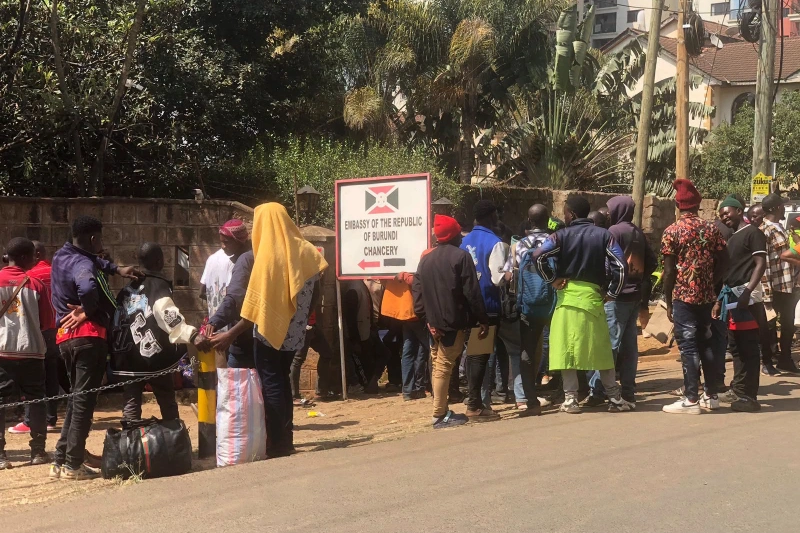

Hundreds of Burundian nationals queued outside their embassy in Nairobi’s Kilimani neighbourhood on Monday. They were scrambling for emergency travel papers as Kenya’s foreign trader crackdown took effect.
The rush followed a directive President William Ruto issued on 2 September. It ordered the closure of small-scale retail and hawking businesses run by foreigners within five days.
By mid-morning, the queue outside the Embassy of Burundi on Dennis Pritt Road had grown into hundreds, according to the Eastleigh Voice. Many applicants carried identity cards, passports and residence permits.
The mission, led by Ambassador Evelyne Habonimana, began issuing Laissez-Passer documents on Monday under Kenya’s foreign trader crackdown. It is a one-year travel pass that lets Burundians move freely within the East African Community.
Processing hours were limited to between 9am and 2pm. Many applicants were unsure whether they would be attended to before the day ended.
Some travellers abandoned the embassy queue altogether and headed for Machakos Country Bus Station, hoping to secure seats on buses bound for home.
Peter Nakumujango, 62, said he had built a life in Kenya but was leaving against his will. “I am not going home by choice. I have been forced to go,” he said.
Eighteen-year-old Munezero Farnke appealed for more notice. He said a week would have let traders plan their departure or arrange to cross the border in an orderly way.
Kenya’s foreign trader crackdown has unsettled an estimated 16,000 Burundian refugees and asylum seekers registered in the country, a figure the UN refugee agency has previously cited. Many work in small-scale trade around Nairobi, selling items such as secondhand clothes, coffee and roasted groundnuts.
Burundi’s government has responded sharply to the fallout from Kenya’s directive. Its Ministry of Foreign Affairs, Regional Integration and Cooperation for Development said it was preparing buses and free laissez-passer documents for citizens wishing to return.
The ministry warned that Nairobi would bear responsibility for the safety of Burundian nationals. It also raised the prospect of reciprocal measures, though it stressed respect for Kenya’s right to set its own trade policy.
Foreign Minister Edouard Bizimana went further. He warned that continued hostility towards Burundians in Kenya could strain relations between the two neighbours.
His ministry has alleged that some traders faced harassment, dispossession and violence in the days before the deadline tied to Kenya’s foreign trader crackdown.
The tension traces back to a July video showing a Kenyan man confronting a Burundian trader in Nairobi. He accused the trader of taking business opportunities away from locals.
A Kenyan legislator later added to the row, claiming construction firms preferred cheaper Burundian labour over local workers.
Ruto has defended his stance behind Kenya’s foreign trader crackdown. He told small-scale traders at State House that foreign investment should build large enterprises rather than compete with Kenyans in hawking and informal retail.
He also urged Parliament to close loopholes in a pending business bill designed to reserve certain trades for citizens.
Kenya’s Cabinet Secretary for Trade, Lee Kinyanjui, said the country had opened its doors to visitors through visa-free entry since January 2024. It also scrapped electronic travel authorisation for most African nationals in January 2025.
He stressed, however, that visa-free access does not automatically grant the right to work or run a business. Some affected traders, he added, were operating outside their visa conditions.
Foreign Affairs Principal Secretary Korir Sing’oei sought to calm nerves amid Kenya’s foreign trader crackdown. He insisted that foreigners holding valid permits and licences, Burundians and other East Africans included, remain free to live and work in Kenya lawfully.
The dispute has drawn wider criticism. Some argue that Kenya’s foreign trader crackdown sits uneasily with the East African Community’s founding principle of free movement of people, labour and capital across its eight member states.
Some Burundian and Rwandan traders are reportedly already relocating their operations to Uganda rather than risk further disruption.
Burundi’s embassy has called on Ugandan President Yoweri Museveni, who currently chairs the EAC, to convene an urgent summit over the treatment of Burundian nationals.
For now, the queues outside the Nairobi mission show no sign of thinning. It is a daily reminder of how quickly Kenya’s foreign trader crackdown has reshaped the lives of traders who once called the city home.


