



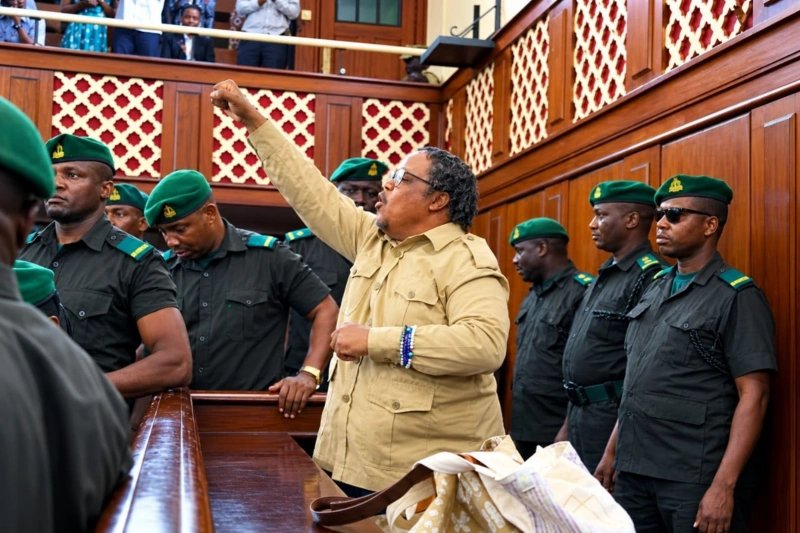

A Tanzanian court told prison officers to stop listening in on Tundu Lissu’s lawyers. Eight days later, his lawyer says the order is being ignored, and Lissu’s hunger strike is about to begin.
The jailed opposition leader will stop eating on Monday 26 October, according to his lawyer, Rugemeleza Nshala. He spoke to journalists in Dar es Salaam on Saturday after meeting Lissu in prison.
Nshala, quoted by the Associated Press, said he warned Lissu about the health risks because he relies on medication. The planned Lissu’s hunger strike remains in place.
“I am ready to face the consequences,” Nshala quoted him as saying. The lawyer added that Lissu was prepared to stop taking his medication too.
On paper, the demand is small. Lissu is not asking to be freed, and he is not asking for the treason charge to be dropped. Lissu’s hunger strike has a narrower aim: a room where no prison officer can hear him talk to his lawyers.
A court has already said he is entitled to exactly that.
On 16 October, a three-judge High Court bench found that officers at Ukonga Prison had unlawfully listened in on consultations between Lissu and two of his legal advisers. The case, The Chanzo reported, was brought by advocates Kulwa Maduhu, Nashon Nkungu and Paul Kisabo.
Two of them told the court that at least four uniformed officers stayed in the room, about one metre away. The prison authorities said the officers were out of hearing. The judges found no measurements, room plan or acoustic barrier to back that up.
The rule itself is short. Regulation 13 of the Prisons (Prison Management) Regulations, 1968, says a legal visit must happen “within the sight but out of hearing” of an officer. The judges said in their formal orders: “Visual supervision is lawful; supervision of the substance of consultations by listening is not.”
The judges also pointed to Rule 61 of the UN’s Nelson Mandela Rules, which likewise allows sight but not hearing, as support for their reading.
The court was careful to define the limits of its ruling. It did not find that CCTV had recorded the conversations, that the courts hearing Lissu’s criminal cases had denied him a fair hearing, or that he should be released. Its decision concerned the confidentiality of his consultations with lawyers.
Nshala says little has changed since the ruling. He alleges that prison authorities are still refusing to allow confidential consultations and that lawyers have sometimes been prevented from seeing Lissu altogether. These allegations have not been independently established in the account of events since the judgment.
Lissu’s own question, as Nshala relayed it, is pointed. Why are court decisions that keep him in custody enforced, while an order protecting his access to lawyers is allegedly disregarded?
When the Associated Press filed its report, prison authorities, police and the government had issued no public statement on Lissu’s hunger strike. Separately, Jeremiah Katungu, the Commissioner General of Prisons, told Mwananchi newspaper that he would investigate the allegations.
The order runs on two clocks. Ukonga Prison must immediately make arrangements to ensure that Lissu can consult his lawyers out of hearing of prison officers. Separately, the Commissioner General of Prisons has 60 days from service of the judgment to issue written directions on confidential legal consultations to every prison head in the country.
Maduhu said after the ruling that he would go to Ukonga to test the order. If he were refused, he said, he would seek judicial review and consider action against officers in their personal capacity.
Lissu was arrested on 9 April 2025, after a rally calling for electoral reforms. He was charged with treason the next day. The offence carries a possible death sentence.
He has been here before. In May 2025, the Associated Press noted, he went on hunger strike over being made to appear in court remotely. If Lissu’s hunger strike goes ahead, it will be his second known fast in custody.
The planned Lissu’s hunger strike comes against the backdrop of Lissu’s decision to conduct his own defence in the treason trial. In June 2025, he told the Kisutu court he was dismissing his legal team of more than 30 advocates.
He cited repeated denials of private access to his lawyers and a desire to shield them from blame for the outcome of the case. However, the High Court recognised that Maduhu had been instructed to provide him with legal advice and research, making confidential consultations an ongoing concern despite his decision to represent himself.
In closing arguments covered by The Chanzo, prosecutors said on 29 September that 17 witnesses had proved he meant to incite the public to intimidate the executive. Lissu argues the charge is defective, the evidence unreliable and his words were not treason.
Judgment is due on 6 November. That is just 11 days after Lissu’s hunger strike starts.
Concern over his detention pre-dates Lissu’s hunger strike. A United Nations working group found in February that he was being held arbitrarily and called for his immediate release. The opinion followed an application by his international lawyers.
A man who survived being shot 16 times in 2017 is now risking his health over a prison regulation dating back to 1968. The judges have said what the rule means. Lissu’s hunger strike will show whether the prison agrees.


