



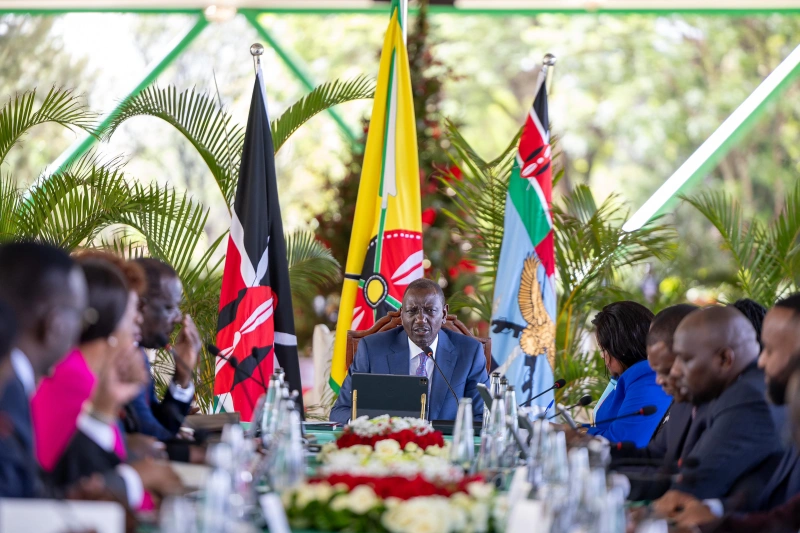

Kenya’s High Court has given President William Ruto 120 days to fix his Cabinet’s breach of the country’s two-thirds gender rule, in a ruling that reopens one of the most contested provisions in the nation’s constitution.
A three-judge bench sitting in Nairobi delivered the decision on Tuesday, 30 June, declaring that the current Cabinet falls short of the constitutional threshold requiring that no more than two-thirds of members of any appointive body be of the same gender, Nation reported. Justices Eric Ogola and Stephen Githinji formed the majority, while Justice Jairus Ngaah dissented on two central points, according to the same publication.
The judges found that President Ruto’s Cabinet, as presently constituted, violates Article 27(8) of the Constitution, which obliges the state to ensure gender balance in elective and appointive bodies, Nation stated. They ordered the President, as the appointing authority, to make fresh nominations that bring the Cabinet into line with the two-thirds gender rule within four months.
The court also settled a technical question that had complicated earlier compliance debates. It ruled that the Secretary to the Cabinet is not a member of Cabinet and therefore cannot be counted when assessing whether the two-thirds gender rule has been met, KDRTV reported.
The petitions that triggered the ruling were filed separately by Katiba Institute, the Centre for Rights Education and Awareness, Transparency International Kenya, the Community Advocacy and Awareness Trust and the World March of Women-Kenya, Kenyans.co.ke reported. Governance activist Wanjiru Gikonyo and the Kenya Human Rights Commission also brought related petitions that were partly allowed by the bench, Nation added.
The consolidated cases challenged Cabinet appointments made after President Ruto dissolved his entire Cabinet on 11 July 2024, following nationwide anti-government protests, Nation reported. He later reappointed several of the dismissed ministers and brought opposition figures into government under what his administration calls a broad-based arrangement.
Despite finding the Cabinet in breach of the two-thirds gender rule, the court upheld the wider architecture of that arrangement. It dismissed arguments that appointing politicians from outside the governing coalition breached the Constitution, ruling that the document neither establishes an official opposition nor bars such appointments, according to Nation. The judges also upheld the reappointment of previously dismissed ministers and confirmed that the National Assembly met public participation requirements during Cabinet vetting.
Justice Ngaah disagreed with parts of the majority position. He held that ministers dismissed in July 2024 should not have been swiftly reappointed, arguing that the President had publicly tied their removal to performance failures, Nation reported. He further found that appointing opposition politicians into Cabinet without a formal coalition or merger agreement undermined the constitutional framework for multiparty democracy.
Cabinet members currently serving under the broad-based arrangement include Treasury Cabinet Secretary John Mbadi, Mining Cabinet Secretary Hassan Joho, Energy Cabinet Secretary Opiyo Wandayi and Cooperatives Cabinet Secretary Wycliffe Oparanya, alongside Attorney General Dorcas Oduor, Nation noted.
The two-thirds gender rule has shadowed Kenyan politics since it was enshrined in the 2010 Constitution. President Ruto promised during his 2022 campaign that his government would deliver full compliance within 90 days of taking office, a pledge that remains unmet three years on, according to Wikipedia’s account of the rule’s history.
Parliament itself has faced repeated legal pressure over the same threshold. In 2020, a separate High Court bench temporarily halted an advisory from then Chief Justice David Maraga recommending the dissolution of Parliament for failing to meet the two-thirds gender rule, JURIST reported at the time.
Tuesday’s judgment on the two-thirds gender rule now places the burden squarely on the Executive. With 120 days on the clock, President Ruto faces a fresh round of Cabinet nominations that must satisfy both the gender threshold and the delicate political balancing act that has defined his administration since the 2024 upheavals. Gender rights groups behind the petitions are expected to monitor compliance closely, given Kenya’s long record of missed deadlines on the same constitutional obligation.


