



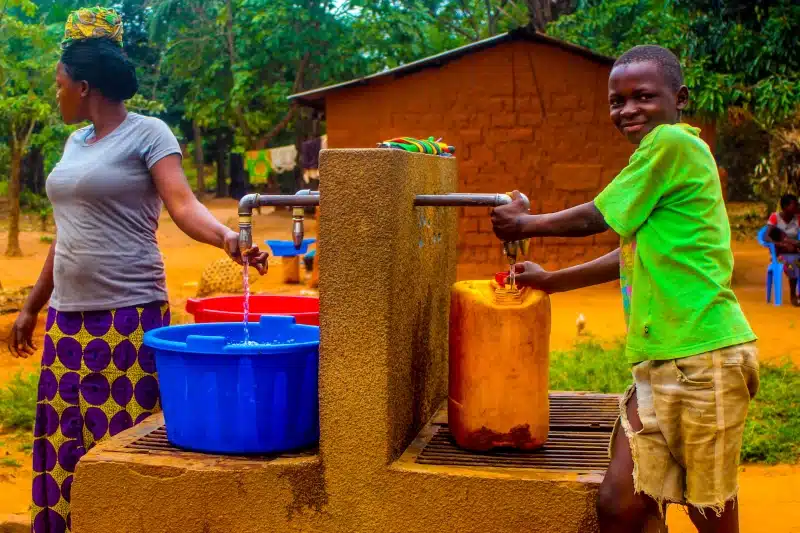

Water supply in Bamako has been restored, days after suspected sabotage to a high-voltage transmission line cut electricity across large parts of Mali’s capital and left taps running dry.
Residents had gone without running water since Sunday. With no power to drive the pumping network, thousands turned to solar-powered boreholes to get by. In the Lafiabougou district, one resident told AFP the water drawn from a neighbour’s borehole, shared among long queues of people, was only enough for cooking and drinking.
The breakthrough came not from a grid repair but from a workaround. Mali’s drinking water utility, SOMAGEP, said it had secured enough diesel fuel to run its pumping stations independently of Energie du Mali, the state power company. In a statement carried by AFP, SOMAGEP said it had taken steps to reduce its dependence on the national grid and confirmed it was now 100 percent operational.
That restored water supply in Bamako does not mean the wider crisis is over. The electricity grid itself remains severely disrupted, and EDM has not said when full power will return to affected districts.
The disruption traces back to a single point of failure with regional consequences. SOMAGEP said the sabotage struck the high-voltage line linking Bamako to the Manantali Dam, a hydropower facility roughly 400 kilometres away on the border shared by Mali, Senegal and Mauritania. The disruption quickly translated into a crisis water supply in Bamako because pumping stations lost the electricity needed to keep water flowing.
That location is not incidental. Manantali was built and is still jointly owned by the three countries through the Organisation pour la Mise en Valeur du Fleuve Sénégal, a river basin authority that has pooled Senegal River resources since 1972. Under the arrangement, Mali draws roughly half of the dam’s output, with Senegal and Mauritania sharing the rest. The importance of the dam to water supply in Bamako became clear once electricity to pumping facilities was interrupted.
That shared ownership is precisely why a single act of sabotage on Malian soil can ripple into a wider West African infrastructure story. Manantali has long been held up as a rare example of successful regional energy cooperation in a part of the continent where cross-border power sharing is still uneven. A prolonged outage on its transmission lines does not just affect Bamako. It exposes how fragile that cooperation becomes when security conditions deteriorate in just one of the three member states.
No group has claimed responsibility for the sabotage. Energie du Mali, in an earlier statement, described it only as an incident on the transmission network, without giving further detail. The uncertainty has raised concerns about how vulnerable water supply in Bamako remains while repairs to the transmission line are ongoing.
For months, roads leading into Bamako have faced blockades and attacks on fuel convoys blamed on armed groups operating in the wider Sahel, part of a security crisis that has strained Mali’s infrastructure since 2012.
For now, the restoration of water supply in Bamako offers residents some relief, particularly in neighbourhoods where households had gone days relying on shared boreholes. But utility officials have been careful not to describe the situation as resolved. SOMAGEP’s fuel-based fix keeps water flowing, not the grid running, and the underlying vulnerability, a single transmission corridor serving three countries, remains exposed until repairs to the Manantali line are completed and confirmed.


