



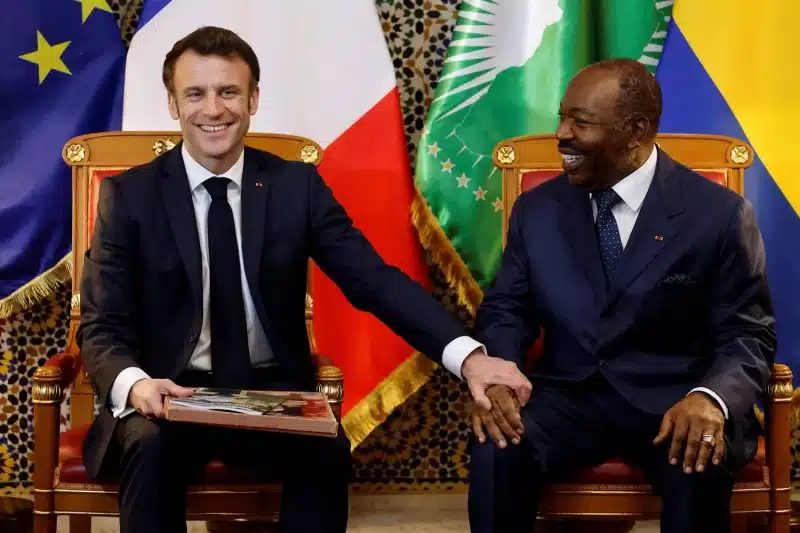

Former Gabon president Ali Bongo says France orchestrated the coup that removed him from power in 2023, accusing French soldiers of working behind the scenes to install his cousin Brice Oligui Nguema as leader.
He did not soften the claim. Bongo told the outlet that French soldiers worked in the shadows to remove him. He says they let the world believe Gabonese officers had acted alone. In his telling, France orchestrated the coup down to the smallest detail. Then Paris stepped back so the takeover would look homegrown.
The man he blames for carrying out the operation is his own cousin. Brice Oligui Nguema led the Republican Guard at the time. He took charge of the country within hours of the coup. Bongo insists Nguema lacked the means and the intent to move against him alone. He believes France orchestrated the coup precisely because his cousin could not have managed it. He described his cousin as “my cousin and my bodyguard” in the same breath.
That description doubles as an accusation. Bongo argues that a man he personally appointed to guard him could not have staged the takeover by himself. Only an outside power, he suggests, had the reach to bring the Republican Guard along. He is convinced that France orchestrated the coup with help from people close to him.
France’s own record from that week tells a different story on paper. Paris condemned the takeover within hours. The then foreign minister, Catherine Colonna, said France condemned the coup and wanted constitutional order restored. Military cooperation between Paris and Libreville was suspended on 2 September 2023. Roughly four hundred French soldiers stationed in the country resumed normal activity only days later.
France’s response in the days after the coup remains central to the debate. Paris condemned the takeover within hours and suspended military cooperation with Libreville. For Bongo, however, those actions do not rule out French involvement. He argues that public condemnation could have served to distance France from events already set in motion. He has not provided evidence to support that allegation, and French authorities have consistently rejected suggestions of involvement.
This is not the first time Bongo has pointed fingers since his release from house arrest. Earlier this year, he asked publicly who had placed Nguema at the head of the Republican Guard. He framed the appointment as proof that he trusted a man who later turned on him.
The timing of his own words on the day of the coup matters too. When soldiers announced his removal, Bongo appeared in a fifty one second video. He spoke English rather than French. He now says the choice was deliberate. He wanted the wider world, not just Paris, to hear his appeal for help. By then, he says, he had already concluded that France orchestrated the coup.
Bongo’s latest accusation lands as Gabon settles into its transition under Oligui Nguema. Nguema won a presidential election in 2025. He has worked to distance the country from the family dynasty that ran it for fifty five years. Neither Nguema nor his government has responded publicly to the latest claim that France orchestrated the coup. Bongo, for his part, says he no longer wants the presidency. He hopes instead to keep a role inside the PDG, the party his father built and he later inherited.
Family ties run through the entire saga. Bongo has lived in Paris since May 2025. He owns a property on Avenue Foch and holds French nationality alongside his Gabonese one. His wife, Sylvia, and son, Noureddin, live in London. Both were sentenced in absentia to twenty years in prison for embezzlement in 2025. Sylvia gave her own interview in March. She described mistreatment during twenty months in detention, a claim Gabonese authorities have not addressed publicly.
The claim that France orchestrated the coup may never gain traction beyond Gabonese politics. That matters less than what it reveals about his position now. Bongo is exiled and stripped of formal power. His family faces prosecution from abroad. He is fighting for a version of history in which his fall was engineered by outsiders, not driven by discontent closer to home.


