



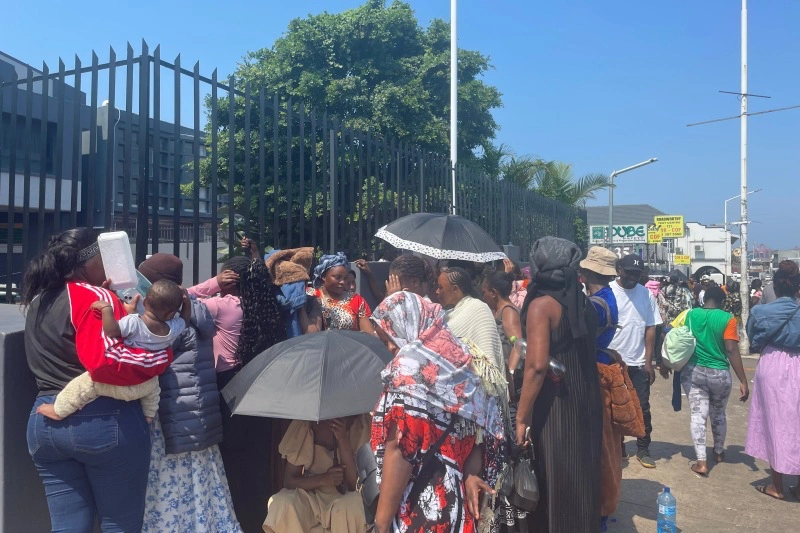

Some wore masks. Most carried sticks. About 15 vigilantes walked past police officers and into the car park of the Durban refugee centre on Tuesday, shoving people who had queued since dawn to apply for asylum.
Many of those waiting at the Durban refugee centre had been locked out of the system since 2020. They had waited years for this week.
The group shouted insults at the crowd, including “kwerekwere”, a xenophobic slur for African immigrants, and “criminals”. Some told the asylum seekers to go and apply in the country nearest their own.
According to GroundUp, police stepped in only after a few minutes. Officers moved the group out of the car park and, once reinforcements arrived, formed a barrier to stop it crossing the road.
One detail stood out. Police allowed the group’s leader, Wandile Mhlongo, to walk inside the Durban refugee centre. The idea was that he could see the application process and report back to the others. Mhlongo said the aim was to block people from seeking asylum in South Africa.
He also said March and March had not organised the protest. Yet at about 3pm, Xolani Zuma, husband of March and March leader Jacinta Ngobese-Zuma, arrived to speak to police. March and March is a pressure group that campaigns against illegal immigration and has organised demonstrations outside refugee facilities in Durban.
He said he was shocked that Home Affairs could help so many refugees while many South Africans still lacked identity documents. The department, he said, should “stop processing the refugees”.
So who was behind it? The record does not settle that. Being linked to a movement is not the same as being run by it. What the record does show is a pattern.
Al Jazeera reported that violence broke out in early September when March and March supporters confronted refugees camped outside the Durban refugee centre. At least four people were hurt. GroundUp reported that police used rubber bullets and stun grenades to disperse the crowd.
A week later, about 200 supporters returned. The refugees’ blankets and belongings were later seen on fire. In mid-September the government cleared the camp, and 274 people were bussed to Lindela, a government-run detention facility in Gauteng.
The movement insists it is opposing undocumented migration rather than foreign nationals in general. But the people queuing at the Durban refugee centre on Tuesday were doing the opposite of hiding. They were standing in line to be documented.
The long queue outside the Durban refugee centre exists largely because of a court ruling that reopened access to South Africa’s asylum system.
On 7 July, the Constitutional Court confirmed a High Court ruling that struck down amendments to the Refugees Act. Those amendments let officials turn people away before anyone heard their claims. A Home Affairs circular dated 28 September then told refugee offices to accept every new applicant, including those who entered the country without a visa.
The ruling was significant because it restored the right of asylum seekers to have their claims heard before being turned away. Rights groups argued that the previous rules effectively shut thousands of people out of the asylum process, leaving them unable to renew documents, work legally or access basic services.
The Scalabrini Centre of Cape Town, which brought the challenge with Lawyers for Human Rights, told the court that hundreds of thousands of people were affected.
One of them, Bihh Mutombo, fled the Democratic Republic of Congo 12 years ago and was shut out in 2020. He had been waiting at the Durban refugee centre since 6am. Another woman, who runs a small salon and asked not to be named, said she sometimes struggles to get treated at hospital without papers.
For many Congolese, going home is not an option. Kafuti Muyumba, a refugee community representative, recently told Al Jazeera: “There is still war there.”
By the end of the day, officials at the Durban refugee centre had processed just 20 applicants. The rest were told to return on Wednesday.
James Chapman of the Scalabrini Centre said this week he hoped the offices would not be overwhelmed. Parliament heard in May that the Refugee Appeals Authority already faced a backlog of about 161,000 cases.
The pressure is political too. South Africa votes in local government elections on 4 November, and Al Jazeera has described migration as an increasingly prominent issue in the campaign.
At the time of writing, we found no public statement from Home Affairs or the South African Police Service on what happened at the Durban refugee centre on Tuesday.
The court gave them a place in the line. Tuesday showed that someone still has to guard it.


