



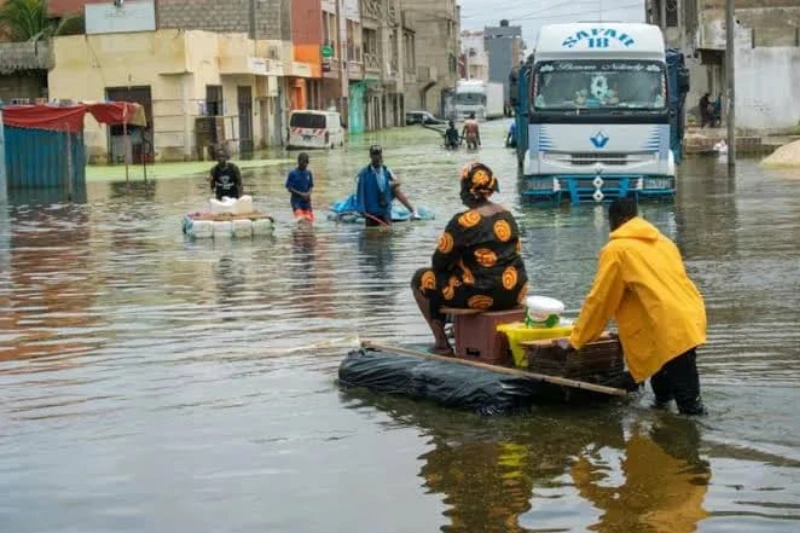

A mother and her four-year-old son drowned during severe flooding in Dakar on Sunday. Two days later, the government delayed the Senegal school reopening for every pupil in the country.
Senegal school reopening, earlier planned for Wednesday 7 October, has been pushed to Monday 12 October. The Ministry of National Education announced the change on Tuesday. Days of torrential rain had cut roads, flooded homes and left classrooms unfit for use.
The delay affects millions of pupils across Senegal and comes as emergency teams continue assessing damage to schools, roads and public facilities after one of the heaviest rainfall events recorded in the capital in recent decades.
In a statement carried by Pulse Senegal, the ministry said the decision was “first and foremost a matter of safety and protecting our children”. The extra days will let local authorities and communities finish pumping, cleaning and disinfecting flood-hit schools before the Senegal school reopening.
Late starts are not new in wet years. In 2024, UNICEF counted 248 schools, 130 of them in the Dakar region, that did not reopen on time because of floods. What sets this Senegal school reopening delay apart is its reach. Every region now waits, and AFP called a nationwide postponement unprecedented in recent years.
The rainfall figures show why the Senegal school reopening could not stay on 7 October. Diabel Ndiaye, head of the climate service at the weather agency Anacim, said 137.5 mm fell on Dakar-Yoff in 24 hours on 4 October. Only two wetter days appear in the station’s records since 1981, he said. Those were 160.8 mm on 26 August 2012 and 144.1 mm on 7 September 1996.
Rufisque, on the capital’s edge, logged 142 mm. Guédiawaye recorded 107 mm.
The human cost is still being counted. Officials put the provisional toll at five dead, three of them children. Pulse Senegal reported that a 25-year-old mother and her four-year-old son were swept away in Parcelles Assainies. In Bambey, lightning killed two children aged six and eight.
Prime Minister Ahmadou Al Aminou Lo triggered Dakar’s regional emergency plan on Monday and set up a monitoring committee. He said the plan would keep the government “on permanent watch”. He also announced a national sanitation programme worth about 921 billion CFA francs, aimed at improving drainage systems and reducing the impact of recurring urban floods.
The pledge is large. The track record is harder to defend. Less than ten months ago, the Ministry of Hydraulics and Sanitation judged its handling of the 2025 floods broadly satisfactory at a national review. The same review reported 20 deaths and 8,336 people affected. One heavy Sunday in October has now stalled the school calendar.
There is also a design problem. The Senegal school reopening date is set once for the whole country, and it lands near the end of the rains. UNICEF linked the 2024 closures to torrential, late rains driven by climate change. A single national date is easy to administer. It also means one bad week of weather can hold up everyone.
There is little slack left. Dakar hosts the Youth Olympic Games from 31 October to 13 November, and the ministry says the Games will affect how some schools operate. It wants to protect teaching time and says classes cannot be put off again.
Even so, the ministry tied the new date to conditions that keep pupils and staff safe. That is a firm promise with a condition attached. If the rain returns, the Senegal school reopening faces the same test again.
For families in the flooded suburbs, the days before the Senegal school reopening are a race to drain and disinfect. A reopening date can be moved by decree. Floodwater leaves in its own time.


We need better preparedness for nature – every major rainfall should not turn into emergency