



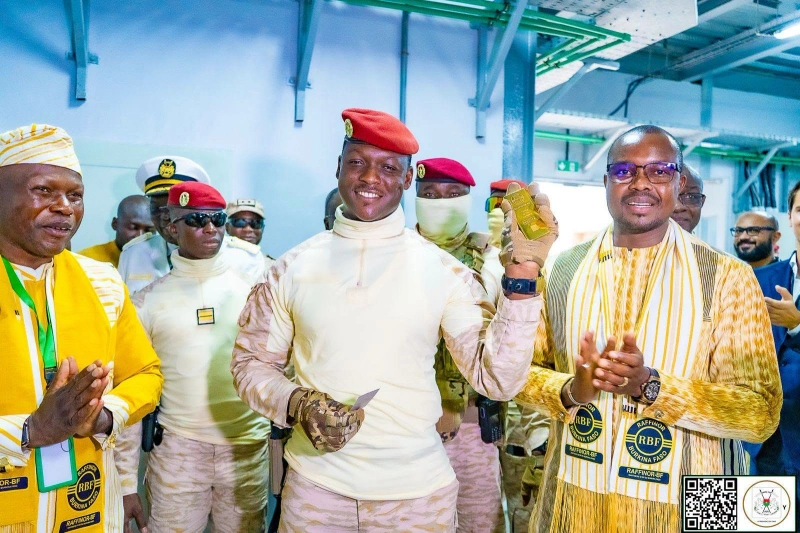

The new Burkina Faso gold refinery can process 164 tonnes of gold a year.
Captain Ibrahim Traoré inaugurated the plant, known as Raffinor-BF, on 28 September 2026. The presidency described the launch as “a historic step” in the country’s drive for economic sovereignty and industrial transformation.
For decades, most Burkinabe gold was refined abroad, meaning a significant portion of the value generated by the country’s largest export left its borders.
“We want to have the entire value chain here.”
— Captain Ibrahim Traoré
The Burkina Faso gold refinery is designed to change that.
Mines Minister Yacouba Gouba said the state financed the project through the National Precious Substances Company (SONASP) alongside private partners. Premium Times reported that the refinery cost more than $19 million.
Gouba said the Burkina Faso gold refinery will process doré, the semi-pure gold produced by mines, into bars with a purity level of 99.9 per cent. He added that authorities intend to expand capacity to 515 tonnes in the coming years. Official projections indicate the facility will create about 100 direct jobs and 5,000 indirect jobs.
The refinery is being launched at a time when Burkina Faso’s gold sector continues to expand. According to the World Bank, the country produced 94 tonnes of gold in 2025, up from 61 tonnes in 2024. Government figures show industrial mines accounted for 51.55 tonnes while SONASP purchased more than 42 tonnes from artisanal miners.
Production remained strong during the first half of 2026. Industrial mines produced 26 tonnes, while SONASP bought about 29 tonnes from small-scale miners, according to the ministry’s mid-year review of Gouba’s performance contract. SONASP has set a target of purchasing 45 tonnes from artisanal miners by the end of the year.
Current production levels suggest the refinery will have access to substantial domestic supply from the outset. The government, however, sees the Burkina Faso gold refinery as more than a national facility. Officials have repeatedly signalled ambitions for the refinery to serve as a regional hub capable of processing gold from neighbouring countries as economic integration deepens across the Alliance of Sahel States.
The Bigger Challenge May Not Be Volume but Sourcing
During the first half of 2026, SONASP purchased more gold from artisanal miners than the industrial mines produced. That highlights the growing importance of the small-scale sector in feeding the formal market.
The progress is notable, but it also exposes a persistent vulnerability. Premium Times reported that authorities continue to struggle with illicit mining networks, smuggling and insecurity in some gold-producing areas. The government has previously linked illegally traded gold to the financing of armed Islamist groups operating in parts of the country.
“The success of the Burkina Faso gold refinery will depend not only on refining capacity but also on the state’s ability to channel more artisanal production into formal supply chains.”
The government hopes to position the Burkina Faso gold refinery as a destination for gold from across West Africa, but neighbouring countries are developing similar ambitions. Ecofin Agency reports that Guinea already operates the Nimba refinery, while Côte d’Ivoire plans to commission a refinery with an annual capacity of around 100 tonnes by the end of the first half of 2027. Ghana is also pursuing policies aimed at refining more of its small-scale gold production domestically.
Traceability is becoming increasingly important as major gold markets tighten sourcing requirements. Ecofin says the London Bullion Market Association is preparing stricter guidance aimed at improving supply-chain transparency, with final rules expected in December 2026 and implementation beginning in 2027. For the Burkina Faso gold refinery, the ability to verify the origin of gold could become a competitive advantage if it seeks international recognition and access to global markets.
Coverage of the launch did not indicate whether the refinery has applied for accreditation through the London Bullion Market Association, a status widely regarded as important for international market access.
The refinery is part of a broader state-led transformation of Burkina Faso’s mining sector since Traoré seized power in September 2022.
Premium Times reported that the government has increased its stake in mining projects from 10 per cent to 15 per cent and established a national gold reserve.
The state mining company, Sopamib, assumed control of the Boungou and Wahgnion mines in 2024. According to Ecofin, the company now controls three industrial mines. Before 2022, only one industrial mine in Burkina Faso was operated by a Burkinabe company. By the end of 2025, six of the country’s 15 industrial mines were majority Burkinabe-owned.
In May, the government established a sovereign mining fund known as Siniyan-Sigui. Finance Minister Aboubakar Nacanabo said the fund will be financed by revenues generated when mineral prices exceed official government benchmarks, with the first investments expected from 2027.
The industrialisation strategy extends beyond mining. Authorities recently inaugurated the $30 million TEXFORCES-BF textile factory, which officials say can process more than 12 tonnes of raw cotton fibre daily. Like the Burkina Faso gold refinery, the project is intended to retain more value from domestic raw materials within the national economy.
Supporters view the Burkina Faso gold refinery as an important step towards capturing more value from the country’s most important export and reducing dependence on foreign processing facilities.
Construction began in late November 2023. The Burkina Faso gold refinery is now complete.
“Its long-term success will depend on whether it can secure reliable supplies, meet international standards and establish itself as a credible refining centre for Burkina Faso and the wider region.”


