



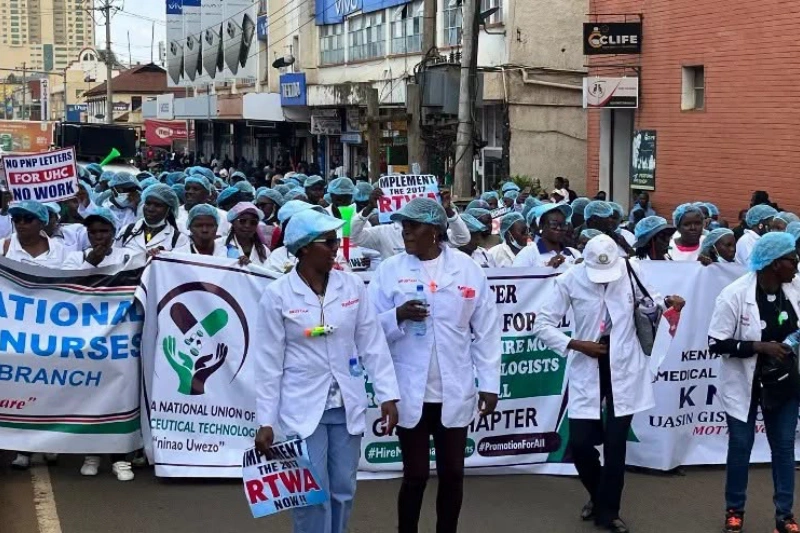

Kenya’s public hospitals remain under severe strain. The Kenya nurses strike stretched into its 30th day on Wednesday. Unions and the Council of Governors are still far from a resolution.
Nurses and midwives under the Kenya National Union of Nurses and Midwives have refused to return to their stations. They insist county governments have reneged on agreements reached over several years. That position was confirmed in The Standard’s Tuesday reporting on the standoff.
At the centre of the Kenya nurses strike are four demands. Union leaders say all remain unaddressed. These include the long delayed implementation of the 2017 return to work formula. They also want the rollout of career progression guidelines already approved by the Public Service Commission. Nurses want the conversion of Universal Health Coverage staff to permanent and pensionable terms too. On top of that, they are demanding full honouring of the 2025 to 2029 collective bargaining agreement.
Kenya National Union of Nurses Secretary General Seth Panyako has remained defiant throughout the strike. He has rejected a court order from the Employment and Labour Relations Court in Mombasa that directed health workers to resume duty. Speaking at a briefing, he said nurses were prepared to face legal consequences rather than abandon their demands.
Panyako argues that other cadres who took part in the 2017 labour dispute have since had their arrears settled. Clinical officers are among those he cites. He accuses the Salaries and Remuneration Commission and the Council of Governors of stalling progress on nurses’ issues, calling the delay deliberate. Other unions, he says, resolved similar issues years ago.
The Universal Health Coverage staff transition sits at the heart of the Kenya nurses strike. Thousands of nurses hired under the UHC programme have payslips indicating permanent and pensionable status. Yet many have never received formal appointment letters. Those letters would confirm whether they fall under national or county government payrolls. That uncertainty has left workers without clarity over pensions, promotions or job security. It has hardened positions on both sides of the dispute.
Devolution has added another layer of friction to the Kenya nurses strike. Kenya’s 47 counties employ health workers independently. Negotiations require buy in from each county government rather than a single national settlement. Some counties have moved to sign return to work agreements. Others have held back, citing budget constraints.
The Council of Governors insists it cannot make binding financial commitments without confirmed funding from the national treasury. Unions say that position has been used to delay action indefinitely.
Court intervention has done little to end the Kenya nurses strike. Judges have twice ordered striking health workers back to their posts. They cite the workers’ status as essential service providers under the Labour Relations Act. Nurses have defied both rulings. They argue that returning to work without firm commitments would simply repeat a cycle of broken promises stretching back to 2017.
The consequences of the Kenya nurses strike for patients have been severe. Blood transfusion services have been disrupted in several counties. Surgeries have been postponed and routine consultations delayed. Kenyatta National Hospital, the country’s largest referral facility, has urged patients with non urgent conditions to seek care elsewhere. It has directed them to private or faith based clinics as it struggles with rising caseloads and thin nursing staff.
The strike has also exposed strain in Kenya’s devolved healthcare financing model. Counties reportedly owe billions of shillings in unpaid obligations. That complicates efforts to guarantee the funding nurses are demanding. Health sector analysts warn that disputes like the Kenya nurses strike could recur. That risk stands even after this one ends, unless the national government steps in with a clear financing framework.
For now, union leaders maintain there will be no return to work until every outstanding demand is addressed in writing. Government officials continue to describe the process as underway. Nurses say that is language they no longer trust after years of unfulfilled assurances. With hospitals across Kenya still operating below capacity, the coming days are likely to determine whether dialogue can finally end the Kenya nurses strike, one of the country’s longest health worker walkouts in recent memory.


