



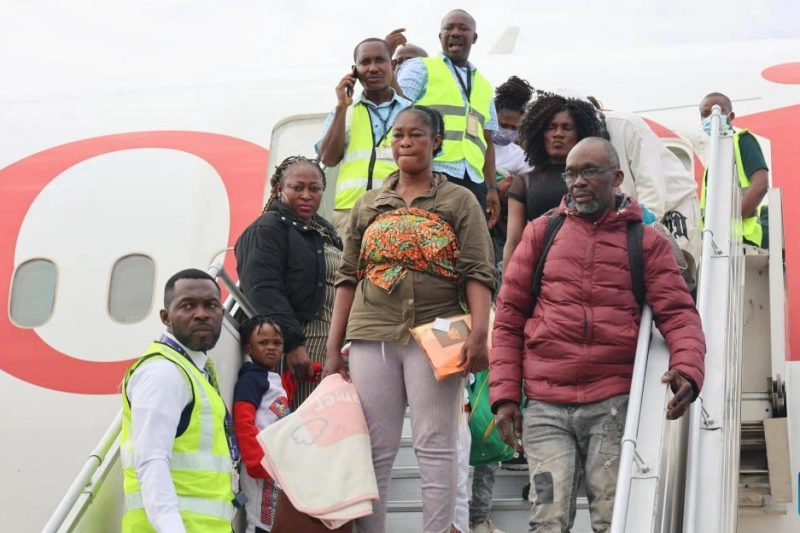

Ghana has begun flying its citizens home. Malawi is arranging its own departures. And across the continent, governments that once quietly tolerated the risks their nationals faced in South Africa are now saying enough. Xenophobia in South Africa has become too visible, and too deadly, to manage through diplomatic silence.
In April and May 2026, a citizen-led movement known as March and March organised demonstrations against undocumented migrants in Pretoria, Johannesburg, and Durban, with violent and sometimes fatal results.
A 43-year-old Cameroonian shop owner in Durban, who had lived in South Africa for nearly 20 years, described how people he believed to be affiliated with the movement attacked him during protests on 17 April. “They whipped me and my three colleagues who are not South African with golf sticks and sjamboks, and sprayed pepper spray on us,” he said. “They also used stun guns on us.”
Human Rights Watch, which documented the account, said the police response to attacks arising from xenophobia in South Africa was insufficient.
Governments begin pulling their people out
Ghana evacuated around 300 of its citizens from South Africa, with authorities processing applications from over 1,500 more nationals for subsequent flights.
The Ghanaian government described the intervention as one of the country’s most comprehensive diaspora protection measures in recent years, providing financial assistance, evacuation support, reintegration allowances, and psychological care for those choosing to leave.
Malawi moved in the same direction. The Ministry of Foreign Affairs in Lilongwe said it had begun diplomatic and consular steps to support affected nationals, working through the Malawian High Commission in Pretoria and the Consulate General in Johannesburg.
For both governments, organising flights to remove their citizens from a fellow African Union member state was itself a political statement.
Pretoria faces a formal diplomatic reckoning
Nigerian Foreign Minister Bianca Odumegwu-Ojukwe called her South African counterpart Ronald Lamola to discuss accusations of violence against Nigerians, including the deaths of two Nigerian nationals in incidents involving South African security personnel.
Ghana formally lobbied the African Union to intervene, arguing that xenophobia in South Africa posed a serious threat to continental unity and regional cooperation. Nigeria’s House of Representatives condemned the attacks and proposed economic sanctions.
Ghana’s formal request asked the AU Commission to place xenophobia in South Africa on the agenda of the Eighth AU Mid-Year Coordination Meeting, scheduled for 24 to 27 June 2026 in Cairo.
Pretoria pushed back hard. South Africa denied reports of the killings of African foreigners by its security services, stating that “there is no credible evidence to draw this conclusion at this stage.”
President Cyril Ramaphosa, speaking on Freedom Day on 27 April 2026, acknowledged the debt owed to neighbouring states, saying: “We did not walk alone into freedom. We were carried by a tide of solidarity from the nations of Africa.”
For Accra and Abuja, however, words of solidarity no longer carried the same weight as chartered flights out.
Mozambique’s Prime Minister Maria Benwinda Levy stated plainly: “We strongly condemn and reject these acts. They contradict the values of SADC and pan-African solidarity.”
Xenophobia in South Africa Triggers Continent-Wide Backlash Against Major Brands
Xenophobia in South Africa carries a specific commercial danger that Pretoria cannot afford to dismiss: its largest corporations are deeply embedded across the continent.
South African businesses with major continental operations, including MTN and Standard Bank, face growing risk of retaliatory action as the story gains global attention.
Nigeria’s National Association of Nigerian Students mobilised members for demonstrations targeting MTN Nigeria and MultiChoice Group in direct response to attacks on Nigerian nationals.
This pattern has played out before. During the 2019 wave of violence, Shoprite outlets and MTN branches were invaded by mobs in Lekki, Jakande, and Surulere in Lagos, with properties looted and destroyed.
When South African multinationals absorb hits across the continent, it registers on the Johannesburg Stock Exchange and weakens the rand by raising the country’s geopolitical risk premium.
The money that stops moving
Xenophobia in South Africa severs something more personal than trade agreements: the regular financial transfers that sustain households across the region.
Zimbabwe received approximately 37 per cent of its remittance inflows from South Africa in 2021, a country that hosts over 690,000 Zimbabwean migrants.
For decades, the Ghanaian diaspora in South Africa sent home millions of dollars annually, directly funding real estate, family healthcare, and school fees in Greater Accra and Ashanti.
When a Zimbabwean miner or a Malawian trader is forced to board a repatriation flight, the monthly transfer that kept his family fed back home stops with him. South Africa hosts over 690,000 Zimbabwean migrants, and in 2021 alone, approximately 37 per cent of Zimbabwe’s remittance inflows came from South Africa. Those are not statistics that absorb disruption easily.
For families in Blantyre or Harare already living without much margin, the sudden return of a breadwinner who left empty-handed is not a reunion. It is a financial emergency.
A cycle with no easy exit
The crisis threatens to erode confidence in regional cooperation frameworks and weaken trust among African states, raising difficult questions about the sincerity of commitments to free movement protocols and continental integration.
The economics are grimly circular. Xenophobia in South Africa is frequently rooted in unemployment and failing public services. Yet the diplomatic isolation, corporate boycotts, and loss of investor confidence that follow only worsen the economic conditions that feed the resentment in the first place.
Major occurrences of this violence were in 2008, 2015, 2019, and 2021 to 2022. Analysts say the pattern points to a structural failure rather than isolated incidents.
The evacuation flights departing from Accra and Lilongwe are more than rescue missions. They are a visible measure of how deeply xenophobia in South Africa has damaged the trust that regional trade, diplomacy, and the promise of African unity all depend upon.


