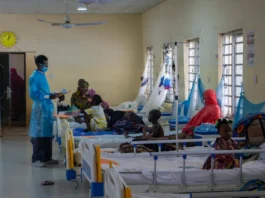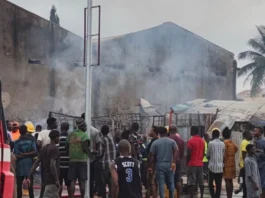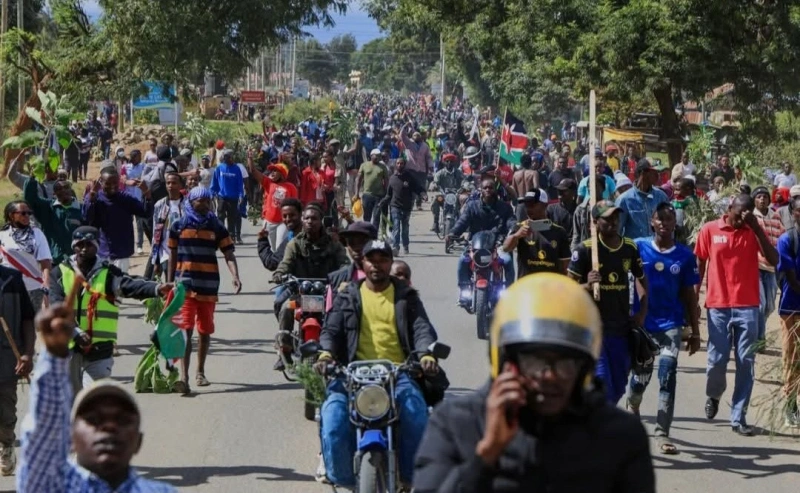
Two people are dead on the streets of Nanyuki after protests over the proposed Kenya Ebola quarantine facility. Hundreds have faced riot police. A court has blocked the plans twice. And President William Ruto’s response to all of it was: “We know what we are doing. People should relax.”
The people of Nanyuki are not overreacting. Their anger is grounded in something real, and it goes far deeper than the science of virus transmission.
The question nobody in power has answered
Dr Davji Bhimji Atellah, secretary-general of the Kenya Medical Practitioners, Pharmacists and Dentists Union, put the central question plainly: “If the United States believes the 12-hour medevac flight back to Washington is too dangerous for its citizens, by what logic is it safe to fly infected or exposed individuals into Kenyan airspace and drop them in Laikipia?”
US Secretary of State Marco Rubio publicly stated that the US “cannot and will not allow any cases of Ebola to enter” the country. Law Society of Kenya President Charles Kanjama pointed directly at those words. “If America, a first-world country, is apprehensive about the health and safety of their citizens,” he said, “we’re asking the Kenyan government to have the same standard as the American government does.”
Nobody in the Kenyan government has answered that question. That silence is itself an answer.
The controversy surrounding the Kenya Ebola quarantine facility has become less about medical science and more about transparency, sovereignty and public trust.
Kenya Ebola quarantine facility: A deal signed in secret
Dr Atellah, who leads the union representing more than 10,000 doctors in public and private hospitals, told CNN the government owed Kenyans a full explanation: “We need total transparency from the Kenyan government on why they agreed to take up this offer.
The Kenya Medical Practitioners, Pharmacists and Dentists Union issued three non-negotiable demands: the government must publish the full bilateral text of the agreement and explain why Kenya was chosen; it must explain how it is prioritising a foreign biohazard facility while public hospitals cannot afford basic supplies; and if the facility proceeds, it must be used as leverage to permanently employ thousands of unemployed Kenyan doctors and nurses, fully funded by the state and its international partners.
Those demands remain unmet.
“A containment colony”
A protester in Nanyuki, Malin Ndegwa, asked the question that was on everyone’s lips: “Why are they not doing it in the DRC? Why are they not doing it in Uganda? Why must they bring it here?”
We will not sit back and watch Kenya be treated as a containment colony for a lethal pathogen that we did not generate,” Dr Atellah said. “If it is too dangerous for America, it is too dangerous for Kenya.”
That phrase, containment colony, landed hard because it names something Kenyans recognised. The Kenya Ebola quarantine facility was not proposed by Kenya. It was requested by Washington, approved quietly by Ruto, and announced to Kenyans as a fait accompli.
Ruto said Trump asked. That is the problem.
President Ruto did not deny the terms of the arrangement. He confirmed them. “When President Trump asked the government of Kenya to support them by having a center at Laikipia Air Base,” he said, “I gave the OK because it was an agreement and a partnership with friends who have worked with Kenya for 30 to 40 years.”
He was asked. He said yes. The Kenyan public was not consulted.
Al Jazeera’s Catherine Wambua-Soi, reporting from Nairobi, said the Katiba Institute told the court the deal between the US and Kenya was not transparent at all, a position supported by the Law Society of Kenya and the main doctors’ union at the same hearing.
What the science says, and why it is not the point
Ebola does not spread through the air. The US Centers for Disease Control confirms that a person infected with the Bundibugyo virus is not considered contagious until after symptoms appear. The people proposed for this facility are asymptomatic. Under a properly run quarantine, a community member outside the base gates faces no meaningful risk of infection.
Supporters of the Kenya Ebola quarantine facility argue that these scientific realities should reassure the public and demonstrate that the project can be operated safely.
But here is why that fact does not settle the argument.
Médecins Sans Frontières has noted that in the absence of approved treatments or vaccines for the Bundibugyo strain, the entire response depends on early isolation, daily contact monitoring over 21 days, strict infection prevention protocols and safe burials. Any failure in those systems carries serious consequences.
The debate over the Kenya Ebola quarantine facility is therefore not only about the biology of the virus. It is also about whether citizens trust the institutions responsible for managing that risk.
The people of Nanyuki are being asked to trust that those systems will hold. They are being asked to trust a government that did not tell them the Kenya Ebola quarantine facility was being built until planes were already landing.
They are being asked to trust a deal whose terms have not been published. They are being asked to trust a health ministry that, as their own doctors’ union pointed out, cannot currently stock basic supplies in public hospitals.
That is not irrational fear. That is a reasonable demand for accountability.
The workers inside the Kenya Ebola quarantine facility
Laikipia Governor Joshua Irungu raised a specific concern that the science cannot dismiss. “This will expose our people to Ebola,” he told journalists, pointing out that many local residents work inside the air base and would be in daily proximity to the facility.
Those workers are not the general public passing on a street. They are cleaners, drivers, caterers and security staff. The question of whether they will be trained, protected and compensated for that elevated exposure has not been addressed publicly by either government.
The real fear is not the virus. It is being disposable.
The Nanyuki protesters understand Ebola biology well enough. What they are expressing is something older and more political: the fear of being treated as a place where powerful countries deposit their problems.
The Kenya Medical Practitioners, Pharmacists and Dentists Union put it directly: “Kenya is a sovereign republic, not a geopolitical isolation ward.”
Two people have been killed amid opposition to the Kenya Ebola quarantine facility and the questions it has raised about accountability and national sovereignty. A court has twice agreed the public interest demands answers.
The governments in Nairobi and Washington owe those answers not as a courtesy, but as a condition of any arrangement that asks ordinary Kenyans to bear a risk that Americans are legally protected from taking home.