



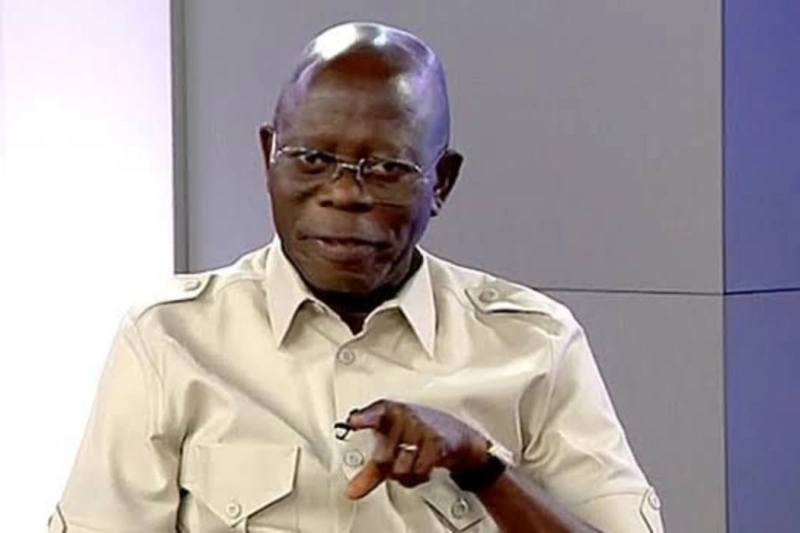

Senator Adams Oshiomhole has urged the Federal Government to appropriate the profits of South African companies in Nigeria and channel the money towards compensating Nigerians affected by the recent wave of xenophobic violence in South Africa.
The Edo North lawmaker raised the proposal during Tuesday’s Senate plenary, reacting to comments by South Africa’s Minister in the Presidency, Khumbudzo Ntshavheni, who had ruled out government compensation for affected Nigerians. Ntshavheni had argued that only legally registered properties qualified for compensation, adding that informal settlements did not meet this requirement.
Oshiomhole rejected that position outright. He described the destruction of Nigerian-owned businesses as unjustifiable regardless of registration status. Speaking on the Senate floor, he said the seized profits from South African companies in Nigeria should be used to compensate Nigerians victims of South Africa xenophobic uprisings.
His proposal specifically names the financial sector. He said the government should reciprocate by appropriating profits from South African shares in companies operating in Nigeria, including banks such as Stanbic IBTC. South African firms, including MTN and several banks, hold significant commercial interests in Nigeria, making the country one of their largest markets on the continent, which explains why any move against South African companies in Nigeria would carry real financial weight.
Oshiomhole was not alone in pushing for tougher measures. Senator Abdul Ningi went further, proposing that Nigeria should consider severing diplomatic relations with South Africa if the attacks persist, while Senator Eshilokun Wasiu called for the outright nationalisation of South African businesses in Nigeria. The debate had expanded beyond compensation to whether South African companies in Nigeria should bear economic consequences for attacks carried out on Nigerians abroad.
The Senate leadership pushed back against immediate action. Deputy Senate President Jibrin Barau, who presided over the session, urged restraint and persuaded both senators to withdraw their proposals pending the outcome of a committee investigation. Barau argued that Nigeria should lead by example and only act once the facts were properly established. The Committee on Foreign Affairs was subsequently given two weeks to submit its report on the attacks.
The Senate went on to adopt four resolutions directing the Federal Government, through the Ministry of Foreign Affairs and the Nigerian High Commission in South Africa, to secure written assurances on the safety of Nigerians and to demand prosecution of those responsible for the attacks. It also directed the Foreign Affairs Ministry, the Nigerians in Diaspora Commission and the High Commission to compile a full record of Nigerians who suffered death, injury or displacement.
The resolutions stopped short of proposing sanctions, but they have intensified scrutiny of South African companies in Nigeria and their role in the broader diplomatic dispute.
This is not the first time Oshiomhole has floated the idea of targeting South African companies in Nigeria. In May, he proposed a more radical route, nationalising affected firms before returning them to Nigerian ownership. He argued that the government could nationalise and later re-privatise the companies so that Nigerians would take control, keeping the profits within the country rather than seeing them repatriated to South Africa.
He also claimed, that South African authorities only responded meaningfully after Nigeria applied diplomatic pressure, insisting that President Cyril Ramaphosa condemned the attacks only after Nigeria targeted South African interests.
The backdrop to all this is a deadline that expired weeks ago. An ultimatum reportedly given to Nigerians to leave South Africa by June 30 was enforced by mobs, while the South African government appeared unable to protect innocent people. Several African governments, Nigeria included, have already begun repatriating citizens who no longer feel safe in the country.
Oshiomhole’s proposal is politically potent but legally fraught. Seizing the assets of South African companies in Nigeria, most of which are properly incorporated, tax-compliant and protected under bilateral investment arrangements, would expose Abuja to arbitration claims and could unsettle the wider investor climate that Nigeria has spent years trying to stabilise. It also risks conflating ordinary corporate presence with state responsibility, punishing shareholders and employees for a diplomatic failure that sits squarely with Pretoria.
Yet the appeal of the idea is easy to understand. Nigerians have watched South African officials draw legalistic distinctions between registered and informal properties while people lost homes, shops and, in some cases, their lives.
For many lawmakers, the prominence of South African companies in Nigeria reflects the deep economic ties between the two countries and explains why calls for retaliation continue to gain political traction.
Oshiomhole’s framing taps into a broader frustration that Nigeria’s economic weight on the continent has not translated into diplomatic leverage when its citizens are harmed abroad. Barau’s caution makes sense politically. Confiscating profits from South African companies in Nigeria might satisfy public anger, but it could just as easily unsettle the foreign investors Nigeria still needs to attract.


