



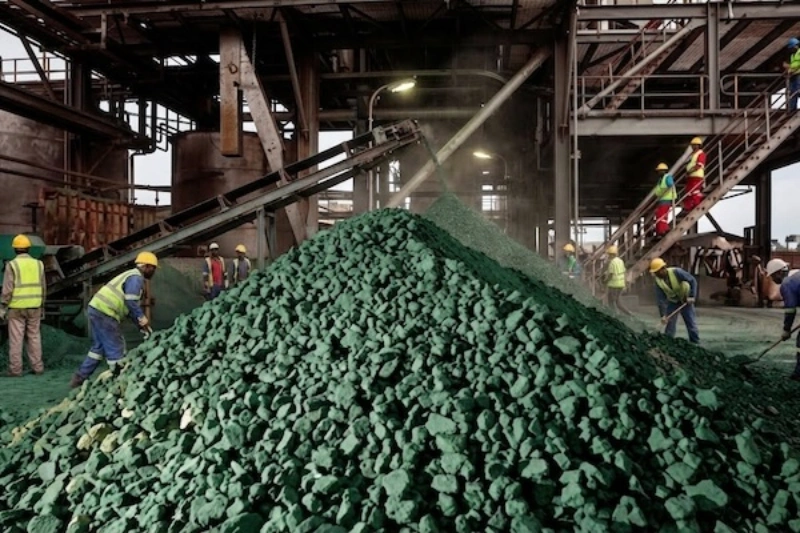

On 29 June 2026, three ministers signed an order imposing a copper export ban along with cobalt concentrates. Mines Minister Louis Kabamba Watum, Foreign Trade Minister Julien Paluku Kahongya and Economy Minister Daniel Mukoko Samba signed the measure, which took effect immediately.
This copper export ban ends a decade of loopholes. It puts Kinshasa’s industrial ambitions to their sharpest test yet.
Concentrate is ore that has been partly processed but not refined into metal. For years, Congolese mining firms shipped it abroad. Most went to Chinese and South African smelters, because local capacity could not absorb the volume.
Kinshasa had tried this before. It banned concentrate exports in 2013, 2019 and 2023, only to hand out waivers each time domestic smelters ran short. The new copper export ban repeals that 2023 order outright. It replaces broad exemptions with a tighter, one year waiver that only the mines minister can approve, and only for projects judged strategically important.
A government order reviewed by Reuters shows the ban began the day it was signed. A companion tax on economically significant mining by-products carries a three month grace period. The message from Kinshasa is blunt. Raw ore stays home, or it does not leave the ground at all.
Congo has leverage most producers can only envy. It supplies roughly seventy per cent of the world’s mined cobalt. It ranks second globally in copper output, behind only Chile.
When Reuters broke the story, markets moved fast. Benchmark three month copper on the London Metal Exchange jumped as much as 1.8 per cent, to 14,369.50 dollars a tonne. That was its highest level since a record peak in January. Traders read the copper export ban as a genuine supply shock, not a bluff.
Yet the numbers suggest the shock may be smaller than the price spike implied. Official trade data for the first quarter of 2026 tell a different story. Congo exported 696,725 tonnes of refined copper cathodes in that period. Concentrate exports were just 53,926 tonnes, containing only 18,863 tonnes of actual copper metal.
Christian-Geraud Neema, a mining analyst with the China-Global South Project, has pointed to this gap. He argues the ban will do little to most operators, because the bulk of Congolese copper and cobalt is already refined inside the country before it reaches a port. If he is right, the copper export ban mostly formalises what the market had already done. It mainly closes the door on smaller producers still shipping raw ore.
The harder question sits underground, quite literally. Can a copper export ban conjure a processing industry where the electricity to run one barely exists?
Congo’s national grid, run by state utility SNEL, has installed capacity of around 2,800 megawatts. Yet it meets only about 40 per cent of demand in the Katanga mining belt, according to industry data compiled by Shanghai Metals Market. In Haut Katanga and Lualaba, the provinces holding most of the copper, installed capacity of roughly 567 megawatts sits against demand near 900 megawatts. Mining alone accounts for 600 of that. Diesel generators fill the gap, at a cost most smelters would rather not carry.
Congo is not starting from zero, though. The Kamoa-Kakula smelter, built by Ivanhoe Mines and China’s Zijin Mining, already produces copper anodes. Its designed capacity runs to 500,000 tonnes a year, giving the copper export ban a working example rather than a promise on paper. Lloyds Metals and Energy, an Indian company that bought the Chemaf group in March 2026, started commercial cathode output from a smaller 12,000 tonne plant that same month.
Both projects prove in-country smelting is possible. Neither proves it can scale fast enough to absorb everything the copper export ban now traps inside Congo’s borders.
Fixing the power problem will take far longer than signing an order. The World Bank approved a billion dollar phased programme in 2025 for the long-stalled Inga hydropower scheme. It could eventually add between two and eleven gigawatts, but construction is expected to run most of a decade. Meanwhile, Congo is negotiating a stake in a 270 million dollar transmission line from Zambia’s Kalumbila copper belt to Kolwezi. It is designed to carry up to 550 megawatts once built, part of a wider infrastructure push funded by a 1.25 billion dollar eurobond raised earlier this year.
Indonesia offers the template Kinshasa is clearly borrowing from. Jakarta’s 2020 ban on raw nickel ore exports pulled in an estimated 30 billion dollars of Chinese smelter investment within a single year. It lifted the country’s share of global nickel mine production from under six per cent in 2014 to more than half by 2024.
The European Union challenged that ban at the World Trade Organisation, and won the case. Yet the ruling changed nothing on the ground, because the smelters had already been built by then. Congo’s copper export ban is betting on the same outcome. No legal setback can unbuild a factory once the capital has gone into it.
The comparison has limits, though. Indonesia gave its industry years of advance warning before the strictest rules bit. Even so, its smelters still needed three to five years to reach meaningful scale. Congo’s ban arrived overnight, in a country where power shortages, not policy uncertainty, have been the real constraint on processing for over a decade.
Whether the copper export ban succeeds may depend less on how firmly Kinshasa enforces it. It may depend more on how quickly the lights stay on in Kolwezi.


