



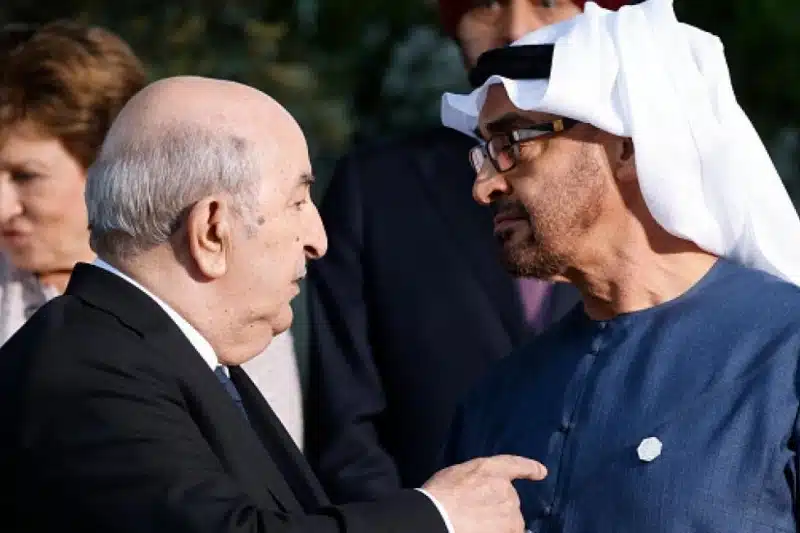

Algiers did not ease into this one. It went straight to the ambassador’s door. It gave him forty-eight hours to pack his bags.
On 10 September, Algeria’s Foreign Ministry announced it was cutting diplomatic relations with the United Arab Emirates. The Algeria-UAE diplomatic break ended a partnership that had been fraying in public for more than a year.
It did not arrive out of nowhere. It was the final step in a longer sequence. That sequence began in January 2025, when a newspaper close to the Algerian presidency first accused Abu Dhabi of financing a separatist movement inside Algeria’s own borders.
That accusation sits at the heart of the Algeria-UAE diplomatic break. Algerian state media alleged that Emirati officials had made contact with the Movement for the Self-Determination of Kabylie, known by its French acronym MAK.
Algiers classifies the group as a terrorist organisation. Ferhat Mehenni, the Kabyle separatist leader, has run the movement in exile from France for years. He campaigns for self-rule in the mainly Berber region east of Algiers.
Algeria has not published evidence to support the funding claim. The Foreign Ministry’s statement, carried by state media, referred only to “provocative and hostile actions” and “regrettable and unjustified conduct” from the Emirati side. It named no specific incident.
The mechanics of the Algeria-UAE diplomatic break moved fast once the political decision was made. The UAE ambassador in Algiers, Yousef Saif Khamis Al-Ali, was summoned and told he had forty-eight hours to leave.
A day later, on 11 September, Algeria’s Defence Ministry shut the country’s airspace to all UAE-registered civilian and military aircraft from midnight.
Commercial passenger flights were spared. They stay exempt until the end of 2026, when the existing bilateral air services contract runs out.
Algeria had, in fact, already begun unwinding that 2013 agreement back in February.
That detail alone suggests this Algeria-UAE diplomatic break was planned well in advance, not decided overnight. It is worth holding onto as the wider picture unfolds.
Here is where the real story behind the Algeria-UAE diplomatic break sits, underneath the headline. The MAK allegation is the trigger Algiers chose to pull. It is not the whole quarrel.
Algeria and the UAE have never been close, and the deeper argument runs through three older fault lines.
The first is Western Sahara. The UAE backs Morocco’s claim to sovereignty there. It opened a consulate in the disputed territory of Laayoune in 2020. Algeria, meanwhile, continues to back the Polisario Front’s push for Sahrawi self-determination.
The second is Israel. Algeria remains firmly opposed to normalisation. The UAE’s leadership of the 2020 Abraham Accords has long irritated Algiers, especially its push to bring other Arab states, including Morocco, into the fold.
The third is influence across Africa itself. Algeria accuses the UAE of backing Khalifa Haftar’s forces in eastern Libya, a rival to the Tripoli government Algeria supports. It also accuses Abu Dhabi of building funding networks across the Sahel, Mali and Sudan.
President Abdelmadjid Tebboune had been signalling this for months without naming names.
In October 2025 he described Algeria’s ties with Saudi Arabia, Kuwait, Oman and Qatar as brotherly. Of one unnamed Gulf state, he added something pointed. Relations, he said, would have been severed long ago were it not for a wish to avoid deepening divisions in the Arab world.
He has also called the UAE a “micro-state” seeking to destabilise the wider region. Nobody in Algiers needed the country’s name spelled out.
The obvious question is why the Algeria-UAE diplomatic break happened now, when most of these grievances are years old.
Part of the answer looks regional rather than bilateral.
Algeria severed ties with Morocco in August 2021 using an almost identical script. It accused Rabat of backing the same MAK movement shortly after Morocco normalised relations with Israel.
The current rupture follows that precedent closely. It points to a pattern in Tebboune’s foreign policy. When Algiers judges that a rival state is meddling, or is seen to be doing so, in Kabylie, the diplomatic relationship becomes expendable.
What makes the Algeria-UAE diplomatic break worth watching is the contrast in tone on either side.
Algeria’s language was sharp, citing exhausted patience and grave consequences.
The UAE’s response, delivered within hours, was gentle by comparison. Abu Dhabi’s Foreign Ministry said it hoped the decision would prove temporary. It stressed its appreciation for the “brotherly Algerian people”, pointing to the tens of thousands of Algerians living and working in the Emirates.
Officials said they would remain welcome regardless of the political rift.
Anwar Gargash, diplomatic adviser to the UAE president, went further in a public post. He suggested that diplomacy needs rationality, communication and clarity.
It read as an indirect jab at Algiers, for relying, in his view, on vague insinuations rather than direct engagement.
As of 12 September, the UAE had not answered the Algeria-UAE diplomatic break with any retaliatory step of its own.
That asymmetry, fury from Algiers and restraint from Abu Dhabi, tells its own story about who has more riding on the relationship staying salvageable.
The UAE has spent years deepening its economic footprint across Africa. A permanent rupture with a major North African hydrocarbon producer sits awkwardly against that ambition.
Algeria, in the same period, has drawn closer to Russia as its principal arms supplier and expanded military ties with Iran. That gives Algiers less to lose from walking away than Abu Dhabi has.
For now, the airspace stays shut to Emirati military and cargo aircraft. The ambassador is gone.
The passenger flights that keep families and workers moving between the two countries are the one thread Algiers chose not to cut.
Whether that thread holds may say more about the Algeria-UAE diplomatic break’s real staying power than any statement either government issues next.


