



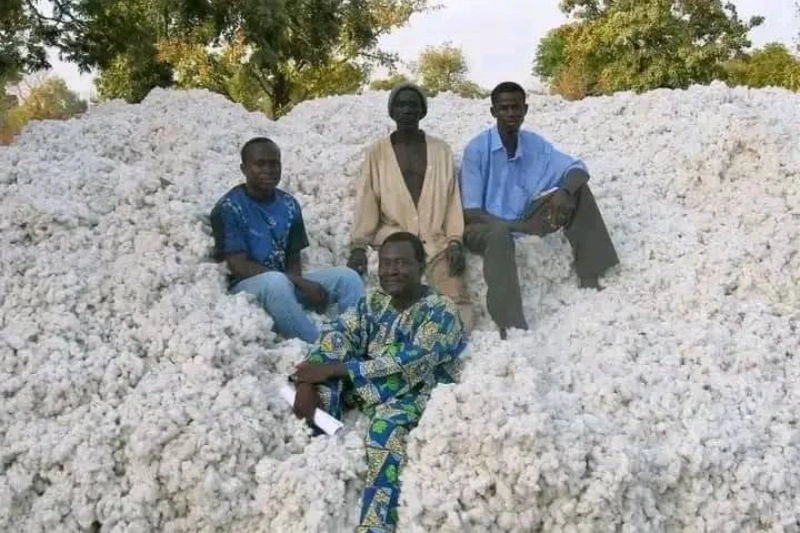

Côte d’Ivoire has signed a new industrial agreement with China to speed up Ivorian cotton processing, as the West African nation tries to keep more value from its cotton harvest at home.
The deal was signed on Tuesday 25 August in Shanghai, on the sidelines of the Intertextile Shanghai trade fair. Côte d’Ivoire’s Cotton, Cashew and Shea Council, known as CCA-K, agreed the partnership with the textile and apparel chamber of the China Council for the Promotion of International Trade, or CCPIT-TEX, aiming to give Ivorian cotton processing new momentum.
CEPICI, the country’s investment promotion agency, took part in the ceremony. Its director general, Solange Amichia, attended alongside CCA director general Mamadou Berté, who signed the agreement. CCA board chairman Jérôme Kouassi Ehui backed the move.
The agreement is meant to open the door to more trade, technology transfer, training and capacity building between the two countries in textiles and apparel, according to a CCA-K statement.
Ivorian cotton processing has lagged behind the country’s raw cotton output for years. More than 90% of Ivorian cotton still leaves the country unprocessed, mostly bound for Asian buyers, according to the latest data cited by CEPICI in 2026.
The country’s spinning and weaving plants have a combined capacity of just 26,000 tonnes a year. Two finishing firms add a combined 35 million metres of fabric annually, a modest base for expanding Ivorian cotton processing nationwide.
Government officials had once hoped to lift processed cotton fibre’s share of output to 40% by 2025, up from 11.49% in 2020. No recent official figures show how close the country came to that target, and the persistent gap in Ivorian cotton processing capacity suggests the goal was not met in full.
China is a natural partner for this push. It is the world’s largest exporter of textiles and apparel, with a value chain that spans spinning, weaving, garment making and industrial machinery. Domestic content made up 89.1% of China’s textile and apparel exports in 2022, according to World Trade Organization estimates, and Chinese firms account for more than 40% of the value added in global textile and apparel trade.
Abidjan wants more than Chinese money. Officials are looking for technology transfer and industrial know how that can strengthen the weakest links in Ivorian cotton processing, from spinning to finished fabric.
The push fits into the government’s National Development Plan for 2026 to 2030, which places industrialisation and local processing of raw materials among its priorities. The state has set aside 1,069 hectares of land for integrated agro industrial textile parks meant to house new spinning and finishing units.
Côte d’Ivoire’s ambassador to China, Abou Dosso, has been tasked with following up on the agreement and helping bring in Asian investors. Experts from the Tony Blair Institute are also supporting the country’s push in Shanghai.
Cotton remains a major crop for Côte d’Ivoire. The country ranks fourth among Africa’s cotton producers for the 2025 to 2026 season, with a harvest of 310,407 tonnes of seed cotton, and it ranks third on the continent for yield, though only a fraction of that harvest passes through Ivorian cotton processing before leaving the country.
Export volumes are still rising. The United States Department of Agriculture forecasts Ivorian cotton fibre exports will reach 610,000 bales in the 2026/27 marketing year, up nearly 10% from an estimated 555,000 bales the year before. More than 95% of the country’s cotton lint is shipped abroad, largely to Bangladesh, India, Pakistan and Vietnam.
Domestic cotton fibre use tells a different story. It is expected to stay flat at just 10,000 bales, a figure that reflects how little of the crop is processed at home and why officials keep returning to the question of Ivorian cotton processing capacity.
For now, the Shanghai agreement is a framework rather than a finished factory. Whether it turns into new spinning mills and finishing plants on Ivorian soil will depend on how quickly Chinese investors move and how far Abidjan can turn diplomatic goodwill into signed industrial projects.


