



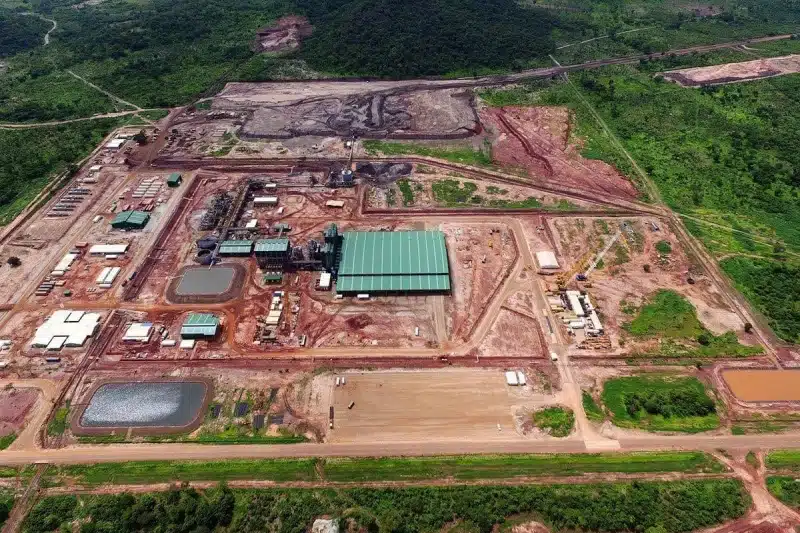

A truck loaded with raw lithium concentrate used to roll freely across Zimbabwe’s border posts. On 25 February 2026, that changed within hours.
Mines minister Polite Kambamura ordered every export of raw minerals and lithium concentrate stopped immediately. Even consignments already in transit were turned back. The decision marked Zimbabwe’s bold shift towards critical minerals processing rather than raw materials exports.
That single order captures a shift now under way in more than a dozen African capitals. Governments are done watching foreign refineries collect the profit while local mines collect the dust.
The real question is not whether Africa wants critical minerals processing on its own soil. It is whether these countries can build critical minerals processing capacity fast enough to matter.
Zimbabwe’s move did not appear from nowhere. The country first required licences for raw lithium exports in 2022.
It banned lithium concentrate specifically in June 2025, with the rule due to bite in January 2027. February’s ban simply brought that deadline forward.
Miners without local processing partners were caught in the worst position. A follow-up letter from the mines ministry in April softened the blanket ban into a quota system.
That system permits limited concentrate exports, but only from companies committed to building domestic critical minerals processing capacity at home.
The pattern of pushing critical minerals processing onto home soil repeats across the continent with small variations. Namibia’s Mineral Beneficiation Strategy, launched in June 2023, already bars the export of unprocessed lithium, cobalt, manganese, graphite and rare earths.
Full implementation is targeted for 2030. Tanzania banned unprocessed lithium exports in 2024, closing a loophole that let firms label raw ore as semi-processed to dodge the rule.
Malawi’s president imposed a freeze on new mining licences in February 2026 while auditing how existing licences for uranium and graphite were granted. Guinea has tightened control over bauxite.
The Democratic Republic of Congo capped cobalt exports at 96,600 tonnes for 2026 and 2027, another bet that a tighter tap will finally force critical minerals processing investment at home. That is roughly half the volume it shipped in 2024.
Numbers explain why governments are moving so fast on critical minerals processing. According to OECD figures cited by the Indepth Research Institute, Africa exported close to 266 billion dollars in raw and semi-processed minerals in 2023 alone.
Only 24 per cent of that total was fully raw. The remaining 72 per cent left as ores and concentrates, with the real value still waiting to be added somewhere else.
A continent holding roughly 30 per cent of the world’s mineral reserves keeps collecting only around 10 per cent of global mining revenue. That gap is one finance ministers can no longer explain away as geology.
Here is where the contrast sharpens. Export bans photograph well, and a minister signing an order projects instant control.
Building a smelter, a refinery or a stable power grid to run one takes years. It also takes billions of dollars and partners willing to commit capital before a single tonne of processed metal ever ships out.
Analysts tracking the Zimbabwe ban for the Bloomsbury Intelligence and Security Institute note that the measure interrupted supply without eliminating it. Buyers scrambled for the volumes still allowed, while producers weighed whether to sell raw ore now or gamble on domestic beneficiation later.
That gamble is precisely where the tension sits. A government can ban an export overnight, but it cannot conjure reliable electricity or trained metallurgists on the same timetable.
Mining analysts have already warned that restrictions imposed without matching investment in energy infrastructure risk starving the very critical minerals processing industries they were meant to grow. Warehouses fill with unsold ore while promised factory jobs never arrive.
Nigeria’s minister of solid minerals development, Dele Alake, chairs the Africa Minerals Strategy Group. He has made that warning his central argument.
Speaking ahead of a high-level roundtable held alongside the United Nations General Assembly in New York on 21 September 2026, he cautioned that fragmented national bans cannot deliver transformation by themselves.
His case is simple. Thirteen separate country decisions on critical minerals processing, however assertive, add up to less bargaining power than one coordinated African position on shared processing hubs, transport corridors and common regulatory standards.
That is the real story behind the wave of bans making headlines this year. It is not simply that African governments have grown bolder about critical minerals processing.
It is that they are testing, mine by mine and port by port, whether unilateral restriction alone can force critical minerals processing into existence. The alternative is that only continental coordination, the kind AMSG is pushing, can turn scattered national orders into an industry that actually pays workers and fills treasuries.
Zimbabwe’s producers now have until the ministry’s next review to prove they can meet the quota terms. The DRC’s cobalt cap runs through 2027, and Namibia’s 2030 target is still four years away.
Every one of those clocks is now running. The answer to whether Africa keeps its minerals, or merely stops selling them cheap, will be written long before any of them expire.


