



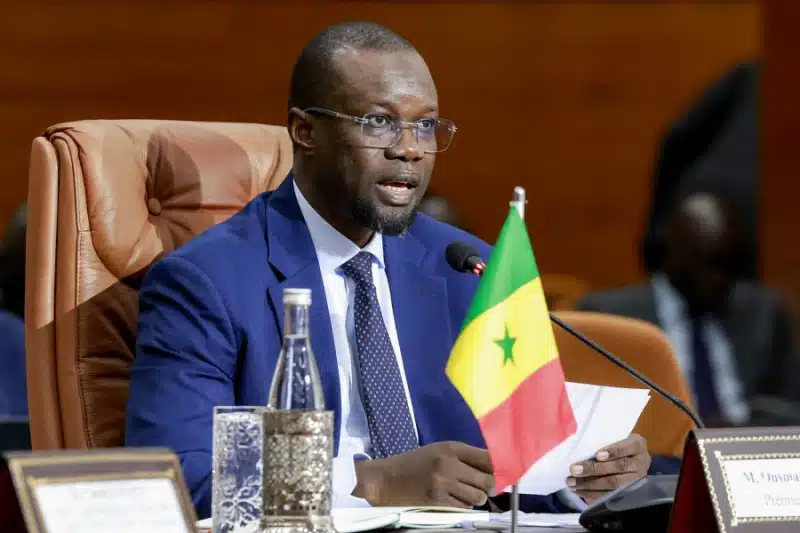

Ousmane Sonko has been elected speaker of Senegal’s National Assembly, a move that has instantly made Sonko Elected National Assembly Speaker one of the biggest political stories in West Africa this week
Sonko, the sole candidate for the position, received 132 votes out of 133 cast, with no member voting against him and one abstaining, according to the session’s presiding member, Ismael Diallo.
The opposition boycotted the vote, with opposition lawmakers deeming his reinstatement to the National Assembly “illegal.”
The session on Tuesday, 26 May, first restored Sonko’s parliamentary mandate before proceeding to the speakership vote.
The path to the speaker’s chair
Sunday saw speaker and close Sonko ally El Malick Ndiaye resign, clearing the way for Sonko to become head of parliament, where PASTEF holds a strong majority with 130 deputies out of 165.
The development means that Sonko Elected National Assembly Speaker has shifted from political speculation to Senegal’s new governing reality.
His appointment as speaker has set up an unprecedented rivalry within the ruling PASTEF bloc, after Faye consolidated his control over the executive.
Sonko’s election to the speaker’s chair marks a swift repositioning. Faye sacked him on 22 May and dissolved the government, citing months of escalating tensions. Within four days, Sonko had secured one of the most powerful positions in Senegalese politics.
The split between two allies
Faye essentially owes his position to Sonko, his one-time mentor who would almost certainly have taken the presidency himself had he not been barred from running in the 2024 election due to a defamation conviction.
Their PASTEF party won outright in the first round of 2024 elections, promising political reform with both men vowing to fight corruption and revive a struggling economy.
The relationship unravelled over the question of Senegal’s debt and how to handle talks with the International Monetary Fund.
The IMF froze a $1.8 billion lending programme after the discovery of misreported debt hidden by the previous government, pushing the country’s end-2024 debt level to 132 per cent of its economic output.
Sonko had opposed any restructuring of the debt, estimated at $13 billion, which he said the IMF was advocating, while Faye has been less vocal on the issue.
Analysts say the political fallout from the Sonko Elected National Assembly Speaker outcome could complicate negotiations with international lenders and deepen divisions inside PASTEF.
Finance Minister Cheikh Diba also warned the country’s fuel subsidy bill could exceed its 2026 budget allocation by as much as 1.15 trillion CFA francs ($2 billion) if oil prices rise to $115 per barrel, adding that Sonko had rejected his request to raise fuel prices.
A new prime minister with a different profile
President Faye appointed Ahmadou Al Aminou Lo, a 60-year-old economist and former national director of the Central Bank of West African States (BCEAO), as prime minister on Monday.
Lo worked for many years at the BCEAO, holding roles including head of the treasury, head of market operations, and director of banking activities, before becoming the bank’s national director for Senegal in December 2016.
Unlike many prominent political figures, Lo is a technocrat closely associated with financial and regulatory circles, and has held several strategic positions since Faye came to power in 2024, including secretary general of the government and minister overseeing the Senegal 2050 National Transformation Agenda.
The choice of a central banking veteran signals that Faye intends to push forward with IMF engagement, a position Sonko publicly resisted. However, with Sonko Elected National Assembly Speaker, it remains unclear how that strategy will unfold.
What it means for Senegal
With Sonko Elected National Assembly Speaker, Senegal now faces a political arrangement its modern history has rarely experienced. The founder of the ruling party controlling parliament, while his former protégé controls the presidency and executive branch.
As head of the largest party in parliament, Sonko could frustrate Faye’s legislative agenda.
President Faye is constitutionally barred from dissolving the Assembly until November 2026, giving Sonko a period of institutional protection from which to operate. The reality of Sonko Elected National Assembly Speaker therefore appears set to shape Senegal’s political direction for months to come.
The opposition reacted angrily to Sonko’s reinstatement and election, with Aissata Tall Sall, who heads the main opposition coalition, denouncing what she described as an “institutional coup” prepared under pressure from the parliamentary majority.
Finance Minister Diba told parliament before Sonko’s dismissal last week that Senegal expects to resume talks with the IMF in the week of 8 June and hopes to reach agreement on key points by 30 June.
Those talks will now proceed with a new prime minister in place, and a former one watching from across the aisle.


