



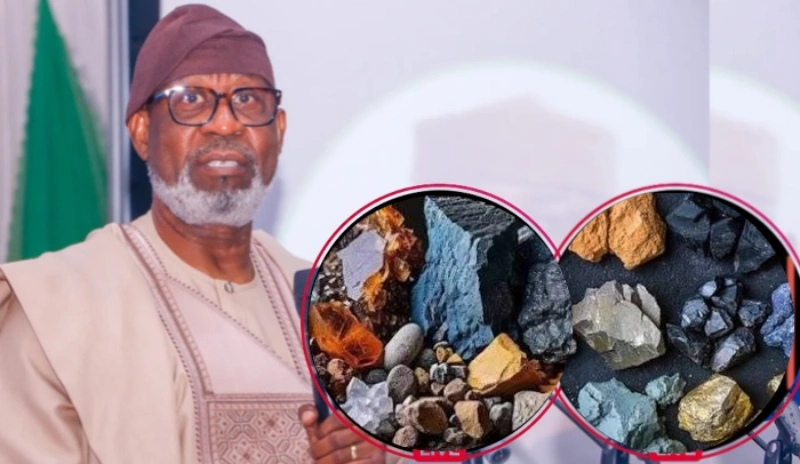

The Nigerian government has confirmed a significant Kaduna mineral discovery, describing it as one of the most important breakthroughs in the country’s solid minerals sector in recent years.
Minister of Solid Minerals Development Dele Alake disclosed the Kaduna mineral discovery on Wednesday at the opening of the African Natural Resources and Energy Investment Summit in Abuja. He said the find sits within the pegmatite region of Gidan Waya in Jema’a Local Government Area and includes high grade deposits of platinum group metals, gold, nickel, copper, lithium and rare earth elements.
Steron Mining, a private exploration firm, made the discovery, and the Nigerian Geological Survey Agency later verified it. Alake told summit delegates that the mineral province is notable for exceptionally high grade deposits, positioning Nigeria among emerging destinations for strategic mineral resources and sustainable mining investment. He added that this was the first time the government had announced the Kaduna mineral discovery publicly.
Kaduna State has long been associated with high purity platinum and lithium bearing rock, but officials say the scale of this particular find sets it apart. The Kaduna mineral discovery covers multiple critical minerals within a single province, which mining analysts say could simplify licensing and attract combined investment rather than piecemeal exploration deals.
Alongside the Kaduna announcement, Steron Mining used the summit to unveil a separate find: an estimated 3.3 million metric tonnes of lithium reserves at its project near Abuja. The company’s geologist, Bello Damulak, said exploration and drilling activity had identified total mineral resources of about 94.8 million metric tonnes at the site, made up of the lithium deposit alongside roughly 91.4 million metric tonnes of granitic rock.
Steron’s managing director, Abu Omar, told delegates touring the Abuja site that the company began as a granite quarry before geologists identified lithium, and later tantalite, within the same concession. He said the firm now runs both open pit and underground operations and processes lithium ore locally, raising purity from about one to three per cent up to six or seven per cent before export, in line with federal rules on local value addition.
The twin announcements come as the Tinubu administration pushes to reposition solid minerals as a genuine alternative to oil revenue. Alake said the government has revoked more than 3,000 inactive or non-performing mineral titles as part of a wider effort to restore discipline in licensing and ensure that mining assets sit with operators capable of developing them.
He pointed to rising sector revenue as evidence the reforms are working. Annual mining revenue stood at about N6 billion before the current administration took office, he said, before climbing to over N38 billion in 2024 and exceeding N70 billion by the end of 2025.
Government officials also linked the Kaduna mineral discovery to a broader wave of processing investment. Alake cited an $800 million lithium processing commitment, a separate $600 million facility under development in Nasarawa State, a $200 million plant near Abuja awaiting commissioning, and a $1 billion iron ore to steel project in Kogi State.
Chinese firms have been especially active in this space. Jiuling Lithium Mining Company and Canmax Technologies have together committed more than $1.3 billion toward processing facilities in Nigeria, including sites in Kaduna State, as global manufacturers race to lock in battery metal supply for electric vehicles and renewable energy storage.
For now, the Kaduna mineral discovery remains at the exploration and verification stage rather than active production, and analysts note that infrastructure gaps, unreliable power supply and regulatory bottlenecks could still slow how quickly the province is developed. The federal government says further details on licensing and investment partners for the site will follow in the coming months.


