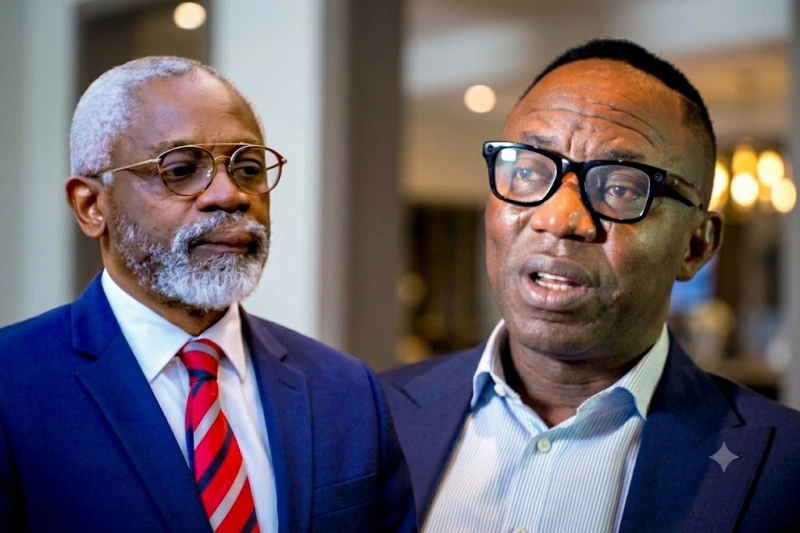
Activist Omoyele Sowore has revived corruption allegations against Femi Gbajabiamila, President Bola Tinubu’s chief of staff, linking him in a lengthy interview to scandals stretching from Atlanta to Abuja.
Sowore is the publisher of Sahara Reporters. He is also a former presidential candidate. He told an interviewer he was not surprised by the newest wave of Gbajabiamila corruption allegations because he had investigated the chief of staff years earlier in the United States.
Public record backs part of the earlier Gbajabiamila corruption allegations. The Supreme Court of Georgia approved a 36 month suspension of Gbajabiamila’s law licence on 26 February 2007. He had admitted violating professional conduct rules by withholding 25,000 dollars in settlement funds owed to a client.
Court papers state that he deposited the money into his attorney trust account in January 2003. He then withdrew it for personal use and closed his practice before leaving the country. He repaid the funds in 2006, a year ahead of the ruling. He was barred outright from the Georgia State Bar in 2020 after further lapses. Bar records cited by Peoples Gazette confirm this.
Sowore claimed Gbajabiamila fled the United States because of the case. The court record does not use that phrase. But his return to Nigeria, and his political rise soon after, sits close to the period covered in the disciplinary filing.
That older episode now sits alongside a fresh set of Gbajabiamila corruption allegations. These newer Gbajabiamila corruption allegations centre on a fake government agency. A man calling himself Prince Adeniyi Adeyemi Matthew presented himself in mid 2026 as director general of the Presidential Foreign Intervention Promotion Council, known in Nigerian reporting as PFIPC.
Reporting from the Guardian, TheCable and Sahara Reporters says Adeyemi claimed he paid Gbajabiamila 400 million naira through a proxy to secure the appointment. He further alleged the chief of staff later demanded a share of a 27.3 billion naira take off grant meant for the agency. Adeyemi also said the council secured office space inside the Federal Secretariat in Abuja. He claimed it appeared in the 2026 Appropriation Act and opened accounts through the Central Bank of Nigeria.
Nigerian authorities have pushed back hard against Adeyemi’s account, treating his side of the Gbajabiamila corruption allegations with open scepticism. Police investigators cited by the Nation newspaper found the council itself was fictitious. They said Adeyemi used a forged appointment letter carrying a falsified signature attributed to Gbajabiamila. He was arrested in Osun State in July 2026 after a bench warrant was issued against him. He now faces criminal charges of forgery and impersonation.
Gbajabiamila denies receiving any money from Adeyemi and rejects this branch of the Gbajabiamila corruption allegations outright. His lawyer, Jiti Ogunye, said his client filed a 15 billion naira defamation suit against the accuser. President Tinubu ordered the Independent Corrupt Practices and Other Related Offences Commission to investigate the affair.
Gbajabiamila voluntarily appeared before the commission in line with that directive. The Head of the Civil Service of the Federation later told a House of Representatives committee that her office failed to properly verify documents linked to the council before staff were authorised. Lawmakers are examining that separate lapse.
Sowore’s interview widened the frame beyond the Gbajabiamila corruption allegations to include Tinubu himself. He pointed to the president’s disputed age and certificate history. He also referenced what he called the baggage of drug trafficking. That claim traces back to a well documented 1993 case in the United States. Court records show the US government filed a civil forfeiture action against Bola Tinubu.
IRS investigators had linked more than a million dollars across several bank accounts to a heroin trafficking network run by Adegboyega Mueez Akande and Abiodun Agbele in Chicago and Hammond, Indiana. Tinubu settled the matter in September 1993. He forfeited 460,000 dollars from a Citibank account while retaining funds held at First Heritage Bank.
A federal judge dismissed the case with prejudice soon after. Because the action proceeded under civil forfeiture rules rather than a criminal charge, Tinubu was never convicted of any offence connected to the case. His supporters stress that distinction. Critics counter that the settlement still deserves a fuller public explanation than he has offered.
Beyond the Gbajabiamila corruption allegations, Sowore also named Ogun State governor Dapo Abiodun. He described him as carrying a drug conviction from the United States. Public records tell a different and more specific story. Documents obtained by Sahara Reporters, and reviewed by several Nigerian outlets, describe Abiodun’s 1986 arrest in Miami Dade, Florida, under the alias Shawn Michael Davids.
The charges were credit card fraud, forgery and petty theft, not narcotics offences. Prosecutors entered a nolle prosequi, meaning the case was dropped rather than pursued to conviction, after Abiodun reportedly cooperated with investigators.
Abiodun has confirmed the arrest. He disputes that it amounts to a conviction capable of disqualifying him from office. Whatever the outcome of that dispute, the underlying allegation concerns fraud rather than drugs. Sowore’s account blurred that distinction.
Sowore’s remarks about Abike Dabiri, the presidential aide he says once asked him to drop an earlier story feeding today’s Gbajabiamila corruption allegations, rest on his own testimony alone. So does his account of a separate case involving a former Buhari aide. Neither claim carries independent documentation in the public domain. Both deserve to be read as personal allegations rather than established fact until corroborated.
Taken together, the current run of Gbajabiamila corruption allegations, alongside the older claims against him, divides into two categories. Some are settled public record. Others remain contested and unproven. Gbajabiamila’s Georgia bar sanction sits in the first category. Tinubu’s 1993 forfeiture sits there too, resolved without a criminal conviction. The PFIPC bribery claim against Gbajabiamila sits in the second category. Police and ICPC findings so far support his denial more than Adeyemi’s version, though the investigation has not closed.
Nigeria keeps relitigating the pasts of its leaders through interviews, court filings and viral documents rather than through any functioning vetting system. That gap is the deeper issue behind the latest Gbajabiamila corruption allegations and every scandal like it. The country has no consistent mechanism for screening the financial and legal history of candidates before they reach the ballot.
Voters are left to sift through decades old court papers long after officials have already taken office. Building that mechanism, rather than waiting for the next scandal to surface, is the accountability work this interview points toward, whatever view one takes of the individual claims.