



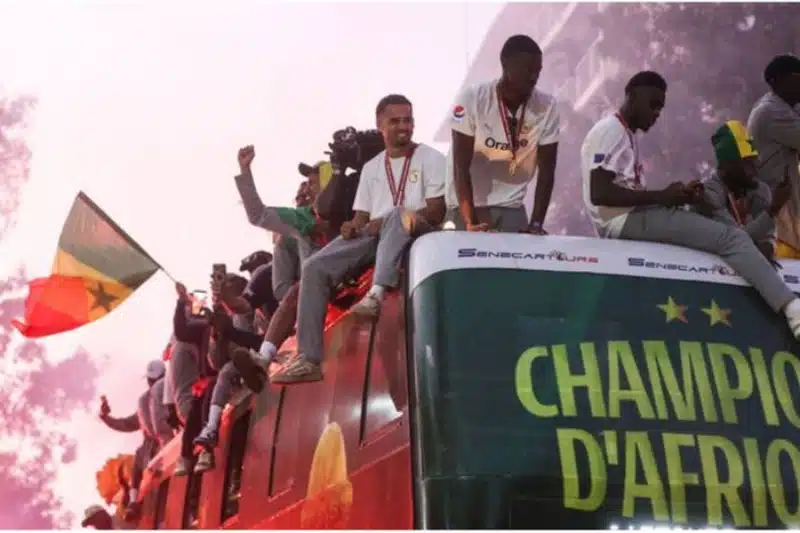

The AFCON 2025 dispute between Senegal and Morocco has moved beyond the pitch, drawing in the Confederation of African Football and raising questions about how decisions are handled at the top level of African football.
At the centre of the row are claims by Senegalese officials that CAF has moved to overturn the AFCON final result, a position that has not yet been fully detailed in publicly available CAF documentation.
What Is Confirmed and What Is Contested
At present, there is no publicly available CAF report setting out a full reversal of the final result. Senegalese football authorities maintain that a ruling has been communicated through official channels.
According to statements from the Senegalese Football Federation, the dispute centres on events during the final in Rabat on January 18, 2026.
These points sit at the core of the AFCON 2025 dispute:
-
A late VAR penalty awarded to Morocco
-
A temporary walkout by Senegal players
-
The eventual completion of the match, followed by Senegal’s win
Independent confirmation of the full sequence remains limited, and CAF has yet to publish a detailed account of its findings.
CAF Regulation Argument
Senegalese officials say CAF has cited tournament regulations, particularly provisions relating to teams leaving the field of play before the end of a match.
Under such rules, a team may be deemed to have forfeited.
However, without a publicly released disciplinary report, it remains unclear:
-
Whether CAF formally classified the incident as abandonment
-
How the match referee’s authority was interpreted
-
Why the result would be altered after the match was completed
This uncertainty remains central to the wider AFCON 2025 dispute.
Senegal Pushback and Political Escalation
Senegal’s response has been both institutional and political.
The Senegalese Football Federation confirmed it is preparing a formal appeal against the ruling, a move officials say will be filed with the Court of Arbitration for Sport.
FSF President Augustin Senghor, speaking to local media, questioned how the decision was reached, pointing to what he described as a lack of publicly released documentation explaining CAF’s position.
Those claims have not been independently verified, and CAF has not publicly responded in detail to the allegations.
At player level, some members of the squad have used social media to signal disagreement with the reported ruling.
Meanwhile, Senegal’s president Bassirou Diomaye Faye has posted imagery featuring the AFCON trophy, widely interpreted by local media as a symbolic assertion of Senegal’s claim to the title.
Legal Questions and Governance Concerns
The dispute has also focused attention on how match authority is defined in football.
The Laws of the Game, set by the International Football Association Board, place control of the match in the hands of the referee.
In this case, the match in Rabat was played to its conclusion, with no indication that the referee declared it abandoned at the time.
That sequence has become central to Senegal’s position in the AFCON 2025 dispute, raising the question of whether a result confirmed on the pitch can later be altered through administrative review.
Without full publication of CAF’s reasoning, it remains difficult to assess whether due process has been followed.
Where the Case Stands
The matter is expected to proceed to the Court of Arbitration for Sport, which handles international sports disputes.
Several elements remain unresolved.
CAF has not published a full disciplinary report setting out its reasoning. Detailed match documentation, including any formal rulings tied to the final, has also not been broadly released.
For now, much of what is known comes from statements by Senegalese officials and reporting from local media, rather than a complete set of documents from all sides.
Beyond the Result
What started as a disputed incident during the final has moved into a wider conversation about decision making within the Confederation of African Football.
The AFCON 2025 dispute now touches on how rulings are reached, how they are communicated, and how much access member associations have to the process behind them.
The outcome at the Court of Arbitration for Sport, could carry implications not just for the 2025 AFCON title, but for how similar disputes are handled in African football going forward.


