



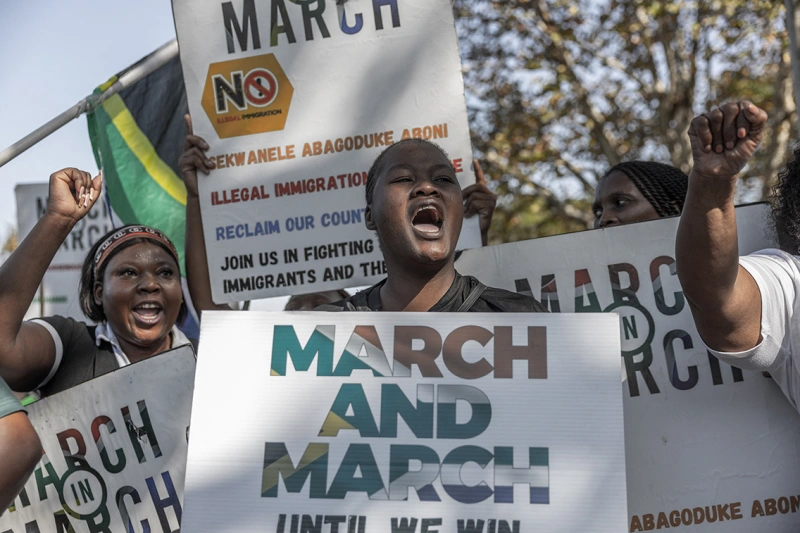

A man was standing at the side of a road in central Durban on Thursday morning when two marchers broke away from their column and walked towards him. Moments later, police say, about 50 people were beating him. He was declared dead at the scene.
Police have not named him. They have not given his nationality, and they have not said whether he held a permit. For legal migrants in South Africa, that silence is already unsettling.
KwaZulu-Natal police spokesperson Colonel Robert Netshiunda said the group was marching along Dr Pixley kaSeme Street when two men “pulled off from the group” and approached the victim. He was thought to be in his late 30s or early 40s. A murder case is open, and no arrests had been reported at the time of writing.
Police also cannot say what the march was about. What is known is that March and March led a motorcade of e-hailing drivers through the same part of the city a day earlier. It started at Berea Centre, where many foreign nationals live. A different man was reportedly assaulted on its fringes.
On Thursday, protesters also allegedly breached a VFS Global office in Essenwood. Police describe it as a company that handles permit applications alongside Home Affairs. It is where applicants go to complete parts of the visa and permit process.
That detail matters to legal migrants in South Africa because the movement says its quarrel is with undocumented migrants only. The record in Durban points elsewhere.
In June, Home Affairs checked 457 displaced people sleeping rough on Che Guevara Road. All but three were documented and legally resident, according to Daily Maverick’s Viewfinder investigation. The finding directly challenges the movement’s claim that its campaign targets only undocumented migrants.
Nearly a third of 235 testimonies gathered by a civil society coalition described assaults allegedly committed by March and March supporters. The movement says it does not target legal migrants in South Africa and denies being xenophobic.
Pressed on the figures, spokesperson Sandile Dube acknowledged the point. “They are documented,” he said. He then argued they should be deported anyway if they would not return to their home communities.
Germain Semihare’s experience shows what those distinctions mean for people who have built lives in the country. He arrived from Burundi in 2004, married a Xhosa woman and opened a hair salon that employed four people, he told Viewfinder. Vigilantes drove him from his home in May. When reporters visited his shelter, he had not seen his wife and children for four months.
Victor Sithole, a Zimbabwean upholsterer who came to South Africa decades ago, put it more bluntly to NPR in June. “They’re not talking about papers,” he said.
Official messaging has struggled to keep pace. In comments published in early October, police told Viewfinder they knew of no xenophobic attacks anywhere in the province. By Friday morning, KwaZulu-Natal police were voicing concern about ongoing attacks on foreign nationals and urging people to report them. Those mixed signals leave legal migrants in South Africa guessing whom to trust.
Government blames disinformation. Spokesperson William Baloyi said on 9 October that people had spread deliberately false claims about a July Constitutional Court ruling on asylum seekers. “We are deeply concerned by what is going on now,” he said. Home Affairs has stressed that the ruling does not give undocumented migrants automatic legal status.
Troops moved into central Durban on 10 October after two days of rioting in which police said at least 14 vehicles were burnt. The government says citizens cannot deport anyone. That promise is being tested daily for people with valid papers.
The next test is already fixed. An online registration system for asylum seekers is due by 10 November. March and March leader Jacinta Ngobese-Zuma has told e-hailing drivers to prepare for a full-day motorcade shutdown if it goes ahead. For legal migrants in South Africa, that date is already circled.
Papers decide who may stay in this country. In Durban this week, a crowd decided who was safe.


