By Anayo M. Nwosu
Our ancestors warned long ago that “ụzọ eji nwa adịghị èchí échî.” The saying means that a marriage that has produced children can never truly be closed.
This traditional wisdom explains why Nnewi man cannot divorce a wife with male children. In the cultural understanding of Nnewi society, once a woman has borne sons for her husband, the connection between the families can never be completely severed.
Modern legal systems now make divorce relatively easy. Couples can approach civil courts and obtain legal separation within months. Yet within Igbo traditional society, particularly in Nnewi, the deeper cultural consequences of divorce are not easily erased.
For this reason many elders continue to emphasise why Nnewi man cannot divorce a wife with male children, regardless of the outcome of modern court proceedings.
Marriage and Children in Nnewi Tradition
In traditional Nnewi society, marriage was never viewed as merely a relationship between two individuals. It was a union between families and lineages.
Children strengthened that bond. Male children in particular carried enormous cultural significance because they continued the family lineage and inherited their father’s compound.
This inheritance structure explains why Nnewi man cannot divorce a wife with male children in the deeper traditional sense. Once sons are born into the marriage, the connection between husband, wife and both extended families becomes permanent.
Divorce might create distance between spouses, but the cultural and family ties remain alive through the children.
The Case of Chief Ekwueme
The dilemma faced by Chief Ekwueme, a businessman from Nnewi, illustrates this cultural reality.
Chief Ekwueme married his wife Ukwunnu when she was still very young while he was already an established trader. Over the years their marriage produced a large household of eight children consisting of five boys and three girls.
Their early years together appeared prosperous and stable. Chief Ekwueme’s importation business thrived and the family enjoyed a comfortable life.
Ukwunnu was widely admired for her beauty and charm. Friends and neighbours often referred to her affectionately as “Nwanyidiuto”, a phrase meaning “a pleasant and delightful woman”.
For many years their marriage seemed enviable.
But life has a way of testing even the most stable households.
When Economic Troubles Enter a Marriage
Years later Chief Ekwueme’s importation business began to suffer a serious downturn.
Financial strain gradually changed the atmosphere within the household.
Among the people of Nnewi there is a saying that “obioma na-ebute ụtụ nkeni,” meaning that happiness and peace of mind often strengthen a man’s vitality and confidence.
As business pressures mounted, the once vibrant household began to feel the weight of anxiety and uncertainty.
This shift in circumstances quietly altered the dynamics of the marriage.
It was during this difficult period that troubling rumours began reaching Chief Ekwueme through relatives and friends. Reports suggested that his wife had begun seeking companionship outside the marriage.
The allegations caused deep embarrassment.
Eventually the chief decided to investigate discreetly. One day he pretended to travel for business but quietly returned home later than expected.
What he discovered confirmed the rumours.
The painful discovery forced him to confront a serious question. Should he divorce the mother of his eight children?
Adultery in Traditional Nnewi Society
Many people today assume adultery would automatically lead to divorce. In traditional Nnewi society the situation was more complex.
Adultery was considered wrong and disgraceful, but it was rarely treated as sufficient reason to destroy a family that already had children.
Instead, the community had traditional mechanisms for resolving such disputes.
Two important institutions often handled such matters.
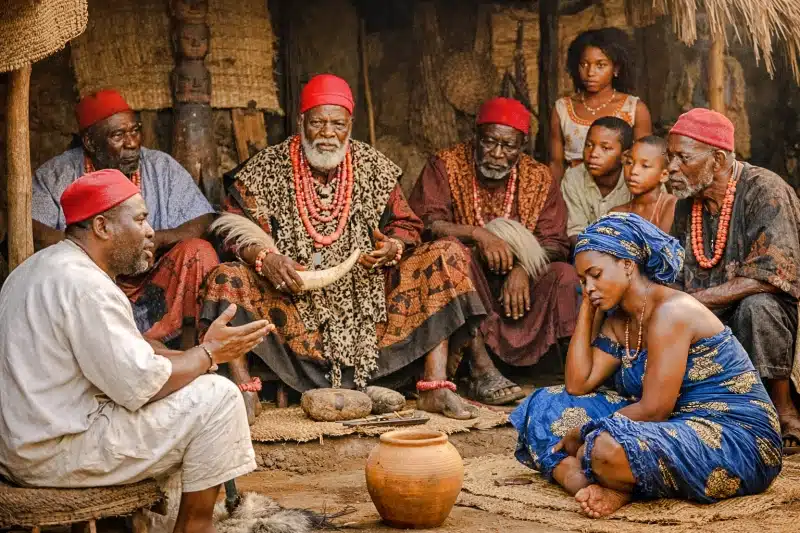
Umunna refers to the council of male elders and relatives from the husband’s extended family lineage. They play a central role in resolving disputes and maintaining family stability.
Umuada refers to the assembly of daughters of the lineage. These are women born into the community who may now be married elsewhere but retain significant moral authority in family matters.
Both groups could summon the couple and examine the situation.
Sanctions might include public reprimand, fines, reconciliation meetings or traditional purification rites.
The objective was usually to restore order within the household rather than dissolve the marriage.
The Symbolic Divorce Ritual
If a man insisted on divorce despite mediation, Nnewi tradition had a symbolic process.
The husband would visit his in laws carrying a keg of palm wine. Hidden inside the keg, or placed on top of it, would be a leaf from the ube tree, the African pear tree.
When the in laws noticed the leaf, they understood the message.
The gesture represented “Ube belu n’oke,” meaning that the boundary of the marriage had been drawn.
The husband might then request a refund of the bride price. In many cases the refund would only be made if the woman later remarried.
Yet even this symbolic divorce did not permanently end the relationship when sons were involved.
Why Sons Reconnect the Mother to the Family
The presence of male children changes everything in Nnewi tradition.
When the sons of a divorced woman grow into adulthood, they have the recognised cultural right to invite their mother back to live with them in their father’s compound.
This right exists even if their father is still alive.
The first son normally inherits the family compound unless his father has formally disinherited him.
Because of this inheritance system, the mother of the sons eventually reconnects with the household through her children.
She may attend family ceremonies and participate in her daughters’ traditional marriages even when those ceremonies take place in the compound she once left.
Some sons also choose to bury their mother in the same family compound after her death.
This cultural reality demonstrates clearly why Nnewi man cannot divorce a wife with male children in the full traditional sense.
Chief Ekwueme’s Final Reflection
Chief Ekwueme understood these cultural implications very well.
Divorcing his wife might satisfy his wounded pride, but it would not truly separate her from the family in the long run.
The mother of his sons would remain connected to his household through their children.
Moreover, his sons and daughters were growing into responsible professionals and he shared a strong bond with them.
After weighing all the options, the chief made a quiet and pragmatic decision.
He would not pursue divorce.
Instead he chose to focus on his children and maintain stability within the household.
A Lesson from Nnewi Tradition
The story highlights a broader lesson within Igbo traditional philosophy.
Marriage is not simply a contract between two individuals. It is a bond between families that grows stronger with the birth of children.
That is exactly why Nnewi man cannot divorce a wife with male children in the true cultural sense.
Through inheritance rights, lineage obligations and the authority of sons, the mother remains permanently connected to the household.
In the wisdom of the elders, “ụzọ eji nwa adịghị èchí échî.”
Credit
Chief Anayo Nwosu (Ojiakonaobi Nnewi)
Corporate and Investment Banker based in Lagos