



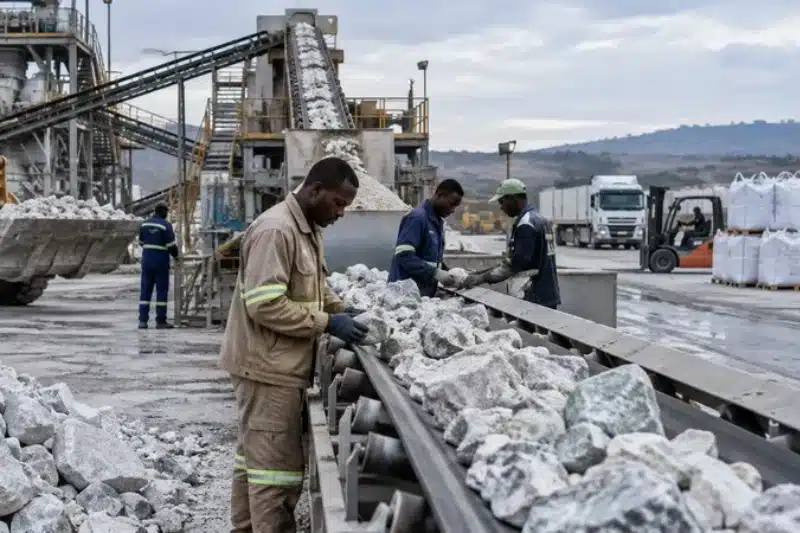

Zimbabwe lithium exports earned $2.16 billion in the first nine months of 2026. Less than nine cents of every dollar came from a product finished at home.
The Minerals Marketing Corporation of Zimbabwe (MMCZ) released the figures at a briefing in Masvingo earlier this month. Lithium has overtaken platinum group metals, which earned $1.73 billion, as the country’s biggest mineral export after gold.
The finished product in question is lithium sulphate. It brought in about $190 million. The rest came from spodumene concentrate and petalite, lithium-bearing minerals shipped abroad for refining. Most Zimbabwe lithium exports go to China.
Look at how the money was made and the picture shifts. Reuters reported that MMCZ general manager Nomusa Moyo put most of the jump down to a 283 per cent rise in the price of spodumene concentrate. MMCZ figures show the average realised price at about $1,483 a tonne, against $387 a year earlier.
Output is barely changing. The finance ministry’s half-year budget review, as Reuters reported in July, expects 2026 lithium production of 2.14 million tonnes, slightly below last year’s 2.2 million.
So Zimbabwe lithium exports earnings are being lifted by the market, not by the factory. The country is richer largely because buyers are paying more for the rock.
Harare has long wanted to change what Zimbabwe lithium exports are made of. It banned raw lithium ore exports in 2022. In 2025, the then mines minister, Winston Chitando, said concentrate exports would stop from January 2027.
Then the plan wobbled. On 26 February this year, the government suspended concentrate exports, citing leakages and malpractice. A mines ministry letter seen by Reuters in April allowed shipments to resume under company quotas, with written timelines for building sulphate plants.
Zimbabwe’s first lithium sulphate export followed in April, when Prospect Lithium Zimbabwe dispatched its initial shipment from a $400 million processing plant at Arcadia, near Harare. It came from a $400 million plant at Arcadia, near Harare. The company is wholly owned by China’s Zhejiang Huayou Cobalt.
Before April, Zimbabwe lithium exports contained no sulphate at all. By the end of September, about 33,000 tonnes had gone out.
Arcadia has a limit, though. Reuters reported in July that it is the only completed sulphate plant in the country and has no capacity to process other miners’ material.
That leaves everyone else racing a deadline. Innocent Rukweza chairs the Lithium Producers’ Association and runs state-owned Mutapa Energy Resources. He asked in June for “just a little bit of leeway” and a delay to about June 2027.
Sibanda, an economist who has studied Zimbabwe’s development and debt challenges, sees the same tension between the policy’s ambition and its practical requirements.
“The danger comes when policy changes happen overnight without the infrastructure to support them,” he told Equity Axis in August.
Sinomine’s Bikita Minerals is one of the biggest producers. It told Al Jazeera the first phase of its sulphate plant would be commissioned in the second quarter of 2027. That is after the ban starts.
The government is holding firm. On 9 October, Secretary for Information Nick Mangwana wrote on X that producers had enjoyed ample time to prepare and that “there is no justification for further extensions”.
What happens in January if the ban takes effect before the other processing plants are ready? Producers could struggle to find legal routes to market for their concentrate. If the deadline slips again, the government’s commitment to domestic processing will face another credibility test.
Zimbabwe lithium exports are one measure of value. Another is what reaches the people living beside the pits.
Farai Maguwu, executive director of the Centre for Natural Resource Governance, told Al Jazeera in June that communities hosting lithium mines were “seeing little benefit”. He pointed to damaged roads, limited local hiring and weak investment in health and education around Bikita, Goromonzi and Sabi Star.
Mountain Mujakachi of the Bikita Land Institute of Development alleged that a $10 million bridge pledged by Sinomine after it bought the mine has not been built. Bikita Minerals points to its own record. It says it built a $1 million health facility serving more than 5,000 people. It also says it spent over $500,000 on roads and other community projects, and it cites a 132kV power line project worth up to $30 million.
Al Jazeera said Prospect Lithium Zimbabwe declined to comment and that Mines Minister Polite Kambamura could not be reached.
Zimbabwe’s push for domestic processing reflects a wider African debate over who captures the value of the continent’s mineral wealth. At a convening in Addis Ababa on 14 February, Ghana’s President John Mahama said “there won’t be any raw mineral ores leaving Ghana” by 2030.
Zimbabwe’s processing deadline is an early test of whether African mineral producers can turn export earnings into more domestic value. Chinese firms, which Reuters says have invested about $2 billion since 2021, dominate both the mines and the processing. The plants are not yet ready to meet the government’s timetable.
Lithium has never earned Zimbabwe more in export revenue. Whether that translates into more value retained at home, and greater benefits for communities living beside the mines, remains the harder question.


