



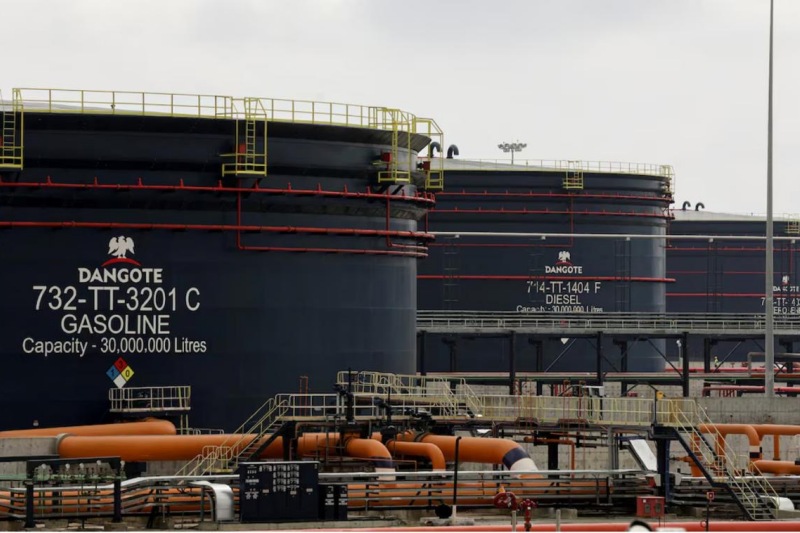

Dangote Petroleum Refinery has resumed gantry loading of Premium Motor Spirit, commonly called petrol, in naira, alongside a new Dangote refinery petrol price. The move ends a seven-day suspension that had unsettled fuel marketers across Nigeria.
The refinery’s commercial department confirmed the change in a notice titled “PMS Price Change Communication.” It took effect on Wednesday, 22 July 2026. The notice read in part that all unloaded gantry volumes would be repriced under the new naira structure, with immediate effect.
Along with the resumption came a fresh Dangote refinery petrol price. The gantry rate has climbed to N1,215 per litre, up from N1,075. That is an increase of N140, or 13.02 per cent, within a single adjustment.
Industry platform Petroleumprice.ng, whose chief executive Jeremiah Olatide independently confirmed the development, said marketers had already been notified and that truck loading resumed almost immediately under the revised template.
Why the refinery had switched to dollars
The 650,000 barrels-per-day plant had halted both coastal and gantry loading on 15 July, days after adopting a dollar-denominated pricing template for petrol, diesel and aviation fuel. Under that template, petrol sold at $0.779 per litre, a level Dangote Group tied directly to a shortfall in naira-denominated crude supplied under the Federal Government’s naira-for-crude arrangement.
A Dangote Group official had told reporters that crude volumes under the arrangement had been limited to roughly four million barrels a month, well short of what the refinery needed to sustain naira-based sales.
The Nigerian National Petroleum Company Limited pushed back on that account. Through spokesman Andy Odeh, the state-owned firm said it had allocated all available naira-denominated crude cargoes to the refinery in 2026, adding that actual off-take depended on variables such as nomination timelines and the refinery’s own scheduling. Odeh said NNPC remained committed to a fully supplied, fully operational Dangote refinery and that any gaps were being resolved jointly with the company.
Coastal loading also repriced
A day before the naira resumption, the refinery had already reopened its coastal loading channel for petrol, pricing marine cargoes at $1,161.23 per metric tonne. That was up from $1,044.62 per metric tonne, an increase of 11.2 per cent, and marked the plant’s first pricing adjustment on that channel since the shift to dollar sales began.
The disruption had already pushed depot prices higher in the days before the reversal. Mid-day data for 22 July showed petrol prices rising at hubs including Lagos, Port Harcourt, Warri and Calabar, with some depots adding as much as N87 per litre during the uncertainty.
Naira-for-crude policy under strain
The naira-for-crude initiative was introduced by the Federal Government in October 2024 to insulate local refiners from foreign exchange volatility, letting Nigerian crude be sold to domestic refineries in naira while refined products were, in turn, sold locally in naira. The policy has since been described by the Ministry of Finance as an open-ended arrangement rather than a temporary intervention.
Even so, the latest disruption to the Dangote refinery petrol price underlines how exposed that arrangement remains to crude availability and to swings in the global oil market. A rally in international crude prices around the same period added further pressure, with both Brent and West Texas Intermediate benchmarks climbing sharply this week, raising the underlying cost of refining petrol, diesel and aviation fuel.
What it means for motorists
For now, the return to naira pricing removes the immediate need for marketers to source dollars to lift products from the refinery gate, a requirement that had squeezed independent operators reliant on inland distribution. Analysts within the downstream sector expect the reversal to ease supply constraints gradually, even as the higher Dangote refinery petrol price works its way through to retail pumps in the coming days.
Whether the Dangote refinery petrol price remains stable may depend on how consistently NNPC’s cargo allocations match the refinery’s stated needs, and on how global crude prices behave in the weeks ahead.


