



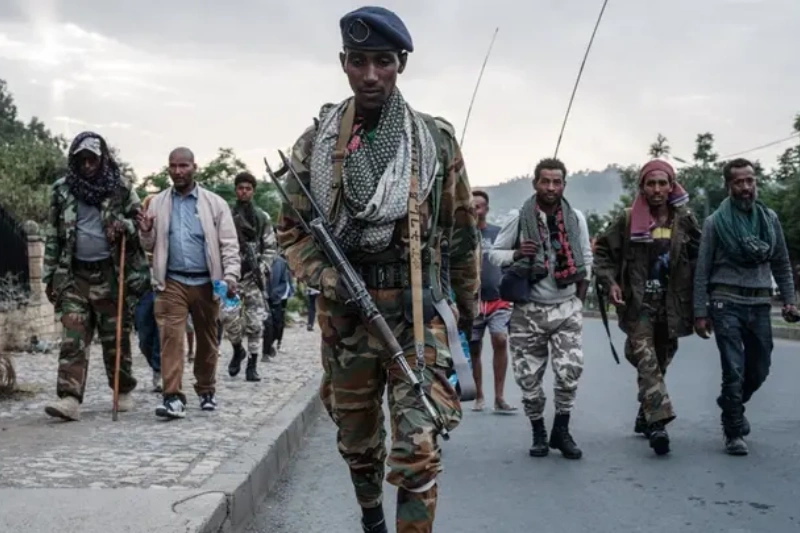

Eritrean troops in Tigray were once Abiy Ahmed’s allies. Now witnesses say they are back on Ethiopian soil, and, according to the conflict monitor ACLED, Ethiopian drones are already targeting their vehicles.
Two witnesses told Reuters on Wednesday that they saw dozens of Eritrean soldiers drive through the town of Adigrat in two trucks. They recognised the men by their off-white camouflage uniforms. Reuters could not independently verify the accounts.
The sighting came days after the Tigray People’s Liberation Front (TPLF) pulled out of Mekelle and federal forces took the regional capital. A local official told Agence France-Presse (AFP), on condition of anonymity, that the soldiers had been around Adigrat for days.
‘The Eritrean army has entered Tigray in uniform, equipped with heavy weaponry,’ said Gebreigziabher Beyene, commander of the pro-government Tigray Peace Force. If confirmed, Reuters noted, it would be the first sighting of Eritrean troops in Tigray since fighting resumed on 23 September.
Even the timing is unclear. ACLED says Eritrean forces crossed the border at Zelambesa on 7 October and moved towards Idaga Hamus, where Ethiopian drones targeted them at Guada. The local official suggested they had been there longer. Last week, the chief administrator of Afar region claimed Eritrean soldiers were already fighting there. Reuters could not confirm that.
Zelambesa is one of the main crossing points between Eritrea and Ethiopia’s Tigray region. The route towards Idaga Hamus runs through territory that saw some of the fiercest fighting during the 2020-2022 war and remains strategically important because it links border areas to central Tigray.
Pinning down when Eritrean troops in Tigray crossed matters. It shows whether this was a reaction to Mekelle’s fall or something planned earlier.
Asmara has not confirmed the presence of Eritrean troops in Tigray. Information Minister Yemane Gebremeskel, widely known as Yemane Meskel, did not deny that troops had crossed the border, Reuters reported. He called Ethiopia’s justification a ‘fallacious narrative’ and described its actions as a war of aggression.
The irony is hard to miss. Between 2020 and 2022, Eritrean soldiers fought beside Ethiopia’s army against the TPLF. UN investigators and rights groups later accused them of serious abuses, and Eritrea denied the accusations at the time. Some never fully left after the war ended, according to Ethiopia’s own government, UN experts and rights organisations.
That history is why reports of Eritrean troops in Tigray land so hard. Today, Ethiopia accuses Eritrea, Egypt and Sudan of backing a TPLF-led alliance. All three deny it.
Dr Abraham Belay, a senior Ethiopian official and former interim head of Tigray, went further on Sunday. The Shaebia government and its military physically participated in this war,’ he said in remarks carried by state media. Shaebia is the common Ethiopian term for Eritrea’s government. He promised that Ethiopia’s response would be doubled.
ACLED’s East Africa analyst, Jalale Getachew Birru, says Eritrea is suspected of backing the new Alliance for Survival. He offers two possible reasons. Asmara was dissatisfied with the Pretoria agreement that ended the last war, and it wants ‘a buffer between Ethiopia and Eritrea.
Kjetil Tronvoll, a regional expert at Oslo New University College, told AFP that Eritrea needs strategic depth in northern Tigray. He said Asmara would rather fight Ethiopia’s army on Tigrayan soil. The Tigray Peace Force commander says much the same, claiming Eritrea wants the fighting kept inside Tigray.
Both readings can be true at once. Eritrean troops in Tigray could be a quiet ally of the rebels and a shield for Eritrea’s own border.
Behind the military movements lies a larger dispute over access to the Red Sea, a question that has increasingly strained relations between Addis Ababa and Asmara.
Abiy was sworn in for a new five-year term on Monday and again said Ethiopia would work for ‘an outlet to the sea’. Ethiopia lost its coastline when Eritrea became independent in 1993. ACLED says Eritrea opposes any Ethiopian bid for the port of Assab, and AFP reports that Asmara fears an invasion to seize sea access.
The diplomatic break came fast. On 1 October, Ethiopia expelled 10 Eritrean diplomats and closed its embassy in Asmara. Eritrea cut all ties in response. On Sunday, the leaders of Egypt, Eritrea, Somalia and Sudan met at New Alamein. They said the Red Sea is the business of its coastal states.
One scenario stands out. AFP reported fears this week that the TPLF could retreat into Eritrea, handing Ethiopia a pretext to invade. That could turn Eritrean troops in Tigray from a buffer into a justification for a new war.
Civilians are already caught in it. An Adwa resident told AFP that drone strikes hit hotels in the town over the weekend, killing several civilians and wounding four. The local official said residents are very worried about Eritrean troops in Tigray.
The United States warned on 3 October that the Horn of Africa has no capacity for another war. It urged both governments to show maximum restraint.
Much remains unproven. Nobody has published a count of Eritrean soldiers. Reuters said spokespeople for Ethiopia’s government and Abiy’s office had not responded to requests for comment. ACLED data show Tigrayan forces heavily present along the same corridor, which makes the picture on the ground hard to read.
For now, Eritrean troops in Tigray are a presence reported by witnesses and ACLED, and not confirmed by Asmara.
The war began as a struggle over political power inside Ethiopia. The reported return of Eritrean troops in Tigray suggests it may now be evolving into a wider regional confrontation involving borders, alliances and access to the Red Sea.


