



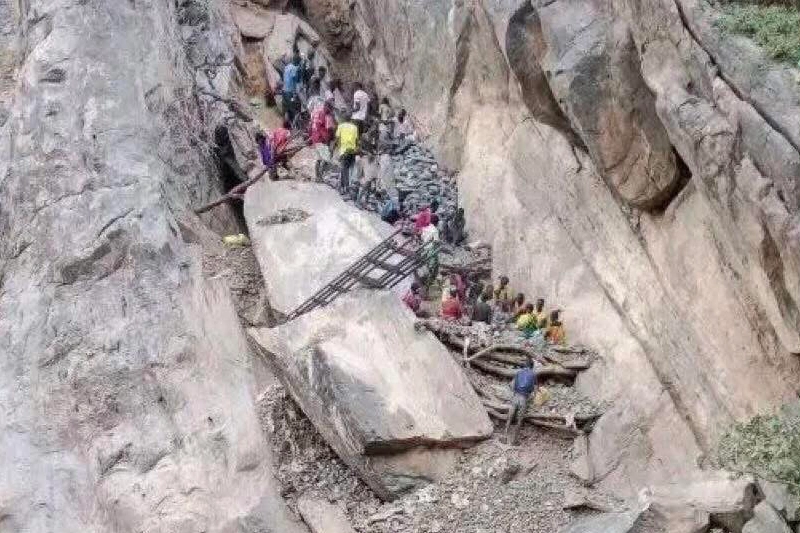

At least 15 people have died after a rockfall buried miners alive at an informal gold pit in Rumos Hills, West Pokot County, in one of Kenya’s deadliest artisanal mining disasters in recent memory.
Miners Buried Alive as Rockfall Strikes Rumos Hills
Rescue teams were racing against time on Friday after the West Pokot gold mine collapse at Rumos Hills left scores of artisanal miners buried under tonnes of rock and soil. The West Pokot gold mine collapse has triggered one of the largest rescue operations seen in the county in recent years.
Lopet area Chief Isaac Lomwai said the incident occurred on Thursday evening when hundreds of artisanal miners were inside the gold pits before tonnes of debris buried them alive.
Witnesses described chaotic scenes immediately after the collapse, with villagers rushing to the mining site armed with shovels and crude tools in an attempt to save those trapped.
It is estimated that more than 100 people were inside the pits when the rockfall occurred.
Death Toll Climbs Through the Night
The number of confirmed deaths rose steadily through the night as search crews pressed deeper into the unstable debris.
At least 10 people were confirmed dead in early reports, with fears that the death toll could rise as rescue operations continued.
By Friday morning, Capital FM reported that the Rumos Hills West Pokot gold mine collapse had claimed at least 15 lives, amid fears that more miners could still be trapped underground.
Earlier, officials at the scene said sounds were still being heard from beneath the rubble hours after the collapse, raising hopes that some victims may still be alive.
Red Cross Deploys Emergency Teams
The Kenya Red Cross Society confirmed in a statement that so far, 11 casualties had been reported, including three critically injured individuals who had been referred to Kapenguria Referral Hospital.
The agency said its emergency teams were working alongside local authorities and community members in the ongoing rescue effort.
At Kapenguria Referral Hospital, medical teams were placed on standby to receive more casualties as rescuers continued digging through debris at the scene.
Governor Had Warned of Danger Just Days Earlier
The West Pokot gold mine collapse happened barely a week after Governor Simon Kachapin publicly threatened legal action against illegal mining operations in the county.
Addressing journalists, Kachapin said the community was growing increasingly frustrated and could be forced to defend its resources if authorities failed to act. The community will rise to defend its resources by taking legal action against illegal miners,” he said.
The governor also alleged corruption was enabling illegal mining to continue. “Gold merchants have bribed some leaders to speak against us, and even police officers have been compromised to chase away artisanal miners while machines are brought in to extract gold,” he said.
Despite those warnings, miners returned to the pits.
A Site With No Safety Systems
The West Pokot mining site, described as informal, lacked the structural reinforcements and safety measures typically found in regulated operations. Such conditions frequently expose workers to landslides, tunnel collapses and suffocation.
Most artisanal operations in the area involve miners digging vertical shafts using hand tools with no geological surveys, no engineered support structures, and no emergency response plans on site.
Local residents joined the rescue efforts, digging through the rubble using basic tools as emergency teams coordinated a more organised response.
West Pokot Has Seen This Before
The Rumos Hills West Pokot gold mine collapse is the latest in a series of fatal accidents that have come to define the county’s gold rush era.
In June 2025, four artisanal gold miners died and several others were injured when a gold mining pit collapsed in Karon Village in the Turkwel area.
Days later, a woman’s body was retrieved from a collapsed mine at Kambi Karaya as rescue teams worked to save several other miners buried beneath the debris, with police spokesperson Muchiri Nyaga confirming that teams from the National Police Service, the Kenya Defence Forces, and Red Cross Kenya had been dispatched to the scene.
In October 2025, four more miners were killed when a shaft collapsed at a gold mining site in the Kambi Karai area. Those killed were identified as Silas Losenya, 22, Jacob Tsangana, 30, Morio Akotopuo, 35, and 14-year-old Lopoghon Lopakar.
The pattern in West Pokot is not isolated. Across Kenya, artisanal mining sites have claimed dozens of lives over the past decade, with regulators and lawmakers repeatedly failing to impose safety standards that match the scale of the gold rush.
The West Pokot gold mine collapse has once again exposed the deadly realities of Kenya’s informal mining sector.
Why Miners Keep Going Back
The answer to why people return after each disaster lies in the economics of northern Kenya.
While very few individuals grow rich from the precious metal, thousands of small-scale miners and landowners are left grappling with dried-up wells, cracked farmland, and broken promises.
Gold discoveries transformed remote West Pokot villages into informal mining hubs almost overnight. With gold trading at over KES 350,000 per ounce on the global market, the hunger for the metal has become insatiable.
For many miners, a few days of extraction yields more income than months of farming or livestock work. That calculation keeps people descending into unshored pits even when they know the dangers.
Leaders Demand Action, But Enforcement Fails
West Pokot Senator Julius Murgor, Kapenguria MP Samuel Moroto, and former Governor John Lonyangapuo have demanded the suspension of mining activities until proper safety and licensing protocols are in place.
Moroto pointed to the broader failure of oversight. “Why aren’t our leaders speaking up? The police protect illegal miners even as mining destroys public institutions such as Loloch Primary School. Where is the Ministry of Education? Where is the security?” he said.
West Pokot Disaster Risk Management Officer Moses Lomungura urged residents to exercise caution. “Mining supports livelihoods, but deaths are becoming too frequent,” he said.
A County Rich in Minerals, Broken by Their Extraction
Claims of a dark side to the boom allege that the mineral sector is fuelling corruption, conflict, human rights abuses, and environmental damage.
Governor Kachapin revealed that the county had received only Sh1,000 in royalties from gold mining activities over the past year, calling the figure shocking given the scale of extraction.
The county’s Department of Environment reported that siltation from unregulated sluicing had rendered water in three sub-counties unsafe for human consumption.
The West Pokot gold mine collapse at Rumos Hills has, once more, forced a reckoning with hard questions: who profits, who dies, and who is truly responsible for a system that keeps burying its poorest workers underground.
Rescue operations linked to the West Pokot gold mine collapse at Rumos Hills were continuing as of Friday morning. This story will be updated as the confirmed death toll and further official statements emerge.


