




Reporting by AfricaQuarters News Desk
Days of intense rainfall have overwhelmed drainage systems and rivers across several regions, deepening what officials describe as a growing Kenya flood disaster.
The Kenya flood disaster has struck several counties, with the capital Nairobi emerging as the epicentre after rivers burst their banks and floodwaters surged through residential neighbourhoods, destroying homes, vehicles and public infrastructure.
Emergency services are still searching for missing people while meteorologists warn that heavy rainfall may continue during the ongoing long-rains season.
Rivers Overflow as Nairobi Neighbourhoods Submerged
Authorities say rivers running through Nairobi, including the Nairobi River and Ngong River, overflowed after intense overnight downpours.
The floods swept through densely populated neighbourhoods such as Mathare, Kibera, Kariobangi, Eastleigh, Kawangware and Donholm, where many residents live close to riverbanks and flood-prone areas.
In several locations, homes built with temporary materials collapsed after floodwaters weakened their foundations.
Local resident Peter Mwangi, whose house in Kariobangi was flooded overnight, said families had little time to react when water entered the neighbourhood.
“The water came in the middle of the night. Within minutes it was already inside the house. We grabbed the children and ran outside with nothing,” he told local media.
City authorities say dozens of neighbourhoods across Nairobi are now classified as flood-prone, highlighting long-standing urban planning challenges in one of East Africa’s fastest growing cities.
Rising Death Toll in Kenya Flood Disaster
Emergency agencies say the number of fatalities has continued to rise as rescue teams reach more affected areas.
At least 66 people have died nationwide, according to figures compiled by Kenyan authorities and the Kenya Red Cross, although officials caution the number could increase as search operations continue.
Several deaths occurred when floodwaters swept through residential streets and major roads, while other incidents were linked to collapsing structures and vehicles trapped in rising water.
Police officers, firefighters and emergency responders have carried out multiple rescue operations in recent days in Nairobi and surrounding counties.
In one incident reported by local authorities, passengers inside a matatu were rescued after the vehicle became stranded in floodwaters along a flooded roadway.
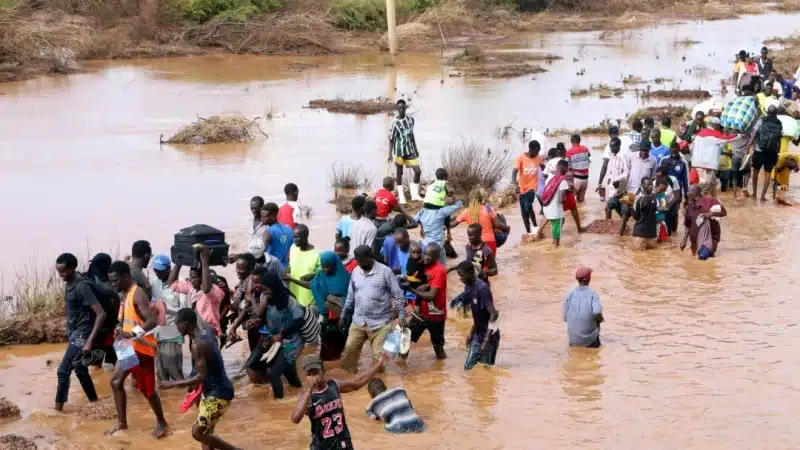
The Kenya Red Cross says thousands of residents have been forced to leave their homes as floodwaters spread through both urban neighbourhoods and rural communities.
Counties Most Affected by the Kenya Flood Disaster
Although Nairobi has seen some of the worst flooding, the disaster extends far beyond the capital.
Flooding has been reported in counties including Nairobi, Nakuru, Kisumu, Kiambu, Bungoma, Murang’a, Migori, Kwale, Kajiado and Kirinyaga.
Government estimates indicate that thousands of families have been displaced, with many now sheltering in temporary camps, schools and community centres.
Thousands of households have been forced from their homes as the Kenya flood disaster spreads across multiple counties.
Humanitarian organisations warn that access to safe drinking water, sanitation and healthcare is becoming a growing concern in several affected communities.
A volunteer with the Kenya Red Cross, Mary Wanjiru, described the situation as urgent as families arrive at evacuation centres.
“Many families lost everything in a single night. People are arriving at evacuation centres with only the clothes they are wearing.”
Transport and Infrastructure Disrupted
The floods have also caused major disruption to transportation and public services.
Transport officials say the Kenya flood disaster has disrupted key transport routes across Nairobi and several surrounding counties.
Several roads in Nairobi became impassable after being submerged, including sections of Mombasa Road and Uhuru Highway, leading to severe traffic congestion across the city.
Floodwaters have also damaged smaller roads and bridges in rural counties, complicating rescue and relief operations.
Power outages have been reported in several neighbourhoods after electrical infrastructure was affected by the flooding.
Government Response
President William Ruto said the government has mobilised emergency teams to support rescue operations and provide humanitarian assistance to affected communities.
Security agencies, including the Kenya Defence Forces and the National Police Service, have joined local authorities and volunteers in search and rescue missions.
Officials are also urging residents living along riverbanks and in low-lying areas to move to safer ground as a precaution while rainfall continues.
Interior ministry officials say emergency teams remain on high alert as weather conditions across much of the country remain unstable.
Climate and Urbanisation Behind Growing Flood Risk
Environmental analysts say the Kenya flood disaster highlights long-standing concerns about how rapid urban growth and changing rainfall patterns are increasing flood risks in East Africa.
In Nairobi, the city’s population has expanded quickly over the past two decades. This growth has pushed housing, informal settlements and small businesses closer to riverbanks and other low-lying areas.
Urban planners have repeatedly warned that drainage systems built decades ago were designed for a much smaller city and struggle to cope during periods of intense rainfall.
Kenya’s Meteorological Department has also noted that seasonal rainfall patterns have become more erratic in recent years. Periods of drought are sometimes followed by heavy downpours that fall within a short period of time.
The current March to May rainy season, commonly known in Kenya as the long rains, normally brings the largest share of the country’s annual rainfall. Forecasts issued before the season began suggested some regions could receive higher than average rainfall, increasing the risk of flooding in urban and riverine communities.
Communities Facing a Difficult Recovery
Even as water levels begin to recede in some areas, the impact of the flooding remains severe for many families.
Emergency teams continue to search flooded neighbourhoods while humanitarian organisations distribute food supplies, temporary shelter materials and basic medical assistance to displaced residents.
Local officials say many families arrived at evacuation centres after losing most of their belongings when water entered homes during the night.
For households that relied on small shops, roadside trading or informal work, the flooding has also disrupted daily income.
Community leaders and relief workers say recovery will likely take time, particularly in neighbourhoods where homes and local infrastructure were badly damaged.
Aid groups warn that rebuilding efforts will depend on continued support from government agencies, humanitarian organisations and local communities working together in the months ahead.
Sources and Reporting
Information in this report is based on updates and public statements from the Kenya Red Cross, the Kenya Meteorological Department, Kenyan emergency authorities and local government officials in Nairobi.
Additional context on seasonal rainfall patterns and disaster response was drawn from public advisories issued by the Kenya Meteorological Department and reporting by Kenyan media organisations.


