




A Federal High Court ruling on Friday has left the African Democratic Congress rudderless days before a critical INEC submission deadline, reinforcing the decision by Peter Obi and Rabiu Kwankwaso to walk away from the troubled party together.
ABUJA – The ADC leadership crisis took a sharper turn on Friday after a Federal High Court in Abuja adjourned proceedings in the suit challenging the party’s internal structure indefinitely, just days before the Independent National Electoral Commission closes its window for parties to submit registers and leadership records.
Justice Emeka Nwite of the Federal High Court halted the case after ADC chieftain Nafiu Bala Gombe asked that the matter be reassigned to a different judge, telling the court he had lost confidence in how the proceedings were being handled.
What Happened Inside the Courtroom
Bala’s legal team told Justice Nwite that a formal petition had already been submitted to the Chief Judge of the Federal High Court, requesting that the case be moved to a different bench.
Lawyers on the opposing side objected immediately. They accused Bala of attempting to delay proceedings and engaging in what they described as “judge shopping,” arguing that the application was designed to frustrate accelerated hearing.
Justice Nwite adjourned the matter indefinitely, stating that the case had become an administrative question, one that now rests with the Chief Judge to decide whether proceedings continue before him or are transferred.
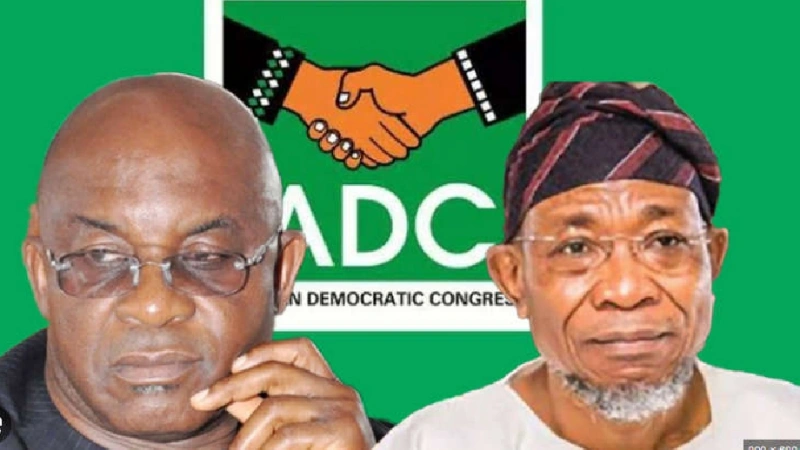
The suit itself centres on the emergence of former Senate President David Mark and former Osun State Governor Rauf Aregbesola within the ADC leadership structure. Bala’s faction contends that the process through which both men came into the party’s hierarchy violated the ADC’s own constitution and the provisions of Nigeria’s Electoral Act.
How the ADC Leadership Crisis Threatens INEC Compliance
The court’s decision lands at a particularly dangerous moment for the party.
The 10 May 2026 deadline set by INEC for submission of party registers and leadership records is now only days away. With the ADC leadership crisis still unresolved in court, serious questions have arisen over which faction INEC will formally recognise, and whether the party can submit a legally clean package before the window closes.
Any failure or confusion at this stage could compromise the party’s standing as a viable platform for 2027 coalition planning and that planning has already suffered a blow that no court date can reverse.
How Obi and Kwankwaso Read the Signs
Friday’s adjournment arrives as the ADC leadership crisis continues pushing major opposition figures away from the party.
On Sunday, 3 May 2026, Peter Obi and former Kano State Governor Rabiu Musa Kwankwaso resigned from the ADC within hours of each other before proceeding together to the NDC national secretariat in Abuja, where they formally received their membership cards into the Nigeria Democratic Congress.
Addressing party leaders at the reception, Obi accused the current government of engineering unresolved disputes and litigation inside opposition parties, saying the pattern had forced members out of one platform after another. He described the NDC as a party whose leadership had assured them of no pending litigation.
Kwankwaso told the gathering that consultations with NDC leadership had revealed strong ideological alignment, particularly around education reform, youth empowerment and national unity. He called on former members of the New Nigeria People’s Party and the wider Kwankwasiyya movement to follow him to the new platform.
For many political observers, the timing of the joint exit from the ADC leadership crisis now looks strategically sound. By leaving before Friday’s indefinite adjournment, both men avoided being drawn into a prolonged party litigation, protected their political standing from association with a legally disputed platform, and kept their options open for broader opposition negotiations ahead of 2027.
Several analysts have already described a potential Obi and Kwankwaso presidential and vice-presidential ticket as a combination that would be difficult for the ruling APC to beat in the 2027 election.
The departures extended well beyond the two principals. A wave of House of Representatives members also moved to the NDC in the days that followed, with lawmakers citing lingering leadership disagreements and internal disputes within the ADC as their reason for leaving.
Friday’s indefinite adjournment, arriving just days after that mass exit, has now left the ADC leadership crisis without its most prominent political assets and without a resolution in sight.
Not a Collapse – A Consolidation in Disguise
The instinct to read Friday’s ruling as a fatal blow to Nigeria’s opposition project may be premature. A closer look at the political landscape suggests a different conclusion.
The ADC leadership crisis, for all the damage it has caused, may be doing the opposition an unintended favour. With the party’s legal future now genuinely uncertain and its most prominent figures already gone, the remaining actors inside the ADC face a sharply narrowing set of choices.
Staying inside a platform trapped by the ADC leadership crisis and indefinite court proceeding, with an INEC deadline bearing down, is a harder and harder position to defend. The path of least resistance now points in one direction, towards the NDC.
That outcome, if it materialises, would mean the crisis that was supposed to weaken the opposition ends up consolidating it instead.
It is worth stating plainly why that matters. A persistent government narrative heading into 2027 holds that there is no credible opposition in Nigeria. Every prolonged court battle, every split, every bout of internal chaos inside opposition parties feeds that narrative. A voluntary consolidation of opposition forces around the NDC would directly challenge it.
The Atiku Question and Why the NDC Has Already Answered It
One figure whose movement will be closely watched is former Vice President Atiku Abubakar. Should Atiku consider the NDC as a landing pad, however, he will encounter a structural obstacle already in place.
Buba Galadima, a leading figure in the NDC and close ally of Kwankwaso, confirmed in an interview on Channels Television that the party has zoned its presidential ticket to the southern region ahead of its forthcoming primaries. Galadima left no room for ambiguity, saying: “No missing words, we have zoned it to the South. Therefore, whoever from the South who is interested should go and register quickly.”
That position, if it holds, effectively closes the NDC’s presidential route to northern heavyweight figures including Atiku, regardless of their individual political appeal.
The NDC’s deputy national spokesman, Abdulmumin Abdulsalam, has since sought to complicate the picture, telling reporters in Abuja on Thursday that consultations on the presidential ticket were still ongoing and that no final decision had been reached, describing politics as “a dynamic game.” The party also denied any arrangement involving former President Goodluck Jonathan.
The conflicting signals from within the NDC suggest the zoning debate is not entirely settled. But the broad direction is clear: the party is positioning itself around a southern presidential candidate, with Kwankwaso’s northern base providing the coalition’s structural backbone, an arrangement that points squarely at an Obi-led ticket.
For those still inside the ADC watching proceedings in the Federal High Court go nowhere, that is a functioning, legally clean platform with a visible power-sharing architecture. The incentive to leave the ADC leadership crisis behind and join the NDC grows stronger with every adjournment.
Report filed from Abuja.


