



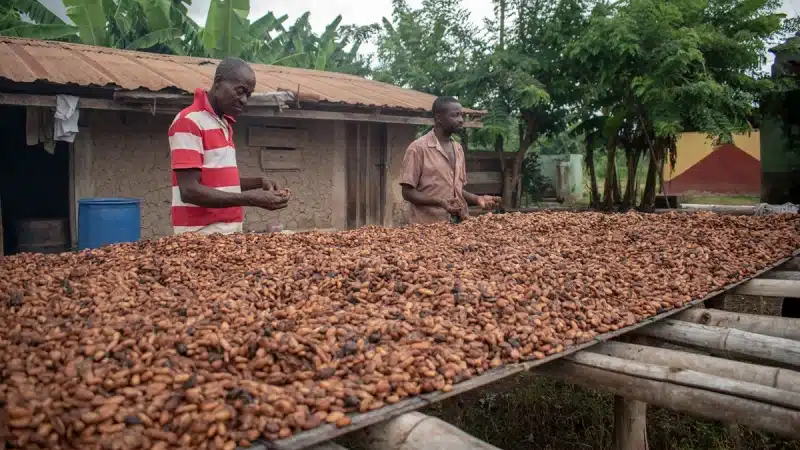

The smell of fermenting cocoa hangs heavy in storage sheds across parts of West Africa this season. In several farming communities, sacks of beans that should already be on ships bound for Europe and North America are instead sitting in warehouses, waiting for buyers who have not arrived.
What farmers are now calling the Cocoa Crash 2026 is spreading through rural districts in Ghana and Côte d’Ivoire, the two countries that together supply roughly two thirds of the world’s cocoa.
What began as a routine downturn in global commodity trading is now turning into something far more serious. Across the cocoa belt, growers say the Cocoa Crash 2026 is rapidly becoming a rural economic emergency rather than a simple market correction.
What Triggered the Cocoa Crash 2026?
The current Cocoa Crash 2026 comes after an extraordinary rally in cocoa prices during 2024 and 2025. A combination of crop disease, poor harvests and extreme weather across West Africa pushed cocoa futures to record highs before the market abruptly reversed, exposing structural vulnerabilities in the global cocoa supply and sustainability challenges
Chocolate manufacturers raised retail prices worldwide during the spike, dampening demand and slowing new purchases.
When buying slowed, inventories began to build rapidly across export warehouses in the region.
In West Africa, where government marketing boards play a central role in cocoa exports, the downturn is being felt immediately by farmers.
In Ghana, the sector is managed by the Ghana Cocoa Board, while Côte d’Ivoire regulates its cocoa industry through the Conseil du Café-Cacao.
These institutions set the farmgate price farmers receive. When international markets fall sharply, however, governments often struggle to maintain those guarantees.
“We would all have liked a better price, but you have all followed the trend in the international price. The international market is forcing us to make an adjustment.”
That was the message from Bruno Koné earlier this month as authorities confirmed a steep reduction in the producer price.
Warehouses Filling as Cocoa Sits Unsold
The human impact of the Cocoa Crash 2026 is most visible inside the warehouses scattered across the cocoa belt.
In Côte d’Ivoire’s Bas-Sassandra region, farmer organisations say exporters have slowed purchases, leaving harvests stranded in storage facilities.
“Cocoa is not selling, but farmers still need money to feed their families.”
Moussa Koné, president of the Ivorian Cocoa Farmers’ Union, says warehouses are filling rapidly as exporters delay buying.
For smallholders, the consequences are immediate. Most cocoa farmers cultivate only a few hectares and rely almost entirely on cocoa income to support their families.
Without buyers, weeks can pass without any cash entering the household.
From Cocoa to Gold
Across Ghana’s cocoa producing regions, the Cocoa Crash 2026 is accelerating a trend that has quietly been growing for years.
Farmers are increasingly abandoning cocoa farming for mining.
“If I keep this cocoa farm for the next ten years, I would die a poor man.”
Manu Yaw Fofie, a 52 year old farmer from Kona in the Ashanti Region, says declining yields forced him to lease part of his land to sand miners after production dropped from around 300 bags to about 50.
Across the border in Côte d’Ivoire, the same calculation is taking hold.
“Today, gold is more profitable than cocoa. We get about 1,500 CFA francs per gram of gold.”
François N’Gbin, an Ivorian farmer, says he has already cleared more than 1,000 square metres of cocoa trees to allow mining operations on his land.
Agricultural economists warn that if the Cocoa Crash 2026 persists, large areas of cocoa farmland could be permanently converted to mining sites.
Environmental Fallout: Forests and Rivers at Risk
The shift from cocoa farming to mining is not only an economic story. It is also rapidly becoming an environmental crisis across parts of West Africa.
Illegal gold mining, widely known in Ghana as galamsey, has already damaged large stretches of farmland and forest in cocoa producing regions such as the Western North and Ashanti regions, with researchers warning about illegal gold mining damaging cocoa farmland and rivers
Mining pits often replace cocoa trees, while excavators strip away fertile soil that once supported agriculture. In many cases the land becomes unusable for farming for years.
Even more concerning is the impact on water systems.
Small scale mining operations frequently rely on mercury and other chemicals to separate gold from ore. These substances often end up in nearby rivers and streams, contaminating drinking water and irrigation supplies used by farming communities.
Environmental groups say several rivers in southern Ghana have already shown signs of severe pollution linked to illegal mining activity.
Farmers warn the Cocoa Crash 2026 could accelerate the problem.
As incomes from cocoa fall, more landowners are leasing farmland to miners in exchange for immediate cash payments.
“The rate at which toxic chemical substances by illegal miners are impacting communities requires an urgent state of emergency,” said Issifu Issaka, president of Ghana’s Cooperative Cocoa Farmers’ Association.
He warned that if the trend continues, Ghana could lose large portions of its cocoa producing land within a decade.
The environmental consequences extend beyond agriculture. Cocoa farms in West Africa often serve as buffer zones that help preserve fragments of tropical forest.
When those farms are converted to mining sites, the damage spreads quickly through surrounding ecosystems.
Researchers say the Cocoa Crash 2026 could therefore have ripple effects far beyond commodity markets, accelerating deforestation and threatening biodiversity in one of the world’s most important cocoa producing regions.
Social Pressure Across Cocoa Communities
Beyond the economic shock, the Cocoa Crash 2026 is beginning to strain rural communities.
Income from cocoa typically pays for school fees, healthcare and household food supplies.
“Accepting the current price means my son will have to drop out of school.”
Mercy Amponsah, a cocoa farmer in Ghana, joined protests in Accra earlier this year against falling farmgate prices.
Environmental damage linked to illegal mining is also fuelling concern.
“The rate at which toxic chemical substances by illegal miners are impacting communities requires an urgent state of emergency.”
Issifu Issaka, president of Ghana’s Cooperative Cocoa Farmers’ Association, warns that mining linked to the Cocoa Crash 2026 could destroy farmland and contaminate rivers.
Illegal mining operations often use mercury and other chemicals that pollute water sources used by farming communities.
Global Chocolate Industry on Alert
The crisis is also being watched closely by chocolate manufacturers in Europe and North America.
Companies across the global confectionery industry depend heavily on cocoa supplies from Ghana and Côte d’Ivoire.
If the Cocoa Crash 2026 continues pushing farmers out of agriculture, analysts warn the chocolate industry could face significant supply shortages within a few years.
For governments in both countries, the stakes are equally high.
Cocoa exports remain a vital source of national revenue and rural employment.
A Fragile Future for Cocoa Farming
The unfolding Cocoa Crash 2026 is exposing deeper structural weaknesses in the global cocoa economy.
For decades, West African farmers have received only a small fraction of the profits generated by the chocolate industry.
When prices collapse, the system offers little protection.
Unless markets stabilise or governments step in with support measures, the Cocoa Crash 2026 may accelerate a long term shift away from cocoa farming across large parts of West Africa.
For many farmers, the decision is becoming stark.
If cocoa no longer provides a reliable livelihood, the farms that produce most of the world’s chocolate could gradually disappear.
And in their place may come something far less sweet.


