




The current moment in relations between Pretoria and Washington is defined by contrast. The emerging US South Africa relations reset is taking shape in formal settings, yet it is being tested at the same time in public spaces where opinion is less controlled.
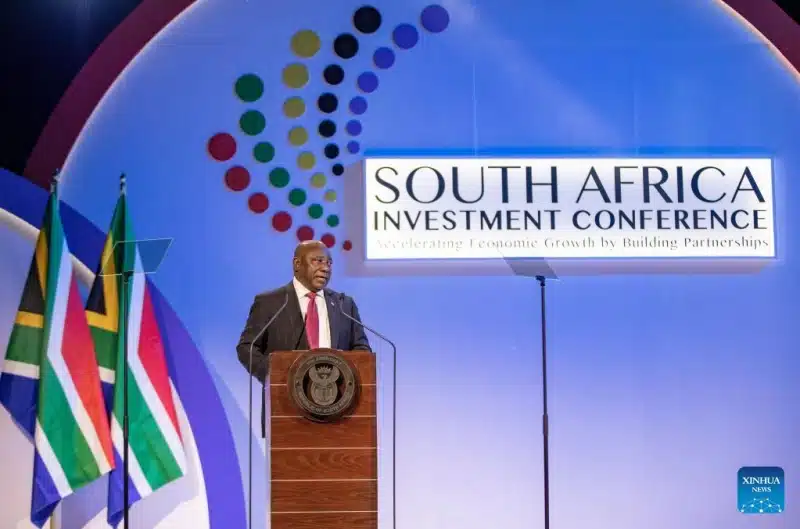
In Johannesburg, Cyril Ramaphosa addressed American business leaders with a message centred on rebuilding trust and strengthening economic cooperation. At almost the same time, demonstrators gathered outside the U.S. Consulate General Cape Town, expressing opposition to the direction of United States foreign policy.
These developments are not separate incidents. They reflect the wider reality of the US South Africa relations reset, which is being shaped by both strategic interests and public sentiment.
Rebuilding ties through economic alignment
At the American Chamber of Commerce meeting in Johannesburg, Ramaphosa’s message was measured but clear. South Africa, he said, is ready to rebuild political and diplomatic trust with the United States, but the pathway runs through economic cooperation.
The timing followed the arrival of L. Brent Bozell III, whose early engagements with Pretoria have begun shaping the tone of this reset.

Ramaphosa’s emphasis was not abstract diplomacy. It was grounded in tangible outcomes, including investment, trade and jobs. He pointed to the more than 600 American companies already operating in South Africa, supporting hundreds of thousands of livelihoods, and endorsed the ambition to double that presence.
This is where the US South Africa relations reset becomes more than rhetoric. It is tied directly to the future of the African Growth and Opportunity Act, the trade framework that underpins much of the economic relationship.
With the current extension set to run only until 2026, questions over long term certainty remain. Ramaphosa said discussions are continuing with United States trade officials and lawmakers, with the aim of securing an arrangement that provides greater stability for both sides.
South Africa is positioning itself as a more reliable trade partner while drawing attention to its importance as a source of strategic resources, including critical minerals. It is also stepping up efforts to attract greater American investment across key parts of the economy, from energy to manufacturing.
Within this context, the US South Africa relations reset is taking shape around a simple calculation. Economic cooperation is being prioritised as a way to steady a relationship that has, in recent years, been marked by political differences.
The weight of recent tensions
The need for a reset reflects the strain that has developed over recent years. Differences over global alignments and foreign policy priorities have placed pressure on what was once a more predictable relationship.
South Africa’s role in BRICS, and its ties with countries such as Russia and Iran, remain points of concern in Washington. Its decision to take legal action at the International Court of Justice has also added to those tensions, reinforcing differences between the two governments on several issues.
This is the context in which the US South Africa relations reset is unfolding. The differences are still there and continue to shape how both sides engage. For now, the priority is to keep the relationship steady, despite the differences that remain.
Public sentiment and visible resistance
The gathering outside the United States consulate brought together groups that have long opposed what they see as Western influence in global affairs.
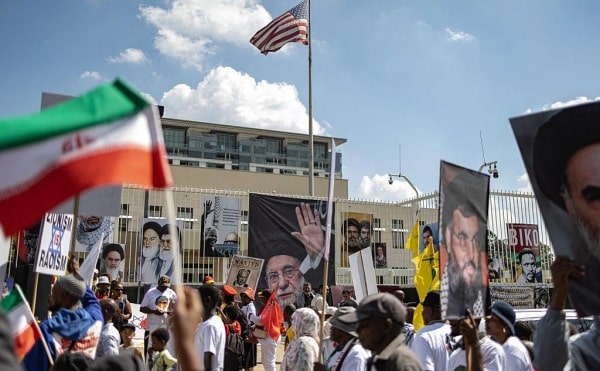
Many focused on issues such as support for Palestine and opposition to foreign involvement in other regions. These positions are not new, and they remain an organised and visible part of South Africa’s political landscape.
The demonstration was monitored by local authorities and flagged in advance by U.S. security alerts. Its significance lies in what it reflects about public sentiment.
For the US South Africa relations reset, this presents an additional layer of complexity. Diplomatic engagement is taking place alongside a domestic environment where scepticism towards the United States continues to find expression in public demonstrations.
A careful balancing act
Pretoria is trying to balance economic and political priorities. It needs investment, stronger exports and continued access to key markets. At the same time, Pretoria is keeping a foreign policy that does not always match Western positions.
The US South Africa relations reset reflects this. It does not mark a clear change in direction. It reflects an effort to manage the relationship as it is.
There is no certainty this will last. It will depend on ongoing contact and whether both sides continue to work together where their interests align.
What comes next
The coming months will show whether the US South Africa relations reset leads to real progress.
Key indicators include new investment, the direction of trade negotiations and the tone of diplomatic engagement. The future of AGOA remains particularly significant, as it will shape the economic framework of the relationship in the years ahead.
Domestic reactions will also influence how far and how quickly any progress can be made.
Bottom line
The US South Africa relations reset is underway, but it remains at an early stage.
It is being built through official engagement and economic planning, while also being tested by public opinion and unresolved political differences.
Whether it succeeds will depend on how both countries manage those differences while advancing areas of cooperation.


