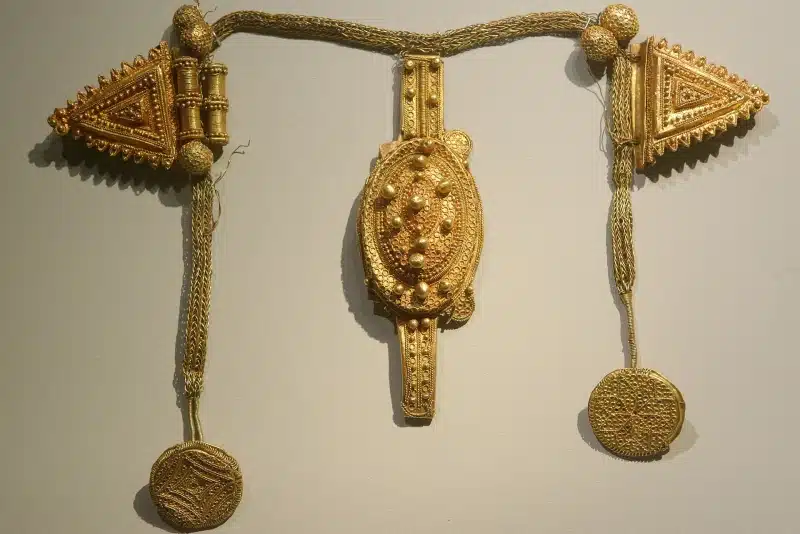
France’s new restitution law has revived hope that the Ségou treasure, a hoard of gold, silver and religious objects seized from Mali in 1890, could finally return home, yet nothing about this moment deserves applause.
The French parliament adopted Law no 2026-351 on 9 May 2026, creating a legal framework for returning cultural property looted during the colonial era. The National Assembly backed the text on 13 April with 170 votes in favour and none against. The Senate had already approved it in January, and a joint committee of MPs and senators reconciled the two versions before the final vote in May.
The law covers objects taken through theft, looting, coercion or violence, or acquired from someone with no right to give them away, provided the taking happened between 1815 and 1972. That window includes the seizure that produced the Ségou treasure.
In April 1890, French colonel Louis Archinard led troops into Ségou, a historic city in present-day Mali, and took the palace of Ahmadu Sheku by force. Archinard’s men carried off gold, silver and jewels that had belonged to Al-Hajj Umar Tall, the Islamic scholar and Tijaniyya leader who built an empire stretching across Senegal, Mali, Mauritania, Gambia and Guinea before his death in 1864. Those objects are now scattered across French museum collections, with several pieces held at the Musée du Quai Branly-Jacques Chirac in Paris, according to research published by scholar Kwame Opoku.
The Ségou treasure remains one of the most prominent unresolved restitution claims linked to France’s colonial expansion in West Africa.
Descendants of Umar Tall in Senegal have pressed for years to bring what remains of the Ségou treasure back. Their case has already produced one result. In 2021, France handed Senegal a sword and sheath that had belonged to Umar Tall, an object previously held by the French Army Museum and displayed on long-term loan in Dakar. Family members now want the rest of the hoard returned under the new law.
For descendants of Umar Tall, the return of the Ségou treasure would represent more than the transfer of museum objects. It would be a recognition that objects seized during colonial conquest cannot simply be absorbed into another country’s national collection and treated as detached artefacts.
Mali and Senegal are not alone in pressing France on colonial-era loot. Algeria wants personal effects belonging to Emir Abdelkader, the nineteenth-century resistance leader. Benin has asked for a statue of the deity Gou, still kept at the Quai Branly museum. Ivory Coast has submitted a list of roughly 150 objects, and Madagascar has an outstanding claim too.
Passage of the law was not without friction. The far-right National Rally argued that restitution should depend on states maintaining what it called cordial relations with Paris. Green lawmakers objected that the text avoids the word colonisation altogether, and the hard-left France Unbowed pushed for a wider scope than what was eventually agreed.
None of this legislative manoeuvring changes the basic fact at the centre of the Ségou treasure. It was not acquired, collected or donated. It was taken from a palace at gunpoint by an occupying army, and the people it belonged to had no say in the matter. A law that finally allows France to give it back is not a gesture of generosity. It is the state correcting something it should never have done in the first place.
There is also something uncomfortable in how these objects have spent more than a century on display. Families whose ancestors were robbed have had to travel to Paris to see their own heritage sitting behind glass in the very institutions built on the wealth of empire.
For generations, descendants of the people who lost these objects have effectively been asked to admire them as museum pieces while ownership remained in the hands of the state that took them. Seeing stolen property displayed as a cultural treasure does not make the taking any less real. Calling that arrangement a museum exhibit does not change what it actually is.
France still has not set a timeline for handing back the Ségou treasure specifically, and the law leaves the decision to a scientific review process rather than a fixed date. Mali and the Umar Tall family will now have to make their case through that new administrative route rather than through parliament, a shift that could speed up smaller requests even as larger, more sensitive ones like Ségou remain under examination.
Whatever the outcome, the story should be told plainly. A theft took place in 1890. What is happening now is not a favour. The return of the Ségou treasure would not be an act of generosity. It would simply be the beginning of putting that right.