



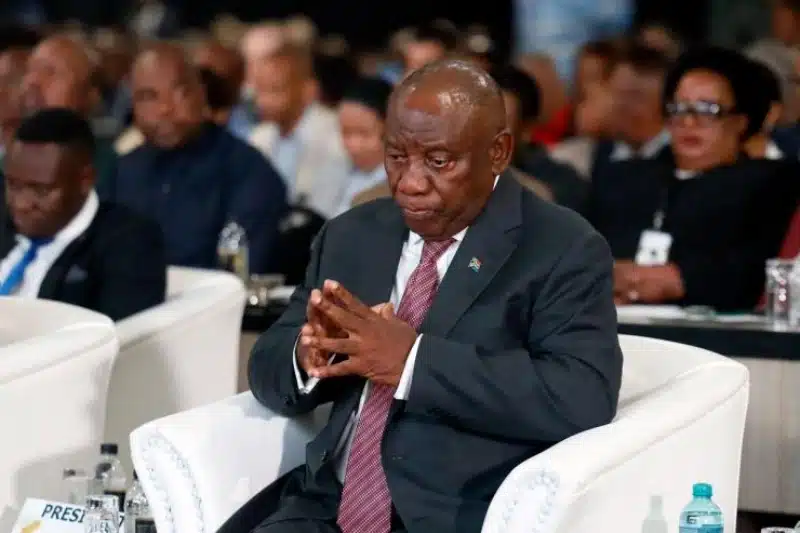

The Constitutional Court has ruled that Parliament illegally blocked President Cyril Ramaphosa’s impeachment inquiry over the Phala Phala farm scandal. The judgment does more than shake one presidency. It sends a message across the continent.
What the court actually said
The Constitutional Court did not remove Ramaphosa from office. What it did was rule that lawmakers improperly buried the impeachment pathway that had opened in 2022 over the so-called “Phala Phala” scandal. The court ordered that the process must now move forward.
Parliament may now establish a formal impeachment committee. That committee has the authority to examine whether Ramaphosa committed serious misconduct, violated the constitution, or abused his office. A final Ramaphosa impeachment, however, would still require a two-thirds majority vote in Parliament, a threshold that analysts say he is likely to survive.
- Parliament constitutes a formal impeachment committee
- Committee hears evidence and examines the Phala Phala allegations
- A recommendation goes back to the full Parliament
- Lawmakers vote; a two-thirds majority is needed for removal
- The process is expected to run for several months, possibly longer
The farm, the cash and the cover-up claim
At the heart of the Ramaphosa impeachment push lies a 2020 incident at Phala Phala, Ramaphosa’s private game farm in Limpopo Province. Thieves broke into the property and made off with a substantial amount, reportedly around $580,000 in United States dollars, that had allegedly been concealed inside furniture, including a sofa.
The theft itself was not the real scandal. The outrage was what allegedly followed. Critics say the robbery was never reported through official channels and that presidential protection officers and state security resources were deployed to recover the stolen cash, raising the spectre of state machinery being bent to a private purpose.
Questions also emerged over where the money came from, whether it had been declared to tax authorities, and why such large sums in foreign currency were being stored at a farm rather than in a bank.
Ramaphosa has maintained throughout that the money came from a legitimate sale of buffalo and that he broke no law. He has accused opposition parties of inflating the scandal for political gain.
“The original Section 89 independent panel concluded in 2022 that there was prima facie evidence serious questions needed answering, that finding is what triggered the impeachment recommendation in the first place.”
Who is driving the Ramaphosa impeachment charge
The Economic Freedom Fighters, led by Julius Malema, has been the most aggressive force behind the Ramaphosa impeachment effort. Malema’s party argued for years that the African National Congress had politically shielded Ramaphosa and that Parliament had abdicated its oversight duty. The EFF was also central to the Constitutional Court challenge that has now revived the process.
Another key figure is Arthur Fraser, a former intelligence chief with close ties to former President Jacob Zuma. It was Fraser who, in 2022, filed the formal complaint that put Phala Phala into the constitutional spotlight. Many analysts reading the Fraser angle see it as part of a deeper factional battle inside the ANC between Ramaphosa’s reform wing and the political forces still aligned with Zuma.
Why impeachment is unlikely, but still dangerous
Even if the formal Ramaphosa impeachment vote never succeeds, the political damage is real and accumulating. The ruling revives a scandal Ramaphosa had largely managed to sideline. It chips away at the anti-corruption image on which he built his presidency. And it arrives at a moment when the ANC is more politically exposed than at any point since 1994.
The ANC lost its parliamentary majority in the 2024 general election, forcing the party into coalition politics for the first time. In 2022, ANC numbers alone would have protected Ramaphosa comfortably. Today, coalition fractures, factional rebellions or calculated defections could make each parliamentary vote a genuine contest.
Analysts still consider full removal unlikely, Ramaphosa almost certainly retains enough parliamentary support. But “unlikely” is not the same as “impossible,” and the process itself will keep his authority under pressure throughout.
The lesson for Africa’s judiciaries
Here is where the story transcends South Africa entirely.
Across the continent, one of the most reliable predictors of a failing democracy is a judiciary that knows its place: quiet when the president is in the dock, loud only when the opposition is. Courts in too many African nations are institutions in name only, their independence hollowed out by presidential appointments, budget pressures or outright intimidation.
South Africa’s Constitutional Court has just demonstrated that it is not that court.
The ruling is significant not just for what it means for the Ramaphosa impeachment, but for what it says about institutional design. The court did not rule that Ramaphosa was guilty. It ruled that Parliament did not have the right to shut the question down. That distinction matters. It is the difference between a court that delivers verdicts and a court that protects process, and protecting process is the harder, more important work.
For countries from Nigeria to Kenya, from Zimbabwe to Senegal, where presidents routinely insulate themselves from accountability through compliant legislatures and captured judiciaries, that precedent deserves careful attention. Democratic accountability is not a luxury item available only when leaders consent to it. It is a mechanism that must function whether or not those in power find it convenient.
A deeper frustration on the surface
For many South Africans, the Phala Phala saga has long since stopped being about a robbery. It has become a referendum on a question that defines the post-Mandela era: does accountability apply equally to powerful people, or is it something that happens only to the powerless?
The Ramaphosa impeachment process, however it concludes, has forced that question back into the centre of South African political life. The Constitutional Court has made certain the Ramaphosa impeachment process cannot be quietly buried again.
That, at minimum, is what functioning judiciaries are supposed to do.
AfricanQuarters covers governance, politics and accountability across the African continent. Published at africanquarters.co


