



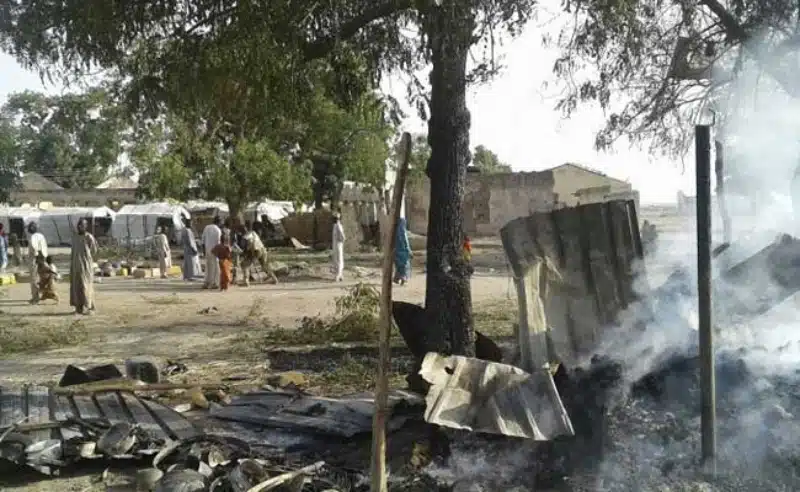

Amnesty International says jets circled, left, and came back to strike a crowded weekly market in Zamfara State. Military sources say commanders were told to keep such incidents quiet until after the 2027 election.
The latest airstrike on civilians in Nigeria unfolded at Tumfa market on Sunday when jets first appeared overhead.
Traders were selling livestock. Women were spread across the stalls. Teenage girls moved between buyers, hawking their wares. It was an ordinary afternoon at the weekly market in Zurmi Local Government Area of Zamfara State.
Then the aircraft circled and left.
And came back.
100 dead, bodies still being counted
At least 100 civilians were killed in a Nigerian military airstrike on the crowded market in northwest Zamfara State, Amnesty International said on Tuesday, urging authorities to open an immediate investigation.
A source who spoke to AIT on condition of anonymity alleged that the airstrike left about 100 persons dead and over 30 others injured, with many of the victims being teenage girls engaged in petty trading and hawking activities.
Amnesty International Nigeria said on social media that more dead bodies were still being recovered while others had died on their way to hospital, warning that the growing pattern of airstrike on civilians in Nigeria demands urgent independent scrutiny.
Dozens of injured people were being treated at hospitals in Zurmi and nearby Shinkafi, Amnesty said, adding that many of those killed were women and girls.
Jets seen circling before the strike
The source who spoke to AIT explained that the incident happened around noon when an aircraft was first seen conducting surveillance over the area, before returning around 2 p.m. to launch what he described as multiple airstrikes.
Operation FANSAN YAMMA confirmed that a strike was carried out in the area. In a statement issued by Media Information Officer Lieutenant Colonel Aliyu Danja, the military said intelligence reports indicated that suspected terrorist commanders had assembled at a concealed location on the outskirts of Tumfa village, hidden within a densely vegetated area shielded by thick mango trees along a stream channel.
However, residents insist the airstrike hit the busy Tumfa village market, with many civilians, including teenage hawkers, among the victims.
The Nigerian military did not immediately respond to requests for comment but has previously denied targeting civilians, saying airstrikes are intelligence-led and hit only militant targets. Yet repeated cases of airstrike on civilians in Nigeria continue to raise concerns among rights groups and local communities.
The second market bombing in a month
The airstrike on civilians in Nigeria has become a grim recurring headline. Tumfa is not an isolated incident.
The Tumfa strike was the second to kill scores of people at a crowded market in northern Nigeria in a single month. Barely four weeks earlier, jets struck a market in Jilli, near the Yobe-Borno border. The African Commission on Human and Peoples’ Rights said the Jilli airstrike hit a village market, killing over 200 civilians, injuring many and destroying property.
Nigeria’s government denied that those killed were innocent civilians, with a presidential spokesperson calling the market a legitimate military target. The military later announced an internal investigation.
The pattern of airstrike on civilians in Nigeria stretches back years. The African Commission noted that the latest incidents form part of a series including a strike in Zamfara State in December 2022 killing 64 civilians and a strike in Kaduna State in December 2023 in which 85 civilians lost their lives.
That Kaduna strike remains the one that cut deepest into the national conscience. It took place as Muslims gathered in Tudun Biri village to observe Mawlid, the celebration of the birth of the Prophet Muhammad. The Nigerian Army later admitted that troops had “wrongly analysed and misinterpreted” the pattern of activities on the ground before calling in the drone strike.
Human Rights Watch noted that since 2017, over 300 people had been reported killed by airstrikes that security forces claimed were intended for bandits or Islamist armed groups but instead hit local populations, and that authorities had taken no concrete actions to provide justice or accountability.
The order to stay silent
It is at this point that SaharaReporters introduces a layer to the story that, if accurate, changes its entire character.
Military sources told SaharaReporters that the publication of a report detailing how at least 36 soldiers and Mobile Police officers were killed in coordinated attacks in Gujba Local Government Area of Yobe State angered top security officials in Abuja. One source alleged that a commander received a call immediately after the report was published, and that the call came from the office of the National Security Adviser, Nuhu Ribadu.
The instruction that reportedly followed left no room for interpretation. The source claimed: “We were told clearly that going forward, information about Boko Haram or ISWAP attacks should not be made public until after the 2027 elections. They said such reports are damaging the image of President Bola Tinubu’s government and the military.
Neither the NSA’s office nor the Nigerian military had responded to those allegations at the time of publication.
Why this matters beyond the body count
The airstrike on civilians in Nigeria has long been treated as a military competence problem, a question of intelligence quality and targeting procedures. The SaharaReporters account suggests the government’s deeper concern is not fixing the problem but hiding it.
Amnesty International has called for a fully independent investigation into the Tumfa strike, arguing that another internal military review is insufficient given the established pattern of airstrike on civilians in Nigeria.
Rights groups have also pointed out that western partners who share intelligence with Nigerian security services may face growing pressure to account for how that intelligence is being used.
For the communities of Zamfara, Yobe, and Kaduna, the conversation about oversight and election optics can feel very distant. What is immediate is this: for the second time in a month, people went to market and did not come home.
The dead of Tumfa were traders, women, and teenage girls going about their day. They were not collateral. They were the story.
Sources: Amnesty International, SaharaReporters, AIT, Reuters, the African Commission on Human and Peoples’ Rights, Human Rights Watch, Al Jazeera, the Associated Press and Operation FANSAN YAMMA official statements.


