



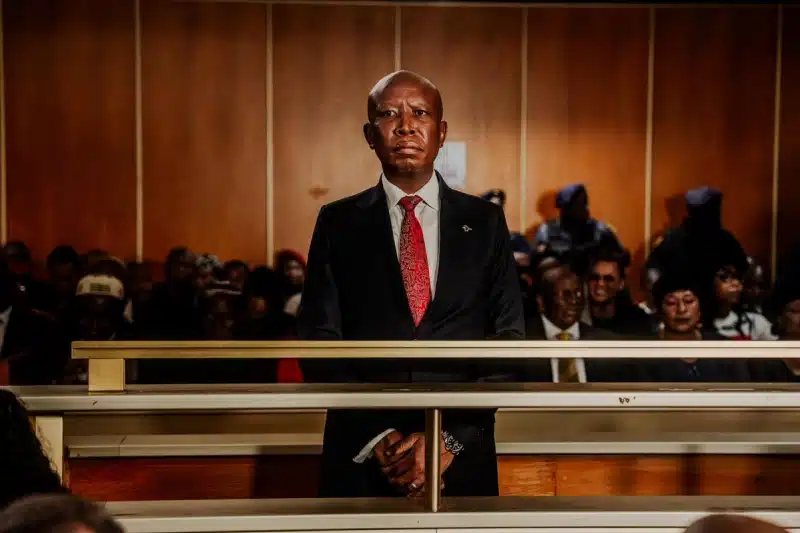

A South African magistrate has handed Julius Malema a five-year prison sentence, triggering a political earthquake that could strip the Economic Freedom Fighters leader of his parliamentary seat and fundamentally reshape the country’s opposition landscape. International media report that the Julius Malema prison sentence now stands at the centre of a rapidly unfolding political and legal crisis.
The sentence handed down in KuGompo City
Magistrate Twanet Olivier delivered the ruling at the KuGompo City Magistrate’s Court, the city formerly known as East London, finding that Malema had shown “no remorse” throughout proceedings. Crucially, the magistrate imposed the five-year term without the option of a fine, a distinction that carries significant legal weight under South African law and one that immediately activates consequences far beyond the courtroom walls.
That distinction is decisive under South African law, automatically activating potential parliamentary disqualification.
The charges
The Julius Malema prison sentence follows his conviction in October 2025 on five counts: unlawful possession of a firearm and ammunition, discharging a firearm in a public and built-up area, and reckless endangerment.
The case traces its origins to an incident at the EFF’s fifth anniversary rally in 2018, held at Sisa Dukashe Stadium. A video that circulated widely showed Malema firing what appeared to be an assault rifle into the air during the celebrations. That footage became the centrepiece of the prosecution’s case.
Magistrate Olivier, in her judgment, focused heavily on public safety. She noted that “celebratory gunfire” of the kind captured in the video frequently causes random fatalities across South Africa, and that a political leader firing a weapon in a packed stadium represented reckless endangerment of the highest order.
The framing of the ruling went beyond punishment, with the court explicitly positioning the Julius Malema prison sentence as a deterrent against political figures normalising dangerous conduct.
Malema’s legal team moves within minutes
Barely had the ruling been delivered when Malema’s lead advocate, Laurence Hodes, filed for leave to appeal. The legal team is simultaneously seeking an extension of bail and a suspension of the prison term pending the outcome of that appeal.
What follows is legally straightforward but politically explosive.
The mechanics of what follows are straightforward but consequential: if bail is extended, Malema remains free while the appeal moves through the courts; if it is denied, incarceration could begin almost immediately. EFF leadership, projecting confidence in the hours after sentencing, signalled that their leader would “sleep at home tonight” despite the weight of the Julius Malema prison sentence.
The parliamentary disqualification clause
Beyond the question of imprisonment lies a constitutional time bomb. Under South African law, any person sentenced to more than twelve months in prison without the option of a fine is automatically disqualified from serving in Parliament. The Julius Malema prison sentence, at five years and without a fine option, meets that threshold precisely.
Should the sentence survive the appeal process, Malema would be removed from the legislature. That outcome would not simply affect one parliamentarian, it would sever the EFF from its most recognisable figure at the dispatch box, weaken the party’s capacity to hold the governing African National Congress to account, and open space for rival opposition groups to consolidate ground ahead of future elections.
In effect, the courtroom ruling could achieve what political opponents have not, making the Julius Malema prison sentence one of the most consequential legal decisions in recent South African politics.
Hundreds fill the streets in red
Outside the court, supporters dressed in the EFF’s signature red painted the streets of KuGompo City. A heavy security presence was deployed around the courthouse, though the atmosphere, while tense, remained controlled. Malema has been consistent in his public position, claiming the prosecution is politically motivated and pointing to pressure exerted by AfriForum, the Afrikaner lobby group that was among the parties that pursued the case.
A test of the rule of law
The Julius Malema prison sentence arrives at a moment when South Africa is grappling with a fundamental question: can its legal institutions hold powerful figures to the same standards as ordinary citizens? The case sits at the intersection of accountability and political theatre, Malema’s public persona has long been built on defiance, while the EFF’s brand of opposition politics thrives on spectacle. The court, by contrast, has reframed the 2018 shooting not as bravado, but as recklessness with potentially lethal consequences.
What happens next
Several developments will determine how this story unfolds. The appeal hearing is expected to be fast-tracked given its political weight. The bail ruling will be the most immediate test of whether Malema walks free in the short term or faces early incarceration. Nationally, the implications of the Julius Malema prison sentence could trigger protests and accelerate political mobilisation, particularly among younger voters who form the core of the EFF’s support base.
For now, the courts have delivered their verdict.
The political consequences of the Julius Malema prison sentence are now being written in real time.


