



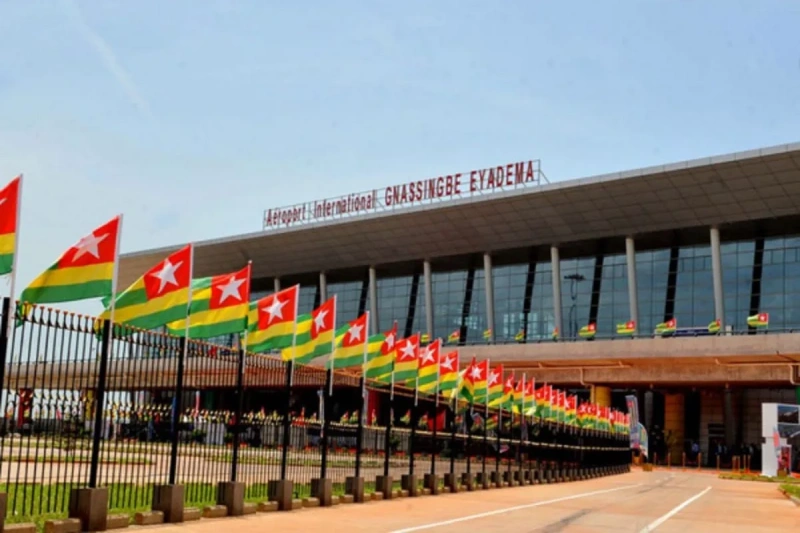

A foul-smelling spill inside Togo’s main airport became a national argument before the floor had fully dried.
What is beyond dispute is that a plumbing failure occurred inside the boarding area of Gnassingbé Eyadéma International Airport. What remains disputed is whether the Lomé airport sewage incident was merely an unpleasant overflow or a far more serious sanitation failure that affected travellers.
Société Aéroportuaire de Lomé-Tokoin (SALT), the company that operates the airport, confirmed that a technical incident occurred at 12:50pm on 30 September.
In a statement issued a day later, SALT said a siphon overflowed in the boarding area and caused wastewater to spill onto the floor. The operator said technical teams and cleaning crews were immediately deployed to contain the problem and restore the affected section.
The Lomé airport sewage claims first gained traction online after Ferdinand Ayité, an exiled Togolese investigative journalist, alleged that toilet pipes had failed and spilled faecal matter onto passengers preparing to board flights.
Ayité, who lives outside Togo after his conviction on charges criticised by international press freedom organisations, was among the first public figures to amplify the allegations.
His account quickly spread across social media platforms, where videos and photographs of the scene circulated widely.
Videos shared online appeared to show wastewater spreading across part of the boarding area as travellers moved away from the affected section. The images generated criticism and questions about maintenance standards at one of West Africa’s busiest airports.
SALT’s version of the Lomé airport sewage incident is considerably narrower.
The operator described the event as a limited plumbing overflow. It said airport operations continued normally throughout the clean-up and that no passenger suffered physical discomfort.
The company apologised for the inconvenience while stressing that the incident did not disrupt flights.
Director General Kanka-Malik Natchaba went further in comments reported by Republic of Togo, a state-backed news portal.
“Nobody was splashed,” he said.
According to Natchaba, the floor was soiled after the overflow but the affected area was quickly isolated. Cleaning teams used vacuum equipment to remove the wastewater before firefighters carried out a final wash-down of the site.
He also accused those who first circulated the story of exaggerating events and damaging the airport’s reputation.
The airport operator’s explanation did not end the debate.
Instead, it narrowed the Lomé airport sewage dispute to a single question: did any passengers come into direct contact with the wastewater?
The reporting currently available does not provide a definitive answer.
No passenger who claims to have been affected has publicly spoken on the record in reports reviewed for this article. SALT has not identified the flight or flights involved, and widely shared images from the scene have not been independently verified.
Those gaps have left room for competing narratives to continue.
Online commentator Ablode Gbadja argued that the incident should not be dismissed as insignificant.
Even if airport management’s version is accepted, he noted, wastewater still reached a section of the terminal used by travellers.
For critics, the issue is not only whether passengers were splashed. It is also how such a failure occurred inside a major international gateway.
That question carries particular weight because of the airport’s importance to Togo’s ambitions as a regional aviation hub.
The current terminal opened in April 2016 following a major expansion project valued at approximately $150 million.
Built to handle around two million passengers annually, the facility has become a key transit point connecting West and Central Africa.
According to figures reported by Agence Ecofin, the airport handled more than 1.58 million passengers in 2025.
That level of traffic places utilisation close to capacity during peak periods, increasing pressure on infrastructure and passenger services.
The Lomé airport sewage controversy arrives at a time when airport operators across Africa are competing not only on connectivity but also on passenger experience.
For travellers, reliability and cleanliness often shape perceptions as much as flight schedules or terminal size.
Natchaba is familiar with those expectations.
He previously led SALT before serving in government and returned to the airport operator earlier this year. Industry observers quoted by Agence Ecofin argue that the next challenge for airport management is maintaining service quality as passenger numbers continue to grow.
Blocked drains and plumbing failures are not unique to Lomé.
What is less common is seeing an incident evolve into a public dispute over what actually happened.
In this case, social media claims travelled across Togo and beyond before airport management released its formal explanation.
By then, the Lomé airport sewage story had already taken on a life of its own.
The spill itself may have lasted only minutes.
The argument over it could last much longer.
A mop can clean a floor. It cannot settle a dispute over who told the truth about it.


