



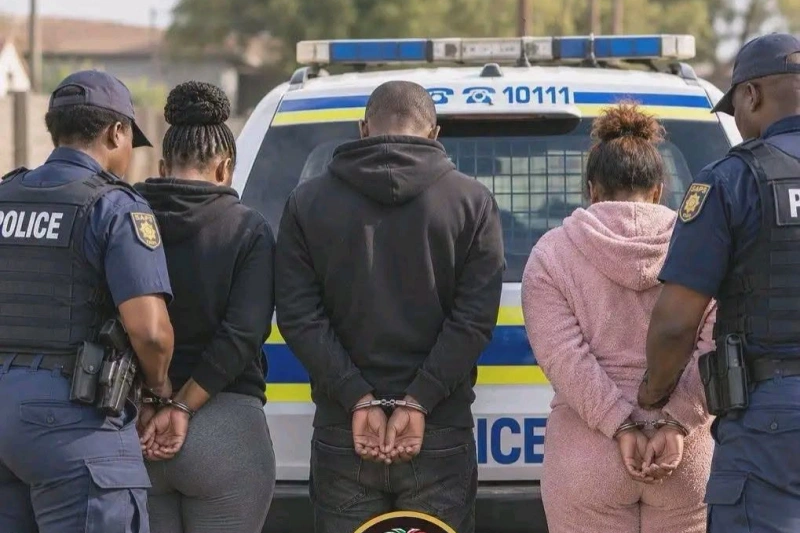

Three suspects sat in a police van outside Boksburg Magistrates’ Court on Monday. Behind them lay two months of fear that had gripped an entire community. Their arrest is the first real breakthrough in the Ekurhuleni murders, a case that has shaken South Africa to its core.
Police confirmed the suspects, two women and a man, were detained by the Gauteng Murder and Robbery Unit over the weekend. They face questioning over the death of Jabulile Ntimba, whose body was found in Dawn Park on 17 September. She is the ninth woman linked to the Ekurhuleni murders since July.
The timeline behind the Ekurhuleni murders stretches back further than most people realise. Busisiwe Mahlangu was found in Kempton Park on 15 July. Weeks passed before Itumeleng Kekana was discovered in the same area on 3 August. Then Nomfesane Mjobo, also in Kempton Park, on 26 August.
By September, the discoveries came faster. An unidentified woman was pulled from the Clayville River in Olifantsfontein on 7 September. Three days later, Gracious Nkomo’s body turned up in Kempton Park. On 12 September, Elizabeth “Tsontso” Moselakgomo, a 38-year-old mother known locally for her passion for running, was found after vanishing during an afternoon jog. Her death, more than any other, turned the Ekurhuleni murders into a national story.
The clustering of cases across Kempton Park, Dawn Park, Kwa-Thema and Olifantsfontein quickly drew comparisons on social media to previous serial murder investigations in South Africa. Community groups and women’s rights organisations began demanding a coordinated national response as public anxiety spread beyond Gauteng.
Two more women followed within days. One was found in Olifantsfontein on 14 September, her name withheld while police traced her family. Dineo Motapane was discovered in Kwa-Thema on 15 September. Then came Ntimba, two days later, the case now tied to Monday’s arrests.
Ekurhuleni forms part of Gauteng province’s East Rand region and includes major urban centres such as Kempton Park, Boksburg and Benoni. Four of the nine victims were found within roughly six kilometres of each other. Several bodies lay near main roads, in open ground that offered little cover. That detail alone has fuelled public suspicion that one person, or a group working together, may be responsible.
Acting Police Minister Firoz Cachalia has resisted that conclusion. “Nothing has yet been excluded while investigations continue,” he said, days before the weekend’s arrests.
“WE LIVE IN A SOCIETY IN WHICH THE WOMEN OF OUR SOCIETY, OUR MOTHERS, OUR SISTERS, OUR DAUGHTERS, OUR CHILDREN ARE UNSAFE.”
— ACTING POLICE MINISTER FIROZ CACHALIA
Investigators have not linked this weekend’s suspects to the other eight killings. That distinction matters. It means the wider story behind the Ekurhuleni murders remains open, even as one family finally sees a court date.
Cachalia has faced mounting pressure over the Ekurhuleni murders and has now brought in national firepower.
Crime intelligence chief Lieutenant General Dumisani Khumalo and KwaZulu-Natal police commissioner Lieutenant General Nhlanhla Mkhwanazi have both joined the investigation, working under divisional commissioner Lieutenant General Hilda Senthumule. The shift signals that Pretoria no longer trusts the case to provincial resources alone.
Local government’s response to the Ekurhuleni murders has included clearing overgrown land near the discovery sites in an effort to remove hiding places investigators believe were used to conceal bodies. Police visibility has also increased across the municipality.
Grief has followed each new discovery. In Kempton Park, women from local churches have gathered at the sites, lighting candles and singing hymns for victims they never knew. Their vigils have become a quiet fixture of the Ekurhuleni murders, a counterpoint to the press briefings and official statements.
South Africa already records some of the world’s highest rates of violence against women. What sets the Ekurhuleni murders apart is not just the number of victims. It is the speed at which the bodies were found, one after another, along the same stretch of the East Rand.
Families of the nine women are still waiting for full answers. Some now have a court date. Most do not.
For a country accustomed to counting its femicide statistics in the thousands each year, the Ekurhuleni murders have put names and faces to the numbers. That, more than any single arrest, may be what changes how this case is remembered.


