



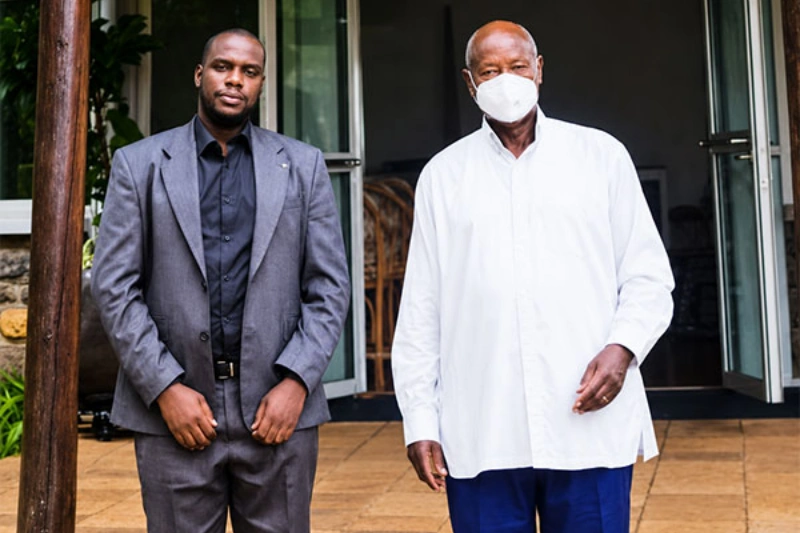

Stephen Nuwagaba walked into Uganda’s corridors of power with a résumé built for intimidation. He called himself a brigadier general. He introduced himself as a Senior Presidential Adviser on Intelligence and Security. He said the Israeli Defence Forces trained him and that he served two years in Israel’s army.
He went further still. Stephen Nuwagaba claimed ten years inside Mossad, Israel’s foreign intelligence service, and a master’s degree in security from King’s College London. None of it has held up.
For a global audience, the appeal of this story sits beyond Kampala. It touches a theme that recurs across fragile political systems everywhere: how easily a confident liar with the right photographs can walk past the people meant to guard a head of state.
A name that made officials nervous
Stephen Nuwagaba was not widely known outside government circles. But among officials in Uganda’s security services, his name carried weight, according to an investigation by The Independent Uganda’s investigation team. He was seen driving vehicles with State House number plates, sometimes deliberately covered. A pickup filled with Special Forces Command soldiers travelled with him as protection, and he lived inside Nakasero State Lodge, the residence reserved for figures close to President Yoweri Museveni.
He circulated photographs of himself with the president, the First Lady and the president’s daughter, Natasha Museveni Karugire, using them as proof of his access. That perceived closeness, the investigation found, became the foundation of an extortion operation. Officials who crossed him were reported to the president in damaging memos. Those who paid were left alone.
One case involved the Director of Operations at Uganda Police, AIGP Frank Mwesigwa. He is reported to have demanded 300 million shillings in exchange for softening a report alleging Mwesigwa had received money from Rwanda. When Mwesigwa refused and ordered him out of his office, a woman connected to the land dispute at the centre of the claim was later arrested and held for ten days without charge, despite the matter already sitting before a civil court.
Fabricated evidence and ruined careers
The investigation also describes a method Stephen Nuwagaba allegedly used to manufacture proof against rivals. He would set up two phones with WhatsApp, load each with a target’s profile picture, then message himself to create the appearance of incriminating conversations. These forged exchanges were then presented to the president as evidence of subversive contact between officials, contributing to the removal of several State House and intelligence figures.
Senior officers, including the chief of defence intelligence and security and the Director General of Uganda’s Internal Security Organisation, were reportedly named in similar reports written by him to the president.
The Mossad check that unravelled the story
The claim that eventually exposed him was the one he leaned on most heavily. When Uganda’s security minister, Maj. Gen. Jim Muhwezi, referred Stephen Nuwagaba to the Internal Security Organisation to assess his stated hacking expertise, the agency tested him directly. Officers gave him $1,000 and a set of phone numbers to intercept, numbers that in fact belonged to ISO’s own technical staff. He took the money and did not return.
Because ISO maintains a working relationship with Mossad, Ugandan officials sent Israeli counterparts his passport records and photographs for verification. Mossad searched its databases and found no record of him ever entering Israel, joining its army or working within its ranks, according to the investigation. The inquiry into Stephen Nuwagaba was closed on that basis.
A pattern that predates State House
This was not his first documented episode of deception. In 2023, Stephen Nuwagaba surfaced publicly with claims about a girlfriend shared with a senior football administrator, alleging he had been tortured over the relationship. He later told associates he had studied hacking in Turkey and Malaysia, and attempted to extort money from several public figures using an audio recording. One senior military figure who met him reportedly suggested he be examined at a psychiatric facility rather than trusted with intelligence work.
He is also said to have positioned himself as an intermediary with Kakwenza Rukirabasaija, the exiled Ugandan novelist living in Germany, soliciting money meant to support him while allegedly funnelling internal State House information to the same exile at the centre of embarrassing leaks about the presidency.
Why the story travels beyond Uganda
Security analysts have long noted that Israel’s historic ties to Uganda’s military and intelligence apparatus date back decades, which is precisely what made a fabricated Mossad and IDF background so plausible to those around Stephen Nuwagaba. His case illustrates a wider vulnerability, one where informal, personality-driven access to a head of state can outpace the institutional vetting meant to prevent exactly this kind of infiltration. Museveni himself has previously acknowledged that State House has been penetrated by people extorting money from those seeking his ear, a context that gave Stephen Nuwagaba room to operate for as long as he did.
Uganda is not the only country to have discovered a fictitious authority sitting inside its own government machinery. In Nigeria, a man named Prince Adeniyi Adeyemi Matthew is accused of setting up a body called the Presidential Foreign Intervention Promotion Council, securing office space at the Federal Secretariat in Abuja, opening an account with the Central Bank of Nigeria and hosting foreign ambassadors before the Presidency dismissed the council as entirely fictitious. The council still appeared in the signed 2026 Appropriation Act with an allocation exceeding 1.3 billion naira, a sum that passed through the Budget Office, the Federal Executive Council and the National Assembly without anyone flagging that the recipient did not legally exist.
Civil society group BudgIT has since described the episode as evidence of systemic weakness in how public money is approved, while lawmakers on a National Assembly probe panel have pressed the Central Bank on how it opened accounts for an agency it could not verify.
The parallel with Stephen Nuwagaba is not incidental. Both cases show how forged credentials, a rented office and a handful of convincing photographs can carry an impostor further into the machinery of state than any single official intended to allow.
For readers outside East Africa, the wider lesson of the Stephen Nuwagaba case is not really about Israel or Uganda specifically. The pattern is not confined to Kampala or Abuja. Wherever access to a president or senior officials depends more on personal trust than on documented verification, the same opening exists for anyone willing to exploit it.
For governments across the continent, both cases raise the same uncomfortable question: how many other Stephen Nuwagabas or PFIPCs are sitting undetected inside state institutions right now, and what would it actually take to find them before they cause harm rather than after.
Uganda’s presidency has not issued a public statement responding to the investigation’s specific findings on Stephen Nuwagaba at the time of writing.


