



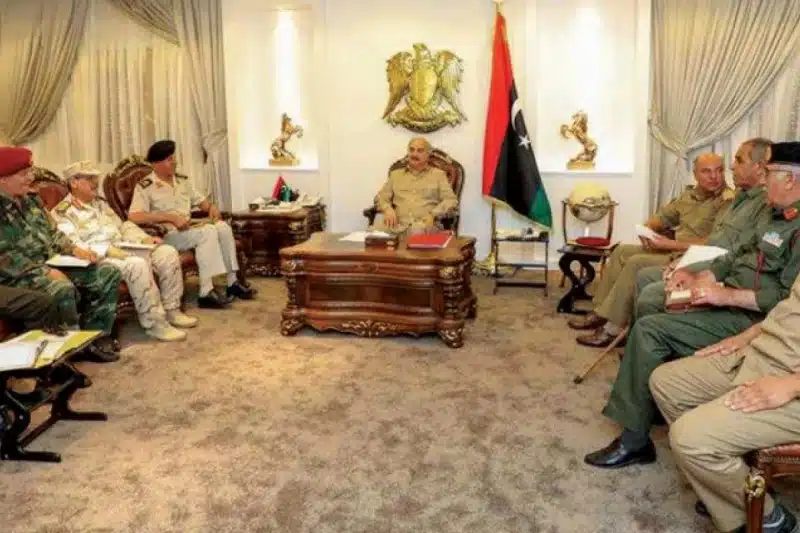

One short statement, posted before dawn in Cairo, tried to kill a rumour that had run for eight days: that Egypt had withdrawn its military experts in Benghazi amid growing tensions with its eastern Libyan partners. The report had raised questions about Cairo’s military relationship with Khalifa Haftar’s forces and whether a shift in Egypt’s Libya policy was under way.
On Sunday 22 November, Egypt said it had not pulled its military experts in Benghazi. Minister of State for Information Diaa Rashwan called the reports “entirely groundless”.
The claim first appeared on 14 November. Radio France Internationale reported that Cairo had withdrawn the experts it kept with Saddam Haftar’s side in eastern Libya, citing tensions. As far as published accounts show, it named no official source.
Rashwan said Egypt’s coordination with the Libyan National Army (LNA) was continuing normally. He urged media outlets to verify information before spreading claims meant to muddy relations between the two countries. The message was plain. The military experts in Benghazi are still there.
Benghazi answered later that day. The LNA’s general command denied any dispute and described a long partnership built on trust. Saddam Haftar, the deputy commander of the eastern forces, wrote on X that the position on relations with Egypt was “clear and fixed.
Two denials in one day put the rumour to rest officially. They do not settle the questions behind it.
Who are the military experts in Benghazi? Neither statement disclosed how many Egyptian personnel are involved, their precise roles or the nature of their presence. Eastern Libya sits on Egypt’s western border, so the stakes are obvious.
The timeline shows why the rumour found an audience.
In February, Egypt’s intelligence chief, Hassan Rashad, travelled to Benghazi to meet Khalifa Haftar. On 20 October, the eastern-based House of Representatives ratified a 2019 maritime deal with Turkey. Egypt rejected it the next day and called it null and void.
Then Cairo turned west. Earlier this month, Egypt reopened its embassy in Tripoli, ending a closure that began in 2014. That is about twelve years without a working embassy in the capital. On 19 November, President Abdel Fattah el-Sisi received Prime Minister Abdul Hamid Dbeibah in Cairo. The two leaders witnessed deals on energy and fisheries.
Rashad also hosted Saddam Haftar in Cairo on 13 November. They discussed joint projects and the road to national elections. The RFI report came a day later.
So Egypt is courting Tripoli and reassuring Benghazi in the same month. Whatever the truth on the ground, the public line is now fixed: the military experts in Benghazi have not left.
Benghazi had a more serious development that same Sunday. Ukrainian naval drones struck the Russian corvette Merkuryat the city’s naval base, causing an explosion that sank the vessel. Libyan officials initially said they suspected Ukrainian sea drones were responsible.
On Monday, Ukraine’s President Volodymyr Zelenskyy confirmed Kyiv’s involvement, saying seven Ukrainian-made naval drones had been deployed in the operation. He also claimed that a Russian Ka-27 helicopter was destroyed and a second vessel, the cargo ship MV Angara, was hit. The United Nations Support Mission in Libya called for an independent and transparent investigation.
Cairo has long leaned on Haftar’s east, and it is now building a door into Tripoli too. The military experts in Benghazi sit right between the two.


