



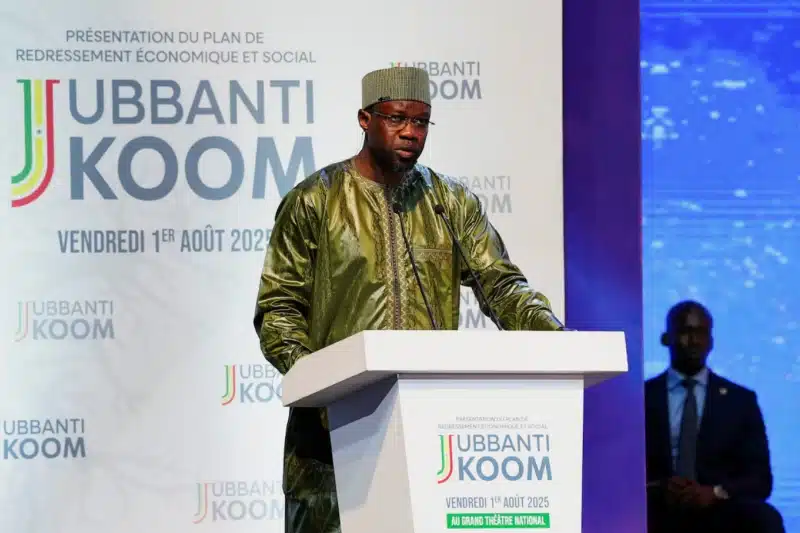

Ousmane Sonko once called debt restructuring a disgrace. Now, as the Speaker of the National Assembly, he holds political leverage over the budget needed to advance the plan meant to address Senegal debt crisis.
The Speaker of the National Assembly took his case to the press in Dakar on 19 October. Speaking at the King Fahd Palace, the Pastef leader said the government was wrong to turn to a G20 mechanism to fix the country’s finances.
His argument is blunt. Senegal, he says, does not need a heavy international process just to change when it repays. Africanews reported that he insists creditors have already ruled out any cut to what the country owes.
He also asked why Senegal should go first. “Senegal did not need to be the first guinea pig, the very first,” he said. In his view, the Senegal debt crisis is a cash-flow problem and nothing more.
The figures suggest a deeper problem. The International Monetary Fund puts Senegal’s public debt at about 132% of GDP at the end of 2024.
That figure emerged after an audit uncovered previously unreported borrowing. Moody’s, S&P and Fitch subsequently downgraded the country’s credit ratings, making access to new financing more difficult. The Senegal debt crisis was no longer easy to explain as a temporary cash-flow problem.
Sonko’s own position has shifted, and that matters. After an IMF mission in November 2025, he called restructuring a disgrace and said tax collection at home could close the gap.
The political stakes rose in May. President Bassirou Diomaye Faye dismissed Sonko as prime minister on 22 May. Four days later, MPs elected him Speaker with 132 of the 133 votes cast, in a ballot boycotted by the opposition.
On 1 September, IMF staff and Dakar agreed the outline of a 36-month programme worth about $2.2 billion. The Fund said board approval still depended on corrective action over past misreporting and financing assurances from Senegal’s partners.
Senegal also said it would use an enhanced version of the G20 Common Framework. Faye explained that his “fundamental concern” was the time creditor talks would take, so he had asked for improvements first.
Prime Minister Ahmadou Al Aminou Lo calls the plan a reprofiling, not a restructuring. He told the Assembly on 8 September that the aim was longer maturities and cheaper borrowing, with CFA franc debt left out. Senegal, he said, had conceded nothing against its own interests.
Sonko rejects that distinction. He argues the official name hides the truth from the public, and that it is restructuring in all but name.
Progress has been slow. The Centre for Global Development noted that at the first virtual meeting of external creditors, chaired by IMF staff on 6 October, lenders raised questions but decided nothing. The committee of official creditors had yet to meet.
Time is tight. Africanews reported that Washington wants the process surrounding Senegal debt crisis resolution finished under a year. Martin Kessler, of the Paris School of Economics, told Bloomberg that “Senegal will really be the test case.”
That brings the story back to parliament. On 13 October, Sonko opened the new session by warning that “opacity has a cost” and spoke of a debt the people never saw.
Six days later, Sonko drew a line. Pastef MPs, he said, would not support the 2026 supplementary budget or the 2027 budget unless both included legal rules governing the special funds.
He described the proposed measures as a savings exercise aimed largely at repaying previously undisclosed debt and pointed to a 555 billion CFA franc cut in investment spending. The standoff puts the government’s fiscal plans at risk of becoming a parliamentary contest over transparency, public spending and the cost of correcting past borrowing.
Rejection, he argued, would not leave a legal vacuum. The 2026 budget would keep running, and only new measures would fall. Any deadlock, he added, would be the executive’s fault alone.
He also claimed alternatives were within reach. He said talks with the United Arab Emirates had produced a deal worth nearly $2 billion, and that the proof sat on his phone. That claim could not be independently verified.
The government has defended the IMF route as a necessity rather than a surrender. Both camps agree Senegal cannot carry on as before. They disagree on the price, and on who decides.
The difficulty is that the programme depends on reforms. Reforms need a budget. And the budget needs votes from the man who says Senegal never needed the G20 route.
Senegal debt crisis negotiations have now collided with a parliamentary fight over budgets, transparency and the government’s room to manoeuvre.
Senegal has asked its creditors for time. First, it must ask its Speaker for votes.


